
Telescopes reveal unprecedented organic compounds in the 10-billion-year-old interstellar comet 3I/ATLAS

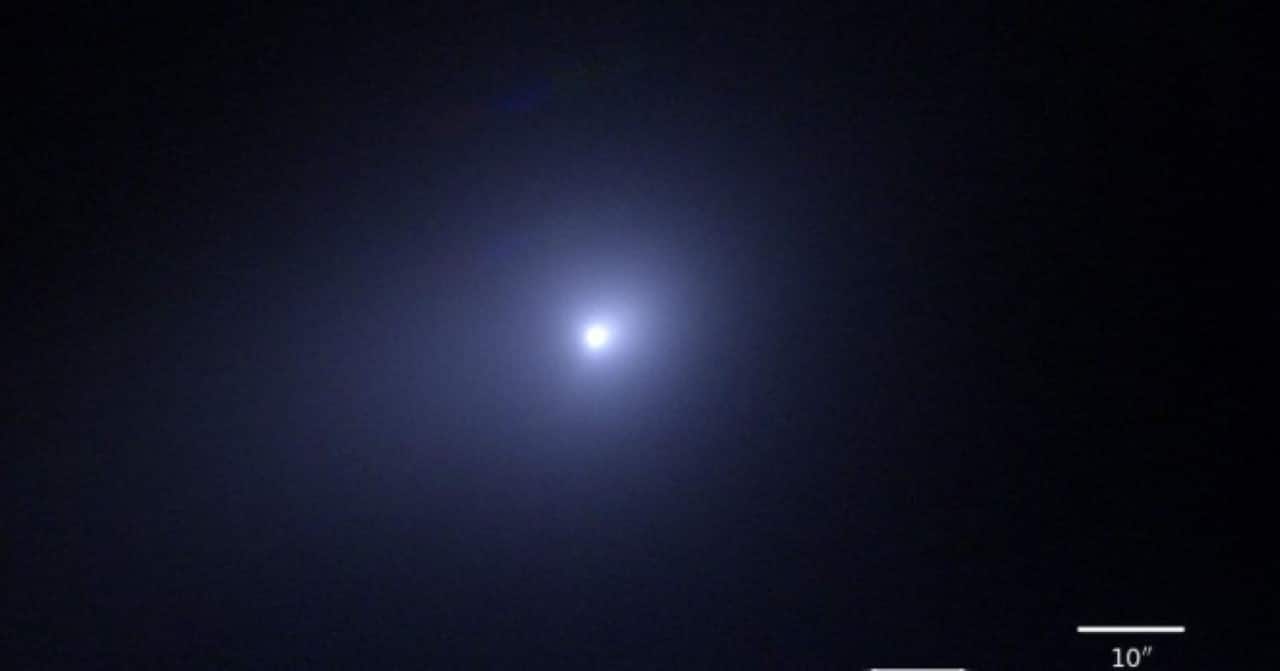
The passage of comet 3I/ATLAS through the inner solar system provided astronomers with a rare opportunity to study materials dating back to the early days of Via Láctea. Observações recent studies conducted by international research consortia have detailed the chemical composition of this hyperbolic object, revealing the presence of complex organic molecules and unusual isotopic ratios. Spectroscopic analysis indicates that the celestial body was formed more than 10 billion years ago, long before the existence of our sun and neighboring planets. The data collected helps map the distribution of fundamental elements in the early galaxy and offers new parameters for stellar evolution models.
The detection of a celestial body of this age and trajectory challenges previous estimates of how often interstellar objects cross our cosmic neighborhood. The comet’s extreme speed, combined with its angle of approach to the ecliptic plane, provided definitive proof that it did not originate from Nuvem of Oort or Cinturão of Kuiper. Instead, the object traveled through deep space for most of the universe’s history before being temporarily captured by our system’s gravity.
The global effort to monitor the celestial body involved reallocating observation time on some of the most sought-after instruments on the planet. The urgency was justified by the ephemeral nature of the event, as the hyperbolic speed of the object guarantees that it will never return after leaving towards interstellar space. Information extracted from its glowing coma now forms a crucial database for modern astrophysics.
Origin and trajectory of the celestial body
The object was initially detected by Sistema of Alerta Último of Impacto Terrestre of Asteroides, operated from facilities at Chile. Desde the first orbital calculations, the eccentricity of its trajectory confirmed its interstellar nature, classifying it as the third confirmed visitor from outside the solar system, after the historic passages of Oumuamua and Borisov. The automated night sky scanning system identified the comet’s anomalous brightness against the background of fixed stars.
During its closest approach to the sun, surface heating caused the sublimation of gases and the release of dust, creating a coma visible to high-powered telescopes. Solar radiation acted directly on the ice sheets that had remained untouched for billions of years. Astronomers recorded the following landmarks on the object’s trajectory:
– Confirmação of hyperbolic orbit by multiple independent observatories around the globe.
– Initial Detecção by the ATLAS system on the first day of July of the previous year.
– Passagem safe and monitored without any risk of collision with Terra or other rocky planets.
Continuous tracking has allowed space agencies to direct their best equipment to capture the most information. Accuracy in determining the orbit was critical to pointing the narrow-field spectrometers exactly at the comet’s active nucleus.
Detection of chemical elements that are precursors to life
Analysis of the 3I/ATLAS coma revealed a substantial amount of carbon-based compounds. Entre The substances identified are methanol, hydrogen cyanide and methane, which are considered fundamental building blocks in prebiotic chemistry. The identification of these molecules in such an ancient object changes the accepted chronology for the formation of complex compounds in the universe.
The release of these materials occurs as radiation penetrates the comet’s outer layers, melting ancient ices. The presence of organic molecules suggests that the ingredients needed for advanced chemical processes were already widely distributed in early Via Láctea. The sublimation process exposed internal layers that function as a chemical time capsule.
The researchers noted that the organic composition differs significantly from local comets. Essa variation provides a unique chemical signature, allowing direct comparisons between the original solar nebula and protoplanetary disks from other regions of the galaxy. The relative abundance of carbon monoxide in relation to water also points to a place of origin with chemical characteristics distinct from our system.
Isotopic ratio and formation in extreme environments
One of the most intriguing findings involves the analysis of the water present in the object’s core. The instruments detected a ratio of deuterium to hydrogen ten times higher than that found in Earth’s oceans and comets in our system. With a D/H ratio close to 0.95%, the data indicate that the comet’s water crystallized in an extremely cold environment, with temperatures around 30 Kelvin, very far from any host star.
This isotopic signature suggests that the celestial body formed in a dense, dark molecular cloud, possibly during the early phases of Via Láctea’s development, when the overall metallicity of the universe was still low. The intact preservation of this heavy water testifies that the comet’s interior remained unaffected by radiation or significant collisions during its journey through interstellar space. The proportion of carbon isotopes, specifically the 12C/13C ratio that varied between 123 and 191, reinforces the thesis of an origin in a primitive galactic environment.
Gravitational interaction with planet Júpiter
In March 2026, the trajectory of 3I/ATLAS crossed the sphere of gravitational influence of Júpiter. The encounter with the gas giant slightly altered the comet’s speed and direction, an event that was widely monitored by astronomers around the world. The precision of orbital calculations allowed observatories to prepare months in advance for this specific moment.
The gravitational force of Júpiter acted like a slingshot, modifying the object’s hyperbolic orbit and accelerating its exit from the solar system. Esse natural phenomenon provided an additional opportunity to study the comet’s internal structure, observing how its nucleus reacted to tidal forces induced by the planet’s enormous mass.
During the close pass, telescopes recorded variations in gas emission, indicating that gravitational stress may have exposed new layers of volatile material. The interaction was not strong enough to fragment the nucleus, but it caused measurable disturbances in the coma’s density and the celestial body’s rotation rate.
Data collected during this event is being used to refine physical models of interstellar celestial bodies. Structural strength under gravitational stress helps determine the density, porosity, and internal cohesion of the materials that make up the object.
Observation instruments and technology used
The wealth of data obtained was only possible thanks to the coordinated use of the most advanced astronomical observation platforms currently available. Telescópio Espacial James Webb used its high-sensitivity infrared spectrometers to penetrate the dust coma and identify the thermal signatures of complex organic molecules, overcoming the limitations of ground-based observations. Simultaneamente, the Atacama Large Millimeter/submillimeter Array, located in the Chilean desert, mapped the emission of radio waves from cold gases, measuring the rotational transitions of molecules with extreme precision. Combining these technologies allowed for unprecedented resolution, revealing details about the rate of gas production as the comet approached the sun and interacted with the solar wind. The joint effort of space agencies and university consortia ensured that the object was continuously observed at different wavelengths, generating a volume of information that will require years of computational processing to be fully deciphered by astrophysicists.
Implications for contemporary astrophysics
The discovery and detailed analysis redefine scientific understanding of the distribution of matter in the galaxy. By proving that complex organic molecules and exotic ices can survive billion-year interstellar journeys, the comet reinforces the theory that planetary building blocks are universal and formed very early in cosmic history. The detection of such ancient materials in their pure state offers a direct window into the physicochemical conditions that prevailed before the formation of our own solar system.
Continuity of space monitoring
Even though the comet is now rapidly moving away into deep space, observation campaigns remain active. Large-field-of-view ground-based telescopes keep track of their outgoing orbit to record the gradual decline of their gaseous activity as the temperature drops and solar radiation diminishes.
The technological legacy of this observation drives the development of new space missions designed specifically to intercept future visitors. The scientific community is working on improving early detection algorithms in new observatories, ensuring that the next similar celestial body is identified even earlier, allowing the planning of direct interception robotic missions.



