
XRISM space telescope discovers origin of X-rays in the gamma star Cassiopeiae after 50 years

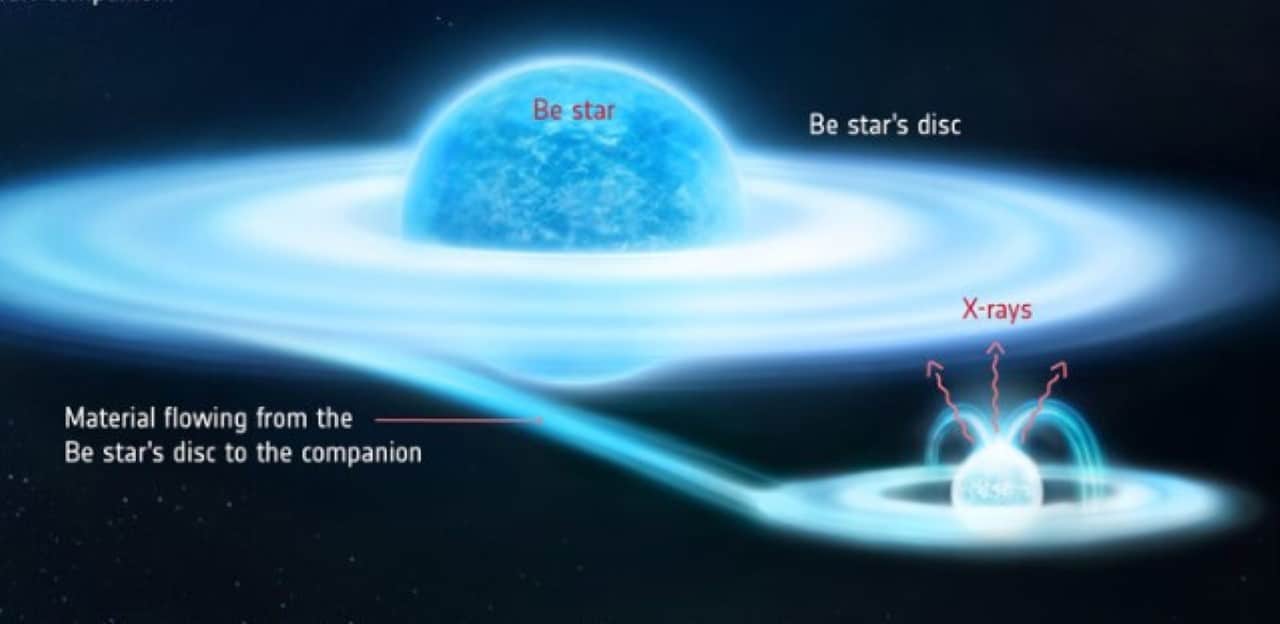
Researchers at Universidade of Liège have identified the exact source of the intense radiation emissions coming from the gamma star system Cassiopeiae. The phenomenon has intrigued the international scientific community for decades, as the energy levels detected did not correspond to the traditional physical models applied to this type of celestial body. The capture of recent data has made it possible to isolate the origin of the superheated plasma, redefining the understanding of mass transfer dynamics in massive binary systems located in Via Láctea.
The elucidation of the astronomical enigma, which had persisted since the first anomalous measurements recorded in 1976, was made possible thanks to the cutting-edge technology of the Japanese space telescope XRISM. The X-ray observation equipment provided high-resolution spectra that separated the emissions from the main star from those of its invisible companion. The results confirm astrophysical theories about the complex interaction between rapidly rotating stars and compact objects reminiscent of stellar evolution.
XRISM solves the 50-year mystery of a famous star 🌟
An invisible companion consuming material from the star gamma-Cas has been revealed as the culprit for curious X-rays coming from the stellar system 👉https://t.co/B3HEm2w1SY pic.twitter.com/qk1Ngzk1vv
— ESA Science (@esascience)March 24, 2026
The gamma system Cassiopeiae presents unique characteristics that facilitated detailed investigation by European and Asian astronomers. The combination of extreme physical factors creates a natural laboratory for studying high-energy astrophysics in deep space.
– The main star belongs to the spectral class Be and can be seen with the naked eye from Terra.
– The celestial body continuously ejects matter at high speed into outer space.
– The ejected material forms a vast circumstellar disk around the star’s equator.
– Plasma temperatures in the system exceed the 100 million degree mark Celsius.
Space monitoring details behavior of the binary system
The team of astrophysicists coordinated three intensive observation campaigns between the months of December 2024 and June 2025. The data capture schedule was structured to cover the entire orbital period of the binary system, which has an estimated duration of 203 Earth days. Essa prolonged observation window ensured the collection of information on different phases of the gravitational interaction between the two celestial bodies.
The records obtained by the Resolve instrument demonstrated that the thermal signatures of the hot plasma showed consistent speed variations over the months. Mathematical analysis of these fluctuations revealed that the movement of the superheated material perfectly followed the orbital path of the compact companion star. The shifting pattern ruled out the hypothesis that the extreme radiation emanated from the main star or its primary equatorial disk.
The statistical precision achieved by space telescope measurements established the first direct evidence of the association between X-rays and the white dwarf. The width of the spectral lines captured, which indicated displacement speeds in the range of 200 kilometers per second, eliminated the possibility that the compact object was a white dwarf devoid of a strong magnetic field. The presence of intense magnetism became the key to explaining particle acceleration.
Magnetic accretion mechanism generates extreme radiation
The energy production dynamics in the gamma Cassiopeiae system are based on the continuous transfer of matter between the two stars. The Be type star, due to its extremely fast rotation, throws large amounts of gas into space, forming a dense disk around it. A significant fraction of this expanding material ends up being captured by the gravitational pull of the neighboring white dwarf, which gives rise to a second disk, known as an accretion disk, around the compact object.
The white dwarf’s powerful magnetic field acts as an invisible funnel for the ionized gas that makes up the accretion disk. The magnetic lines of force capture the charged particles and direct them at high speed towards the magnetic poles of the dead star. The violent impact of this material against the dense surface of the white dwarf converts kinetic energy into extreme heat, resulting in the massive release of photons in the X-ray range.
The radiation flow does not occur uniformly in all directions in space. The primary emission is concentrated in the polar regions of the compact companion, where the material shock is most intense. Simultaneamente, a considerable portion of the X-rays generated are reflected when they reach other areas of the white dwarf’s surface, creating a complex pattern of light scattering that reaches the detectors of telescopes in Earth orbit.
The formulation of this physical model offers a coherent and mathematically solid explanation for the anomalies observed since the 1970s. The intensity of the radiation, which is up to 40 times higher than the standard expected for solitary stars with similar mass, finds exact justification in the efficiency of the magnetic accretion process documented by the researchers of Universidade and Liège.
Stellar Category Validation Redefines Astrophysical Models
Confirmation of the nature of the gamma system Cassiopeiae establishes the definitive existence of a class of binary systems composed of Be stars and white dwarfs in the process of accretion. Levantamentos Recent astronomical studies indicate that this specific configuration represents approximately 10% of the entire population of Be-type stars cataloged in Via Láctea. The observational confirmation ends years of theoretical debates about the physical viability of such stellar arrangements in high-radiation environments.
One aspect that caught the attention of scientists was the preferential association of these systems with the most massive Be stars. Previous stellar evolution models predicted that white dwarfs would be found more frequently orbiting smaller, less massive Be stars, forming a much larger population than actually observed. The discrepancy between ancient theory and current space telescope data requires immediate calibration in algorithms that simulate mass transfer during the aging of binary systems.
Precision instrumentation isolates thermal signatures in space
The success of the investigation fundamentally depended on the technical capacity of the Resolve microcalorimeter, installed on board the Japanese space observatory. The instrument operates at temperatures close to absolute zero to be able to measure the energy of individual X-ray photons with a spectral resolution unprecedented in the history of space exploration. The sensitivity of the equipment allowed astrophysicists to distinguish tiny variations in the wavelength of the radiation, caused by the Doppler effect as the white dwarf moved toward or away from Terra during its 203-day orbit. The elimination of alternative scenarios, such as the occurrence of local magnetic flares on the surface of the main star or the presence of a hidden neutron star, was only possible because the telescope was able to map the exact correlation between the change in plasma velocity and the calculated position of the compact object. The level of detail in the data proves that the white dwarf has the exact dimensions, density and magnetic strength to sustain the observed flow of matter.
Location and visibility of the system in the celestial vault
The gamma star system
The main star maintains an apparent brightness strong enough to be identified with the naked eye during nights with good atmospheric conditions. Astrônomos amadores equipados com telescópios de pequeno porte conseguem registrar as flutuações periódicas na luminosidade do sistema, fenômeno diretamente ligado aos episódios de ejeção de matéria que alimentam o disco circunstelar e, consequentemente, a anã branca magnética.
Advances in research into the evolution of massive bodies
The publication of the results in the scientific journal Astronomy & Astrophysics marks a turning point in the study of high-energy astrophysics. The model validated by the space mission provides a physical template that will be applied in the analysis of around 20 other celestial objects with similar anomalous behavior, already cataloged by observatories around the world over the last few decades.
Precisely mapping the interaction between rapidly rotating stars and compact stellar remnants provides essential data for understanding the final stages of stars’ lives. The research directly contributes to the improvement of equations that predict the formation of systems capable of generating gravitational waves, consolidating the role of X-ray observation in decoding the most extreme processes in the universe.



