
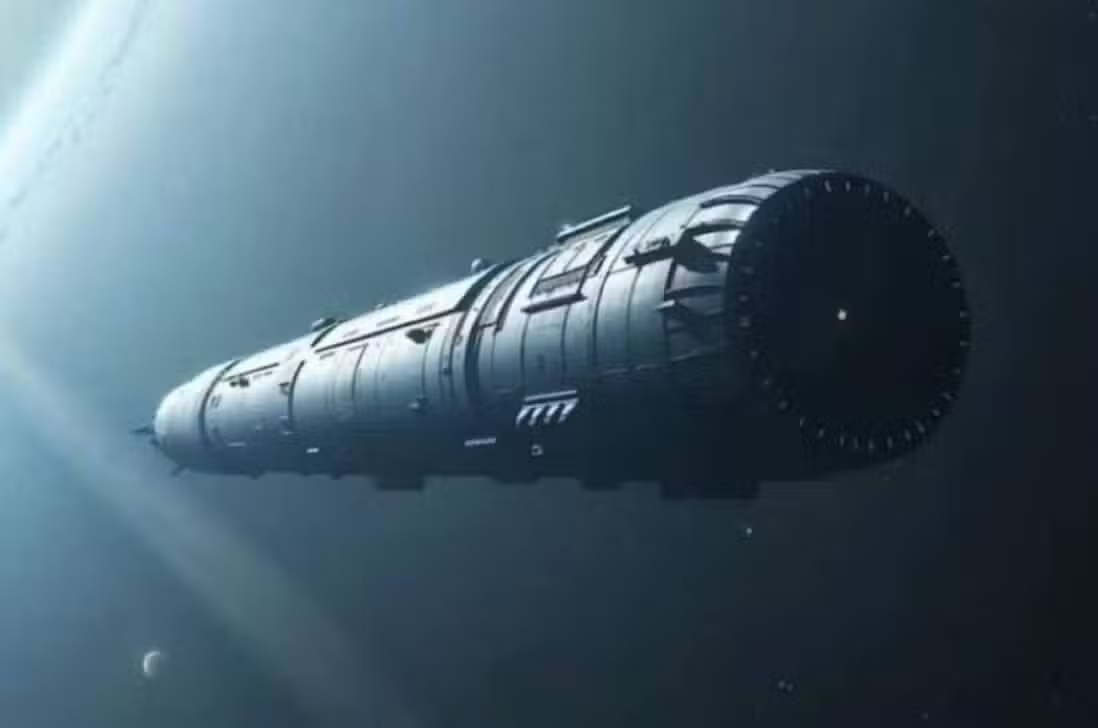
Aerospace engineering advances in the formulation of concrete proposals for the exploration of stellar systems neighboring ours. The architectural concept called Chrysalis stands out as one of the most elaborate proposals to enable an intergenerational journey in deep space. The colossal cylindrical structure, designed to measure an impressive 58 kilometers in length, was designed to house a population of up to 2,400 individuals during a crossing estimated to take four centuries. The model won first place in Project Hyperion, a global competition organized by Initiative for Interstellar Studies that seeks viable solutions for colonization outside of Sistema Solar, combining advanced physics concepts with long-term urban planning.
Architecture and functioning of the space cylinder
The vessel’s design adopts a shape similar to a giant cigar, structured from multiple concentric cylinders that operate in a manner analogous to Russian dolls. Essa specific geometric configuration was chosen by engineers to minimize the extreme structural stresses that the hull will suffer during the long acceleration and deceleration phases in the vacuum of space. Cada inner layer has a vital and independent function, isolating residential habitats from heavy machinery areas and external protective shields. Maintaining such a vast ecosystem over hundreds of years requires the structure to be highly modular, allowing entire sections to be isolated, repaired or even replaced without compromising the integrity of the main mission or the safety of the crew on board.
To ensure travelers’ bone and muscle health, the internal modules maintain a constant rotational movement around the central axis. Essa continuous centrifugal force generates an artificial gravity equivalent to ten percent of Earth’s gravity, enough to enable daily activities and the adequate physical development of the generations that will be born during the trip.
The internal organization of the living space is strictly divided as follows to optimize the use of resources:
- Residential sectors with independent climate control and artificial lighting synchronized with circadian cycles.
- Agricultural areas for high-density hydroponic cultivation and biological oxygen production.
- Industrial zones intended for the total recycling of waste and the manufacture of spare parts.
- Command centers operated in conjunction with state-of-the-art artificial intelligence networks.
Social dynamics and survival in deep space
The vessel will function as a self-sufficient and completely isolated metropolis, where human life will need to find a new point of biological and social balance. Áreas extensive green spaces were designed to simulate varied terrestrial biomes, ranging from dense forests to artificial lakes, elements that are fundamental for the psychological stability of the crew and for the natural filtering of air in closed environments.
Demographic planning requires strict control to keep the population stabilized at a maximum limit of 2,400 inhabitants, avoiding the premature exhaustion of onboard resources and the collapse of life support. Traditional family structures will give way to more horizontal and community models of coexistence, focused on mutual cooperation, the collective creation of children and the equal division of responsibilities essential for maintaining the ship.
Education, technical training and the preservation of accumulated scientific knowledge will be managed by advanced artificial intelligence systems. Esses virtual agents will act as guardians of Earth’s history and impartial advisors in resolving internal conflicts, ensuring that the descendants, who will never see the planet Terra, remain focused on the ultimate goal of the stellar crossing.
Fate focused on system Alpha Centauri
The target of this secular journey is the exoplanet Proxima Centauri b, located approximately 4.24 light years away from our planet. Este rocky celestial body orbits the habitable zone of its host star, the red dwarf Proxima Centauri, which raises the strong astrophysical possibility of harboring liquid water on its surface. The mass of the planet is very similar to that of Terra, a crucial factor that facilitates the biomechanical adaptation of future colonizers after centuries of living under reduced artificial gravity inside the space cylinder.
The choice of this specific destination is based on its relative cosmic proximity, making the journey mathematically possible with propulsion technologies that are already in the theoretical research or initial development phase in terrestrial laboratories. Observações recent astronomical data confirm that the planet completes its orbit in just 11 Earth days, presenting severe climatic challenges, such as exposure to strong stellar eruptions, which will require the immediate construction of underground shelters shortly after the landing crafts land.
Propulsion systems and radiation protection
Moving such a formidable mass through the cosmos requires a revolutionary and highly stable energy matrix. The project stipulates the use of propulsion engines based on direct nuclear fusion, powered by a highly efficient mixture of deuterium and helium-3 isotopes.
This technology allows for continuous and gradual acceleration during the first year of the journey, until the ship reaches its ideal cruising speed for crossing interstellar space. The system was designed to operate with maximum efficiency and redundancy, ensuring uninterrupted power supply to both the main thrusters and the complex internal habitats.
Shielding against the elements of deep space is another central pillar of the ship’s survivability engineering. The outermost layers of the cylinder will act as thick, regenerative shields, designed to absorb the kinetic impact of micrometeoroids and block the lethal cosmic background radiation that permeates the path.
The final phase of the journey will involve a complex braking maneuver that will also last around a year uninterrupted. Neste critical period, the reactors will reverse their thrust to slow down the immense structure, allowing safe and controlled insertion into the target exoplanet’s orbit before colonization protocols begin.
Logistics planning and construction in orbit
The physical magnitude of the vessel, with a total mass estimated at 2.4 billion metric tons, makes any attempt to assemble it on the Earth’s surface unfeasible due to gravitational and aerodynamic limitations. Construction will require the installation of vast orbital shipyards, possibly located in the orbit of Lua, using ores extracted and processed directly in the space environment by fleets of autonomous drones.
In-situ manufacturing capability is a critical differentiator of the project to ensure the longevity of the mission. Impressoras Industrial 3D and automated forges will allow the crew to manufacture complex replacement parts and expand sectors of the ship during the 400-year journey, eliminating dependence on a finite initial stock that would inevitably run out before arrival.
Preparation steps and ground simulations
Before any official launch, safety protocol requires decades of rigorous testing of original crew candidates and their immediate descendants. Simulações of extreme isolation in bases built in Antártida and in remote deserts will serve to assess the psychological resilience of individuals, test life support machinery, and refine the governance models that will be applied during multigenerational confinement.
Technical details awarded by the scientific initiative
The recognition of the project The competition attracted experts from around the globe, but the systemic approach to this 58-kilometer structure outperformed competitors by presenting realistic mathematical and logistical solutions for long-term sustainability. The model is not limited to being just a point-to-point transport vehicle, but rather a living and independent ecosystem that anticipates the mechanical failures and social crises that will inevitably occur over four centuries of absolute isolation. Embora the realization of a mission of this size still depends on significant technological leaps, especially in the area of controlled nuclear fusion and asteroid mining, the concept establishes a new scientific paradigm and a solid technical roadmap for future generations of aerospace engineers who will work to permanently expand the human presence beyond the borders of Sistema Solar.