
Astronomers capture unusual ‘hiss’ from distant supernova, unlocking secrets of stellar physics
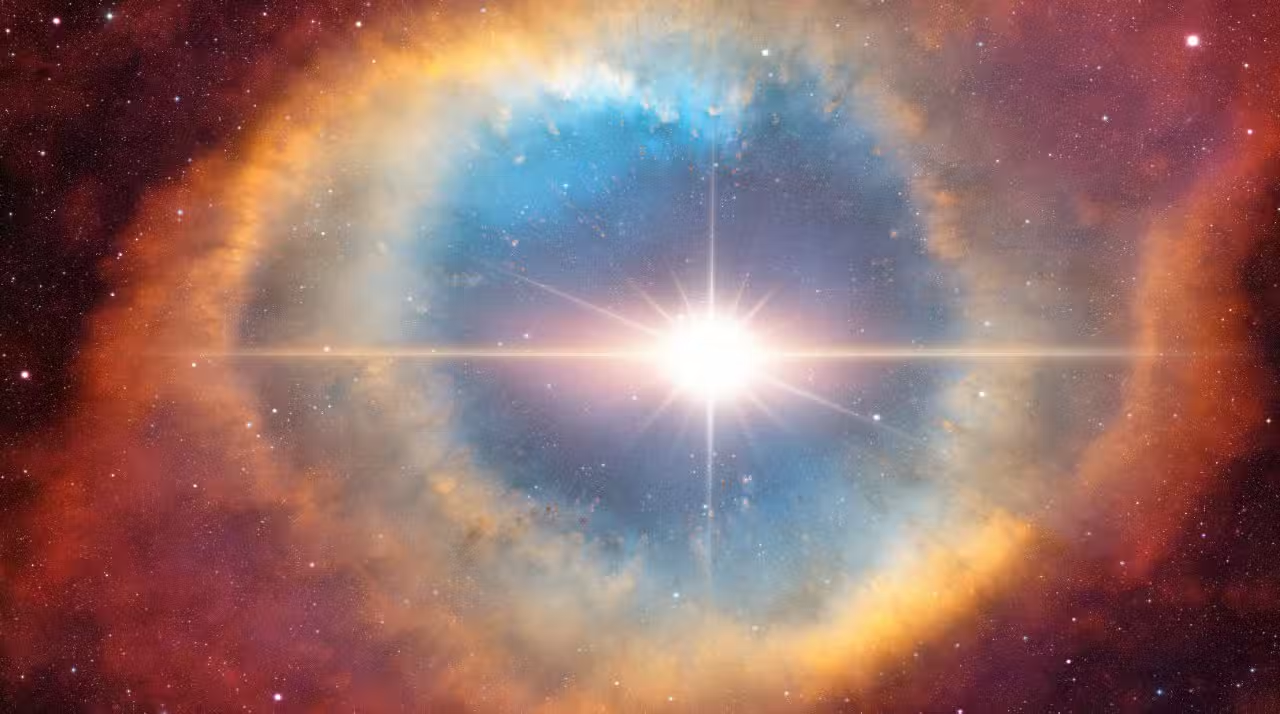
A surprising discovery in astronomy has revealed a mysterious “hiss” emitted by a supernova, a phenomenon that is providing scientists with valuable new clues about the hidden physics behind the explosive deaths of massive stars. The detection, carried out by an international team of researchers, challenges previous understandings about the dynamics of these gigantic cosmic explosions, suggesting the existence of complex and still little explored physical processes during the final stages of stellar life. Este sound, although imperceptible to the human ear, represents a significant anomaly in the collected data, opening a new field of investigation into the intrinsic nature of stellar remnants and the formation of compact objects such as neutron stars and black holes.
The research, published in a renowned scientific journal, details how the signal was identified among a vast amount of astronomical data, requiring advanced processing and analysis techniques to isolate its unique signature. The particularity of the “hiss” lies in its frequency and duration, which do not completely align with existing theoretical models for the emission of gravitational or electromagnetic waves associated with supernovae. Tal discrepancy indicates that events not yet fully understood may be occurring at the heart of these explosions, possibly related to instabilities in the collapse of the stellar core or interactions with the surrounding environment.
The team responsible for the find used a network of state-of-the-art telescopes, including gravitational wave observatories and radio telescopes, to triangulate and characterize the source of the signal. Esta multi-messenger approach was crucial to validate the authenticity of the detection and to begin to unravel its origin. The supernova in question, located in a distant galaxy millions of light years from Terra, provided a natural laboratory for studying extreme conditions that are impossible to replicate in any terrestrial environment, offering an unprecedented window into the most energetic processes in the universe.
The enigmatic nature of the cosmic ‘hiss’
The term “hiss” is an analogy used by astronomers to describe a type of detected signal that resembles a rapid and increasing variation in frequency, similar to the sound of a cricket. In an astronomical context, this translates to fluctuations in gravitational waves or electromagnetic emissions that exhibit an unusual pattern. The detection of this specific pattern in a supernova is particularly intriguing because supernovae are known to emit a wide range of signals, but this particular “chirp” doesn’t fit into any of the expected categories.
Theoretical models of supernovae predict violent explosions that disperse stellar matter across space, leaving behind a dense remnant. Contudo, the presence of this anomalous signal suggests that the collapse of the stellar core may be more complex than previously thought, perhaps involving resonances of nuclear matter or the transient formation of exotic states of matter under unimaginable pressures and temperatures. Compreender the exact origin of this “hiss” could therefore lead to a fundamental revision of current models of stellar evolution and the formation of heavy elements in the universe.
Implications for high energy physics
High-energy physics seeks to understand the fundamental laws that govern the universe at its most extreme scales, and supernovae are natural laboratories for these studies. The discovery of the “hiss” offers a new tool for investigating phenomena that occur under conditions of intense gravity and extreme nuclear density. Scientists believe the signal may be related to the formation of a neutron star or even a black hole shortly after the collapse of the parent star’s core.
The transition from a massive star to a compact object is one of the most energetic events in the universe, releasing a colossal amount of energy in a short space of time. The “hiss” could be the signature of gravitational waves generated by complex, asymmetric motions in the core of the collapsing star, or perhaps from oscillations of a newly formed compact object. Gravitational waves, in particular, offer a way to “see” inside these extreme events, as they are not obscured by matter like visible light or other forms of electromagnetic radiation.
Challenges and future investigations
Identifying and interpreting such a subtle signal amidst the cosmic noise represents a considerable technical and theoretical challenge. Astronomers are now committed to refining their detection techniques and developing new computer models that can simulate the extreme conditions that generate this “hiss.” The goal is not only to reproduce the observed signal, but also to predict other types of emissions that could be detected in future supernova observations.



* Aprimoramento of gravitational wave detection algorithms for high frequency signals.
* Desenvolvimento of three-dimensional hydrodynamic models to simulate stellar collapse with greater accuracy.
* Coordenação of multi-messenger observations to capture as much information as possible from future events.
* Investigação of other supernovae to check whether the “hiss” is an isolated or more common phenomenon.
This line of research is crucial to deepening our understanding of nucleosynthesis, the process by which the heaviest elements are created in the universe. Muitas of the substances that make up Terra and the life in it were forged inside massive stars and dispersed in supernovae. The “hiss” may therefore contain information about the exact mechanisms by which these elements are produced and ejected into interstellar space.
The role of technology in exploring the cosmos
The ability to detect and analyze such faint and distant phenomena is a testament to technological advancement in recent decades. Observatórios such as LIGO (Laser Interferometer Gravitational-Wave Observatory) and Virgo, which revolutionized astronomy by detecting gravitational waves for the first time, are fundamental for research like this. The next generation of instruments, with even greater sensitivity, promises to unlock even more secrets of the universe.
International collaboration between scientists and research institutions is equally vital. The complexity of the data and the need for cross-validation require a joint effort that transcends geographic boundaries. The detection of supernova “hiss” is a shining example of how modern science depends on the global interconnection of minds and resources to push the limits of human knowledge. The scientific community hopes that discoveries like this will continue to inspire new generations of researchers to explore the mysteries of the cosmos.
Future perspectives of stellar research
The discovery of supernova “hiss” marks a turning point in stellar astrophysics, opening new avenues for investigating phenomena that were previously only theoretical. The coming years will see an intensified focus on searching for similar signals in other supernovae and further analyzing existing data. Understanding these extreme events not only fills gaps in our knowledge about the life and death of stars, but also helps us better understand the origin and evolution of the universe itself.
The ability to detect and interpret these cosmic “sounds” is fundamental to multi-messenger astronomy, which combines information from different types of emissions (light, gravitational waves, neutrinos) to form a more complete picture of celestial events. Esta holistic approach is the key to unlocking the deepest secrets of the cosmos and to answering fundamental questions about the nature of matter, energy and space-time. The journey to decipher the hidden physics of supernovae is just beginning, and each new “chirp” detected promises to be a crucial piece in this cosmic puzzle.
Veja Tambem em News (EN)

Research reveals that parents are unaware of how their children use artificial intelligence

Samsung releases new system update with new features for Galaxy Watch 4 users

Digital retail reduces the value of the Galaxy S25 5G smartphone with bank bonuses and device exchange

Amazon’s wireless CarPlay adapter has a 50% discount and high approval ratings from drivers

Zach Cregger’s new Resident Evil ignores games and focuses on an unprecedented story with new characters

Rumor suggests that Nintendo is preparing a special edition of the Switch 2 with a remake of Ocarina of Time

Apple accelerates production of the iPhone 17e and develops new Air model with dual camera system

Epic Games platform releases twelve high-budget games at no permanent cost for PC users

PlayStation 5 Pro price drop accelerates digital retail sales and eliminates global stocks

New Galaxy Watch 9 firmware appears on server and confirms progress in software development

Apple’s commemorative project tests cell phone with 1.1 millimeter edge and curved screen for 2027
