Researchers have identified that storms formed in the Jovian atmosphere are capable of producing electrical discharges with an energy intensity immensely greater than that recorded in terrestrial meteorological events. The discovery occurred following a thorough analysis of a vast set of information collected by high-precision instruments on board a spacecraft that has been orbiting the gas giant since 2016.
The measurements were carried out specifically by the space equipment’s microwave radiometer, a technology capable of capturing radio emissions generated by lightning in the deepest layers of the planet. Esse instrument allows scientists to bypass the visual barrier imposed by dense clouds of ammonia and water, recording electrical activity directly and without optical interference.
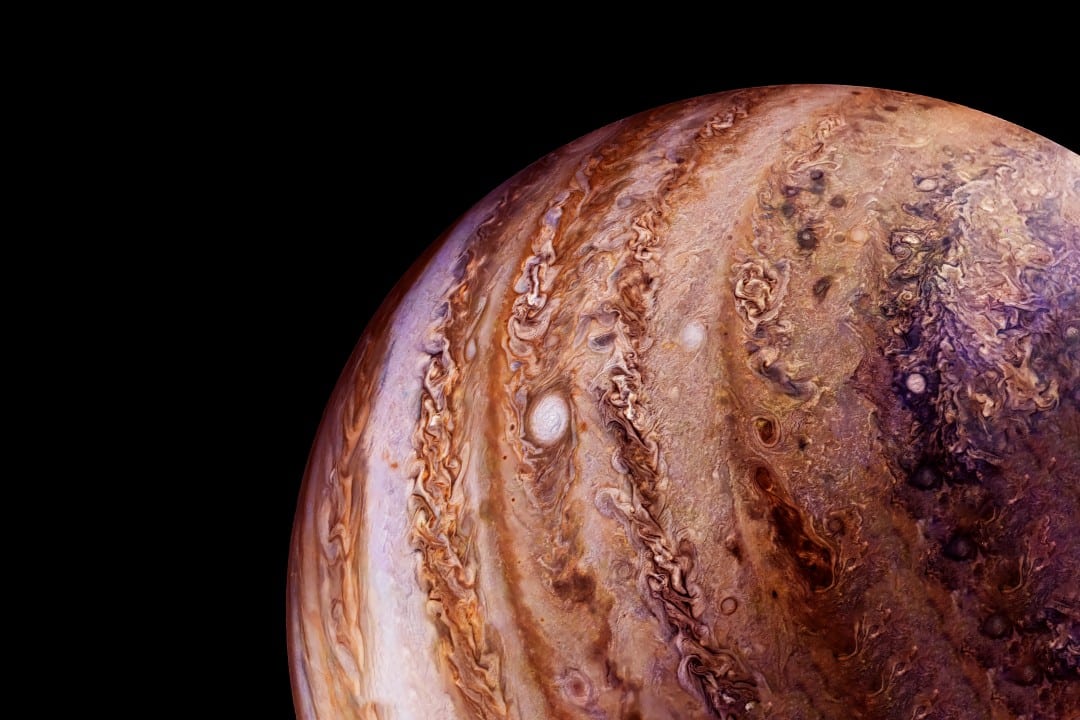
The results obtained highlight profound structural differences in the way meteorological systems develop on different celestial bodies. The chemical composition of the air and the dynamics of fluids in the Jovian environment create a scenario where the release of energy occurs on catastrophic scales, redefining the study models on the formation of storms in the solar system.
Dynamics of stealth superstorms in the gas giant
The surveys focused on large atmospheric systems that emerged in the planet’s northern equatorial belt between 2021 and 2022.
During the observation period, the spacecraft performed twelve strategic orbital passes over these specific weather formations. Nessas approaches, the onboard sensors were able to detect a total of 613 microwave pulses that were directly associated with lightning strikes occurring deep in the planet’s atmosphere.
The compilation of these records allowed the creation of an unprecedented three-dimensional map of the exact location of electrical discharges. The data revealed a very broad power distribution, showing that the events range from intensities comparable to common lightning to explosions of energy that exceed the maximum strength observed on the Earth’s surface by a hundred times.
Precise measurements through dense clouds
The operation of the microwave radiometer represents a fundamental technological advance for planetary exploration, as it captures wavelengths that easily pass through thick layers of gases. Enquanto traditional cameras depend on the visual flash that is often muffled by chemical haze, radio sensors record the pure electromagnetic signature of lightning at the exact moment of its occurrence.
The effectiveness of this system was proven in a single extremely close pass, where the equipment managed to isolate and record 206 distinct pulses in a short space of time. Durante the moments of greatest activity of this specific storm, the occurrence rate reached the impressive mark of three flashes per second, highlighting an environment of extreme electrical volatility.
Structural differences between planetary atmospheres
The discrepancy in the power of lightning is primarily explained by the divergent chemical composition between the two worlds. The Jovian environment is dominated by hydrogen, an extremely light gas that completely alters the thermodynamic behavior of air masses when compared to the mixture of nitrogen and oxygen that makes up the air we breathe.
In this hydrogen-rich scenario, moist air containing water vapor becomes significantly heavier than the surrounding gas. Essa physical characteristic imposes a severe gravitational barrier, requiring a colossal accumulation of thermal and kinetic energy so that ascending currents can push moisture to the upper, colder layers of the atmosphere.
When conditions finally allow this ascension, the friction generated by the extreme vertically moving ice and water particles creates electric fields of gigantic proportions. The release of this accumulated tension results in electrical discharges that carry an amount of energy proportional to the difficulty the storm had in forming.
In addition to intensity, the longevity of these systems is a crucial differentiating factor in comparative meteorology. Enquanto Earth’s storms dissipate their energy in a matter of hours or days, the formations in the gas giant have enough stability to persist for centuries, maintaining a continuous cycle of generation and release of high-power lightning.
Integration of visual and radio data
Validation of the findings required the crossing of information obtained by different space observation platforms, combining microwave readings with high-resolution optical images captured by the Telescópio Espacial Hubble. In August 2022, an orbital pass coincided with a telescope observation campaign, allowing scientists to correlate the multiple detected radio pulses with the physical structures of cloud towers visible from space. Essa dual approach confirmed that the most intense electrical discharges occur in extensive and deep bands, often hidden beneath the visible surface of the planet.
Integrating this data also exposed a historical limitation in previous planetary surveys, which relied almost exclusively on optical sensors to count lightning strikes. The rate of flashes measured by the radiometer vastly exceeded previous estimates, proving that a vast number of electrical events, especially those occurring in lower layers or with less optical luminosity, went completely unnoticed. The new methodology establishes a more rigorous and precise standard for quantifying meteorological activity in harsh extraterrestrial environments.
Ongoing Space Mission Contributions
Extending the operations of the space probe, which originally had a life cycle designed for just five years, has proven to be a fundamental decision for expanding knowledge about fluid dynamics and electromagnetism on a planetary scale. By operating during periods of lower overall storm activity, the equipment found the ideal setting to isolate background noise and focus exclusively on stealthy superstorms, without overlapping signals from multiple simultaneous events. Information continuously transmitted to the control bases provides a robust statistical distribution, allowing atmospheric physicists to accurately model how different gas compositions generate, sustain, and dissipate extreme electrical energy. Esse volume of data not only unravels the mysteries of the largest planet in the solar system, but also offers crucial parameters for understanding electrical phenomena that can occur on gaseous exoplanets discovered in the orbit of other stars, consolidating the importance of continuous long-term exploration.
Lightning energy and frequency patterns
Detailed analysis of microwave pulses revealed that, despite the ability to generate events a hundred times stronger, the planet also produces discharges with energy profiles surprisingly similar to common thunderstorms. Essa variation indicates the existence of multiple friction and charge separation mechanisms acting simultaneously at different altitudes and pressures within the immense columns of Jovian clouds.
Detailed mapping of electrical pulses
The continuous recording and high resolution of the sensors allowed the development of a precise catalog of the geographic coordinates of each detected electrical pulse. Esse mapping is vital to identify zones of greatest thermodynamic instability and understand global wind circulation patterns in the gas giant.
Recent observations have redefined the parameters of space weather measurements, establishing new known limits for the dissipation of energy in the form of light and radio waves. The consolidated data presents specific characteristics that detail the magnitude of the phenomenon.
- Varied power reaching peaks hundreds of times greater than terrestrial records.
- Occurrence rate of up to three flashes per second in high-density areas.
- Focus on four isolated systems in the northern equatorial belt between 2021 and 2022.
- Deep reading capability without the interference of ammonia coating.