Former Sanzaru Games developers reveal unreleased video of canceled Jak & Daxter remaster
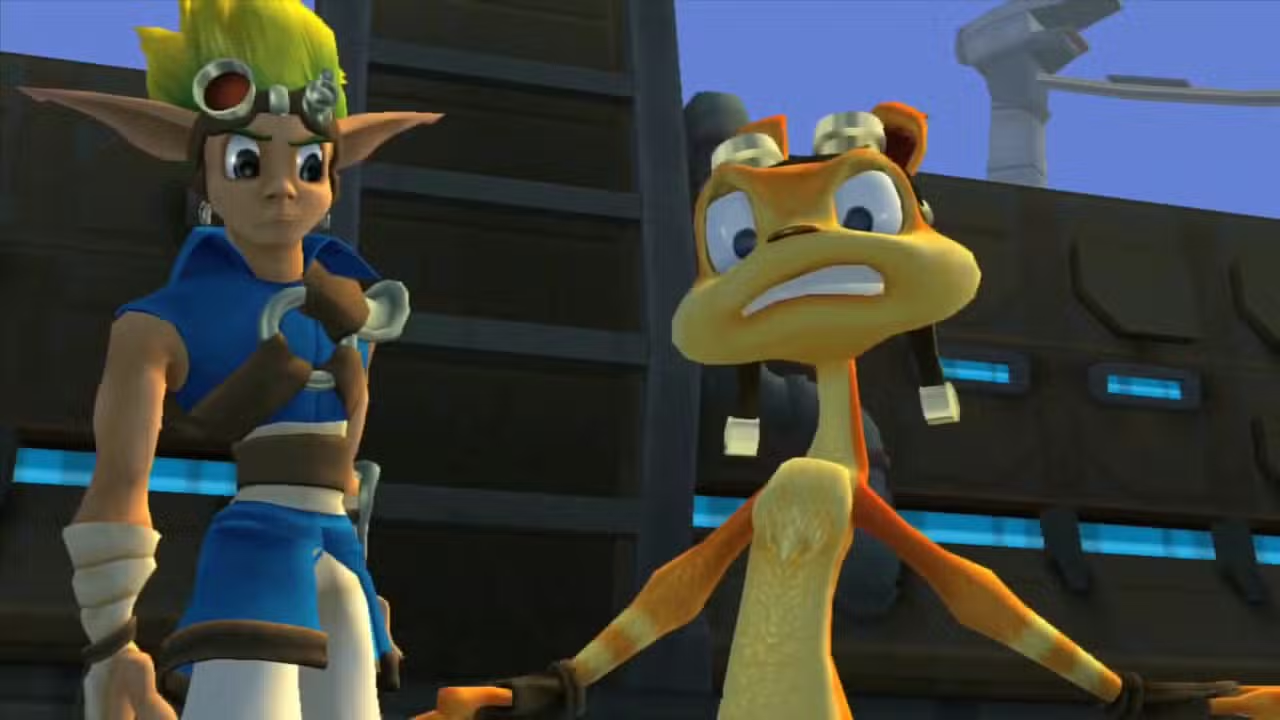
A revitalization project for one of the most popular franchises of the PlayStation 2 era has just been made public through former employees of the electronic games industry. Profissionais, who were part of the Sanzaru Games team, released a 26-second animation clip that demonstrated what a modern version of the classic three-dimensional platform game would look like.
The visual demonstration was originally created in 2019 as an internal proposal to convince Sony to invest in complete development. The material recreates one of the opening scenes of the original adventure frame by frame, displaying updated graphics and greater fluidity in the main characters’ movements.
Travis Howe, a former senior animator at the studio, was responsible for sharing the file recently on his networks, detailing the team’s effort at the time. The publication occurs shortly after the definitive closure of the developer’s activities, motivating creators to show work that never received official approval to reach the market.
Historical context and the studio initiative
The idea of modernizing intellectual property emerged during a period of high demand for returns of classic video game mascots. Sanzaru Games already had a history of collaboration with Sony, having previously worked on remastered collections and the development of titles in the Sly Cooper series.
With this prior experience, the team brought together artists and animators to create robust presentation material. The central objective was to prove that the company had the technical capacity to update the visuals without losing the essence of the gameplay that established Naughty Dog’s original work.
To structure the commercial proposal, the developers focused on specific elements that could attract the attention of the rights holder’s executives:
- Absolute fidelity to the original dialogues and interactions between the protagonists.
- The modernization of facial expressions using state-of-the-art animation tools.
- Maintaining the humorous tone characteristic of the franchise’s introductory scenes.
- The demonstration of a visual polish comparable to major contemporary releases.
Technical details of the animation revealed
The released video focuses specifically on the moment when the character Daxter undergoes his initial transformation, a scene widely recognized by players. Tyler Bronis, Senior Character Artist, led the adaptation of the three-dimensional models to ensure the transition to modern graphics respected the original design.
The animation team applied frame-by-frame recreation techniques to mirror the exact timing of jokes and physical movements. Esse level of detail served to illustrate how the art direction could evolve naturally, taking advantage of the processing power of the latest consoles.
Impact of the closure of Sanzaru Games by Meta
The release of this unprecedented material is directly linked to recent corporate changes in the technology and virtual reality sector. Sanzaru Games was acquired by Meta in 2020, focusing exclusively on immersive projects, such as the Asgard’s Wrath series for the Quest devices.
However, in January 2026, the parent company decided to close the studio’s operations as part of a broad restructuring of the Reality Labs division. The sudden closure forced dozens of qualified professionals to seek new opportunities in the global job market.
It was exactly this closure of activities that motivated former employees to open their personal portfolios. The breach of confidentiality agreements linked to shelved projects allowed the public to finally have access to proposals that did not advance to the commercial production phase.
The wave of revitalization of classics on the market
The Sanzaru Games project was conceived at a strategic time for the electronic games industry. The sales success of the remastered collections of Crash Bandicoot and Spyro the Dragon proved that there was an active consumer audience for intellectual properties of the past.



These releases set a quality standard where the code structure and classic gameplay were maintained, while the entire audiovisual layer was remade from scratch. The proposal for the Sony duo’s adventure followed exactly the same software development guide.
Companies realized that revitalizing old brands presented less financial risk than creating entirely new franchises. Prior name recognition guarantees an established buyer base in the first days of availability in digital and physical stores.
Despite this favorable scenario and the evident commercial potential demonstrated in the clip, Sony chose not to go ahead with the project order. The corporate decision kept the franchise on an extended hiatus, without receiving new titles or official updates on modern consoles.
Reactions from the gaming community on social media
The publication of the video generated an immediate mobilization among platform game enthusiasts on social networks and in specialized technology forums. Diversos users positively evaluated the technical quality of the animation, pointing out that the look presented by the Sanzaru Games team captured the aesthetic identity of the series. The animator Travis Howe himself encouraged the sharing of the original post, indicating that a high view rate could signal to the rights holder that there is an active commercial demand for new content from the brand.
Online discussions quickly devolved into debates over the catalog of PlayStation 2-era intellectual properties that remain dormant. The community often argues that games focused on linear exploration, simplified combat, and straightforward storytelling are lacking in the current industry ecosystem, which prioritizes open-world experiences or games focused on continuous monetization. The 26-second clip acted as a catalyst to reignite public interest in an official return for the character duo.
The legacy of Naughty Dog in the PlayStation 2 era
The original trilogy developed by Naughty Dog in the early 2000s represented a technical and narrative milestone for the Sony platform, establishing solid foundations for the design of seamless worlds without apparent loading screens. The first title introduced a smooth transition between open environments, combining precise jumping challenges with item collecting in a vast universe. Conforme the series advanced to its direct sequels, the developers incorporated elements of urban action, use of vehicles and a considerably more complex plot, reflecting the consumer trends of the time. Esse progressive maturation of the mechanics and tone of the story consolidated the brand as one of the most influential of its generation. The graphics engine created specifically for the hardware of that period allowed distant scenes to be rendered in real time, a remarkable technical feat by current standards. The sales volume and critical reception paved the way for the creative studio to later invest in big-budget narratives. The original team’s transition to realistic-toned projects left a gap in the three-dimensional platformer genre within the publisher’s portfolio. The level design established by this franchise continues to be an object of study for new professionals entering the field of digital entertainment development.
The uncertain future for the Sony license
To date, Sony has not issued any official statement regarding plans to revive the franchise, whether through remasters, complete remakes or direct continuations. The corporation has directed its investments towards high-budget productions and the adaptation of its most profitable brands for cinema and streaming services.
The visual archive released by former employees remains only a documentary record of an isolated development attempt. The material illustrates the technical capacity of partner studios, but does not change the release schedule already established by the intellectual property holder.
Preservation of independent projects in the industry
The revelation of rejected commercial proposals exposes the amount of creative work that ends up archived on technology companies’ internal servers. The attitude of former members of Sanzaru Games contributes to the historical preservation of software development, allowing the public to understand the technical behind-the-scenes and corporate decisions that define the electronic games market.
Veja Tambem em News (EN)

Research reveals that parents are unaware of how their children use artificial intelligence

Samsung releases new system update with new features for Galaxy Watch 4 users

Digital retail reduces the value of the Galaxy S25 5G smartphone with bank bonuses and device exchange

Amazon’s wireless CarPlay adapter has a 50% discount and high approval ratings from drivers
Zach Cregger’s new Resident Evil ignores games and focuses on an unprecedented story with new characters
Rumor suggests that Nintendo is preparing a special edition of the Switch 2 with a remake of Ocarina of Time

Apple accelerates production of the iPhone 17e and develops new Air model with dual camera system

Epic Games platform releases twelve high-budget games at no permanent cost for PC users

PlayStation 5 Pro price drop accelerates digital retail sales and eliminates global stocks

New Galaxy Watch 9 firmware appears on server and confirms progress in software development

Apple’s commemorative project tests cell phone with 1.1 millimeter edge and curved screen for 2027