Leaked images confirm that Sony blocked Bluepoint Games from recreating Jak and Daxter
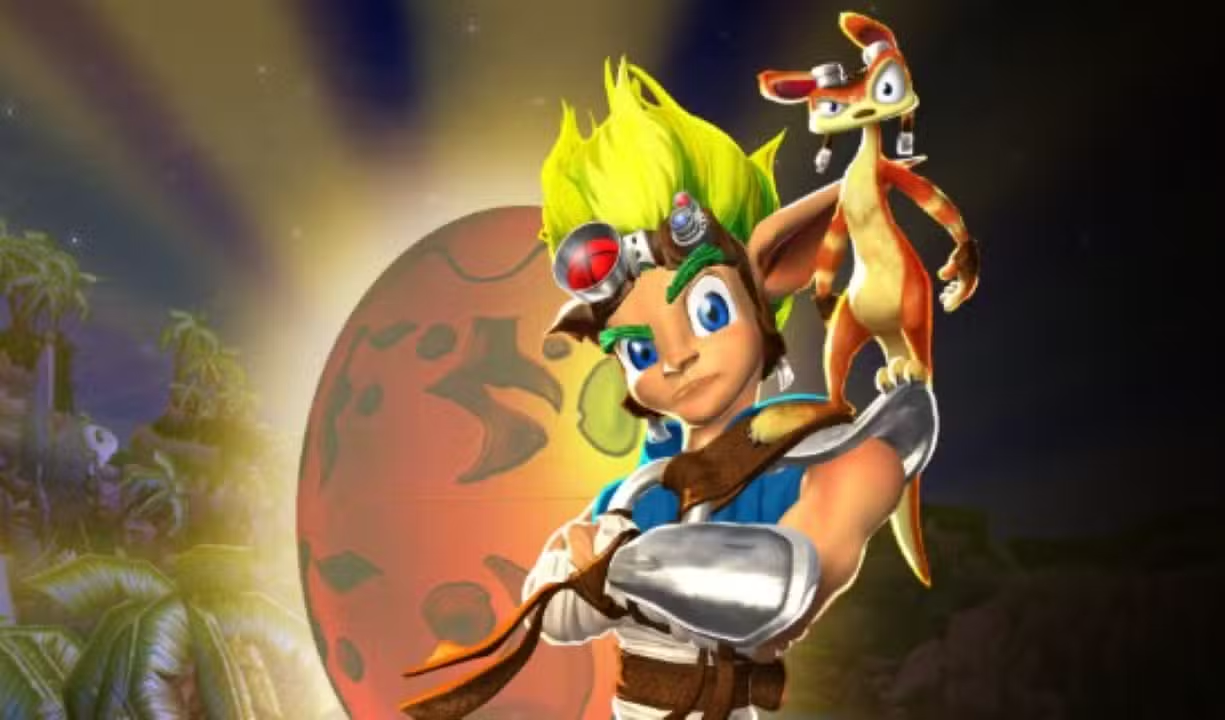
Sony Interactive Entertainment chose not to move forward with a project to recreate the classic series Jak and Daxter, developed internally as a proposal by Bluepoint Games. The information became public after the circulation of unpublished conceptual arts on the internet, which showed the visual direction planned for the return of the franchise. The studio, known for modernizing major PlayStation titles, had structured a detailed plan to bring the duo back to new generation consoles.
The released material presents a complete graphic redesign of the protagonists and the original scenarios. The developer’s central idea was to maintain the platform and adventure essence that popularized the brand in the early 2000s, adapting the controls and visual fidelity to the current technical standards required by the electronic games market.
The rejected proposal included specific elements for the modernization of the classic:
– Atualização 3D models of Jak and mascot Daxter with high-resolution textures.
– Expansão of open-world environments to take advantage of contemporary hardware.
– Implementação of improved volumetric and physical lighting systems in the scenarios.
– Revisão combat and movement mechanics for greater fluidity.
The Japanese giant’s decision raises debates about the management of its catalog of inactive intellectual properties. The rejection of the project comes at a time when the industry is recording high sales rates with re-releases and reconstructions of old games.
Franchise trajectory in the console market
The series Jak and Daxter debuted on the PlayStation 2 under the command of Naughty Dog, marking the company’s transition after the success of Crash Bandicoot. The first title, The Precursor Legacy, set new standards for three-dimensional platformers, eliminating loading screens between map areas. Direct sequels expanded the scope of the narrative, introducing vehicle driving and weapon use mechanics.
The last canonical release of the main saga occurred in 2004, followed by derivatives focused on racing and portable adventures. Desde therefore, the brand remains without new unreleased chapters, only receiving high definition adaptations for later generations of consoles. Esse long period of inactivity transformed the franchise into one of the most requested returns by consumers on the platform.
Specialty of the studio responsible for the proposal
Bluepoint Games has built its reputation in the video game industry by focusing exclusively on restoring and improving renowned works. The company based at Texas has developed its own reverse engineering methodologies to update old codes without losing the original sense of control. Esse technical rigor guaranteed lasting partnerships with major global publishers.
The developer’s most high-profile work includes the complete rebuild of Shadow of the Colossus for the PlayStation 4. The project was widely praised for delivering cutting-edge visuals while preserving the moody atmosphere and sound design envisioned by the original creators. The impeccable technical delivery consolidated the studio as a reference in the segment.
The team was later responsible for Demon’s Souls at the launch of the PlayStation 5, demonstrating the ability to handle newly released hardware architectures. The track record of successful deliveries made Bluepoint the natural candidate to take on the modernization of any classic Sony intellectual property, justifying the creation of the project focused on the hero duo.
Analysis of the conceptual material released
The recently leaked illustrations detail the art direction the team intended to adopt for the Jak and Daxter universe. The sketches show the humanoid protagonist with slightly more realistic proportions, but maintaining the iconic clothes and signature hair. The level of detail in clothing and equipment indicated a clear generational leap.
The supporting character Daxter, who works as comic relief and a fundamental part of the gameplay, appears in the artwork with advanced fur rendering work. The character’s facial expressions were designed to support more complex animations, essential to convey the characteristic humor of the original series’ dialogue.



The conceptual scenarios reveal villages and forests with a density of elements far exceeding the capacity of the PlayStation 2. The images suggest living ecosystems, with dynamic foliage, architectural structures rich in detail and a vibrant color palette that respects the visual identity established by Naughty Dog in the past.
The visual documentation points to a high-budget production scope, categorized in the industry as triple A. The clear intention was to position the return of the franchise not just as a product aimed at nostalgia, but as a title capable of technically competing with the main releases in the current third-person adventure market.
Strategic guidelines and corporate focus of the publisher
Sony’s refusal to finance the full production of the title reflects the PlayStation division’s current investment guidelines. Nos recent years, the corporation has directed most of its resources to the development of realistic cinematic narratives and games as a service. Naughty Dog, the original creator of the series, has established itself in the production of mature franchises such as The Last of Us, distancing itself from the cartoon style of its first works. The approval of a high-cost project focused on platform mascots could represent a deviation from the brand unification strategy that the company seeks to project globally.
Another determining factor for the cancellation of the initiative involves financial return projections. Developing a game along the lines proposed by Bluepoint requires tens of millions of dollars and years of production. The management of Sony carries out constant market research to evaluate the sales potential of each intellectual property. It is likely that internal data indicated that the current consumer audience for Jak and Daxter would not be sufficient to justify the massive investment, especially when compared to the guaranteed commercial performance of other brands active in the company’s portfolio.
The panorama of recreations in the digital entertainment market
The electronic games sector is going through a phase of heavy dependence on already established intellectual properties, with studios minimizing financial risks by recreating past successes. The business model has proven to be highly profitable with recent releases from other publishers, which have managed to modernize horror and RPG classics to achieve impressive sales figures. However, the three-dimensional platformer genre presents a distinct commercial challenge. Diferente of action games with dense narratives, titles focused on jumping and collecting items have a more restricted market niche nowadays. Modernizing these mechanics requires extreme care not to alienate purists, while at the same time it needs to introduce enough innovations to attract contemporary players, accustomed to complex progression systems. The risk assessment around a big-budget platform project is considerably more rigorous, which explains the hesitation of major companies to revive mascots that dominated the industry two decades ago, opting instead to allocate their elite teams to genres with a greater guarantee of mass acceptance.
Repercussion among consumers and enthusiasts
The dissemination of the arts and confirmation of the refusal generated immediate movement on social networks and forums dedicated to electronic games. Usuários expressed frustration with the corporate decision, arguing that the proven technical quality of Bluepoint Games would be the ideal guarantee for a worthy return for the franchise. Campanhas digital media calling for reconsideration of the project gained temporary traction.
Many consumers point out that the absence of big-budget platformers in PlayStation’s current catalog creates a gap in the market. The fan base argues that genre diversification is essential to the health of the console ecosystem, and that the abandonment of classic intellectual properties alienates players seeking experiences focused purely on agile gameplay.
Current status of inactive intellectual properties
The filing of the proposal keeps Jak and Daxter on Sony Interactive Entertainment’s extensive list of dormant brands. Sem projects announced for the short or medium term, the universe created by Naughty Dog remains restricted to the company’s historical legacy, serving only as a reference for the industry’s transition period towards three-dimensional open worlds.
Veja Tambem em News (EN)

Research reveals that parents are unaware of how their children use artificial intelligence

Samsung releases new system update with new features for Galaxy Watch 4 users

Digital retail reduces the value of the Galaxy S25 5G smartphone with bank bonuses and device exchange

Amazon’s wireless CarPlay adapter has a 50% discount and high approval ratings from drivers

Zach Cregger’s new Resident Evil ignores games and focuses on an unprecedented story with new characters
Rumor suggests that Nintendo is preparing a special edition of the Switch 2 with a remake of Ocarina of Time

Apple accelerates production of the iPhone 17e and develops new Air model with dual camera system

Epic Games platform releases twelve high-budget games at no permanent cost for PC users

PlayStation 5 Pro price drop accelerates digital retail sales and eliminates global stocks

New Galaxy Watch 9 firmware appears on server and confirms progress in software development

Apple’s commemorative project tests cell phone with 1.1 millimeter edge and curved screen for 2027