
New astronomical measurements validate continued expansion of the universe after the Big Bang 13.8 billion years ago

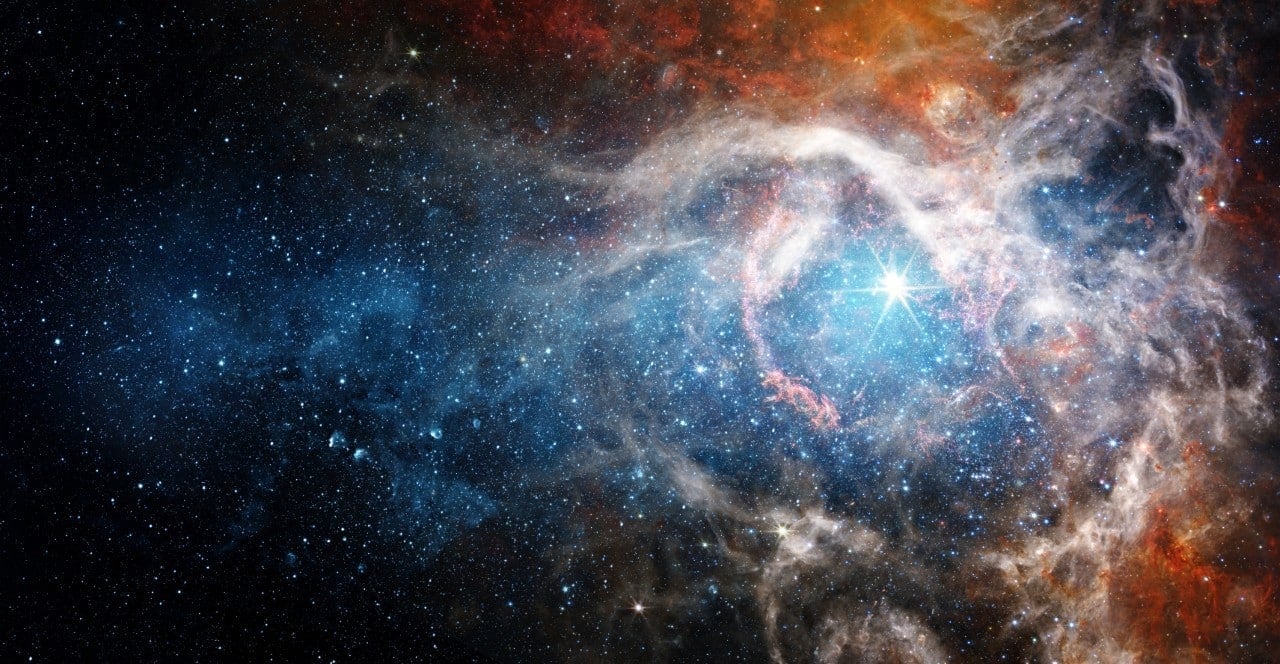
Contemporary astrophysics consolidates the understanding that space-time began a process of accelerated dilation from a state of extreme density and temperature. Observatórios State-of-the-art terrestrial and space-based data provide continuous data that support the premise of a cosmos in constant evolution since its origin, estimated at 13.8 billion years. The progressive withdrawal of galaxies constitutes the primary observational basis for this dynamic, eliminating historical conceptions of a static space environment. Pesquisadores use high-precision instruments to measure the speed at which different celestial bodies move apart, establishing standards that confirm theoretical predictions formulated at the beginning of the last century. Essa convergence between theory and direct observation allows mapping the thermal and material history of space with a level of detail unprecedented in the history of science.
Several pillars support the current model of space evolution, based on independent measurements that complement each other and form the basis of modern cosmology. Entre the main evidence documented by observation equipment, the following factors stand out:
* The detection of residual microwave radiation that permeates all directions of space almost uniformly.
* The specific proportion of light chemical elements, such as hydrogen and helium, formed moments after the initial event.
* The proportional increase in the recession speed of galaxies in relation to their distance from the observation point at Terra.
Dynamics of separation of galaxies and the Hubble-Lemaître law
The fundamental principle that governs large-scale movement in space establishes that more distant celestial bodies move away at a significantly greater speed. Essa direct proportionality relationship was identified through spectroscopic observations that measure the redshift of light, a phenomenon analogous to the sonic Doppler effect. The mathematical formulation of this behavior has recently received formal recognition and updated nomenclature, honoring the pioneering scientists who proposed the dynamic nature of space. Cálculos previous theorists already indicated that the equations of general relativity allowed solutions where the space fabric would be expanding or contracting. The accumulation of photometric data transformed this mathematical hypothesis into an indisputable observational fact.
Modern measurements refined by wide-range telescopes confirm the pattern of galactic recession at increasingly greater distances. Analysis of the light emitted by these structures reveals not only their current speed, but also provides a portrait of how space behaved in ancient times. Astrônomos uses this information to reconstruct the timeline of spatial dilation, going back to times when matter was densely packed. The detailed study of the redshift allows us to draw a three-dimensional map of the distribution of matter, showing that the expansion occurs homogeneously on global scales. Essa directional uniformity reinforces the premise that there is no physical center for expansion.
Cosmic microwave background as thermal echo of the cosmos
A thermal remnant of the early universe fills all observable space in the form of low-frequency electromagnetic waves. Essa emission was released at the moment when the global temperature dropped enough to allow electrons and protons to bond, forming the first neutral atoms. The event occurred approximately 380 thousand years after the beginning of the expansion, making the space environment transparent to the passage of light.
Specialized satellites have mapped this radiation with very high precision, revealing a current average temperature of approximately 2.7 Kelvin. The continuous stretching of spacetime over billions of years has stretched the original wavelengths, transforming the intense light of the past into the faint microwave emission detected today. The measured thermal spectrum coincides perfectly with theoretical predictions of a cooling blackbody.
Small temperature variations in this radiation map represent the seeds of future cosmic structures. Essas tiny anisotropies indicate regions where matter was slightly denser, serving as gravity wells for the later formation of stars and galaxies. Statistical analysis of these fluctuations provides the fundamental parameters that define the composition and geometry of current space.
Formation of light elements in the first minutes
The extreme conditions present in the initial moments of the expansion allowed nuclear reactions to occur on a global scale. Durante a brief period of just a few minutes, protons and neutrons collided with enough energy to fuse into more complex atomic nuclei. Esse process of primordial nucleosynthesis generated specific amounts of isotopes of hydrogen, helium and trace amounts of lithium.
The proportion of approximately 25% helium in relation to the total mass of baryonic matter observed today corresponds exactly to the calculations derived from the expansion model. Observações of primitive gas clouds and low-metallicity galaxies confirm this original chemical abundance. The absence of heavy elements in this primordial material testifies that more complex atoms were forged later in the interior of stars.
Advanced Observations with Telescópio Espacial James Webb
The entry into operation of state-of-the-art infrared observation instruments has revolutionized the ability to see the oldest phases of space history. Equipamentos positioned beyond Earth’s orbit can capture the faint light of galaxies that already showed intense brightness just 280 million years after the beginning of space dilation. The detection of these mature structures at such early times requires adjustments to the computational models that describe the rate of star formation in the primordial environment. Dados rigorous spectroscopic tests confirm that these light sources have extremely high redshifts, attesting to their real cosmological distances and ruling out calibration errors. The presence of supermassive black holes already active in this remote period also adds complexity to understanding how matter quickly clumped together. Pesquisadores analyze the chemical composition of these early galaxies to determine how quickly the first generations of stars enriched the interstellar medium with heavy elements. Continued refinement of stellar feedback rates and primordial gas dynamics will allow us to seamlessly integrate these new observations into the large-scale evolution model.
Influence of dark energy on contemporary acceleration
The rate of space expansion does not remain constant, showing a progressive increase in speed over recent time. Essa acceleration is driven by an invisible component of unknown nature, widely known as dark energy. Essa repulsive force acts in opposition to gravity, dominating spatial dynamics on macroscopic scales.
Calculations based on multiple data sources indicate that this energy makes up about 68% of the entire content of the current space environment. Dark matter, responsible for holding galaxies together, represents most of the remaining percentage, leaving common matter as a minority fraction. The standard model of cosmology incorporates these three fronts to explain the observed behavior of space.
Mapping distant supernovae has provided the first direct evidence of this change in the rate of expansion. The light from these stellar explosions appears dimmer than expected for an environment with a constant separation rate, indicating that space stretched more quickly during the light’s path. Modern Telescópios continue to monitor these events to calibrate the acceleration curve.
The combination of data from gravitational lensing and baryonic acoustic oscillations reinforces the robustness of the influence of dark energy. Pesquisadores use these independent methods to measure absolute distances and test the consistency of the theory at different times. The measurements converge on a scenario where spatial repulsion will dictate the dynamics of the large-scale structure.
Mapping fluctuations and the large-scale structure
The current distribution of galaxy clusters and vast spatial voids directly reflects the microscopic conditions present in the first moments of the expansion. The original quantum fluctuations were stretched to macroscopic dimensions during a phase of extremely rapid inflation. Gravity acted over billions of years to amplify these small initial density differences.
Three-dimensional surveys of the sky catalog the position of millions of galaxies to reconstruct this cosmic web. The mathematical analysis of this network of filaments and nodes coincides with computational simulations based on the cold dark matter expansion model. Detailed study of this architecture provides rigorous limits on neutrino mass and other fundamental physical parameters.
Consistency of the standard cosmological model
The body of kinematic, thermal and chemical evidence establishes a solid foundation for understanding the evolution of space from a hot, dense state. Ajustes punctual events occur as new instruments provide more precise data about remote times, refining specific processes of structural formation. The convergence of multiple independent lines of investigation maintains expansion theory as the most accurate and comprehensive explanation for the phenomena observed in contemporary astrophysics.



