
Noelia Castillo: euthanasia is carried out on 25-year-old Spanish woman after judicial authorization
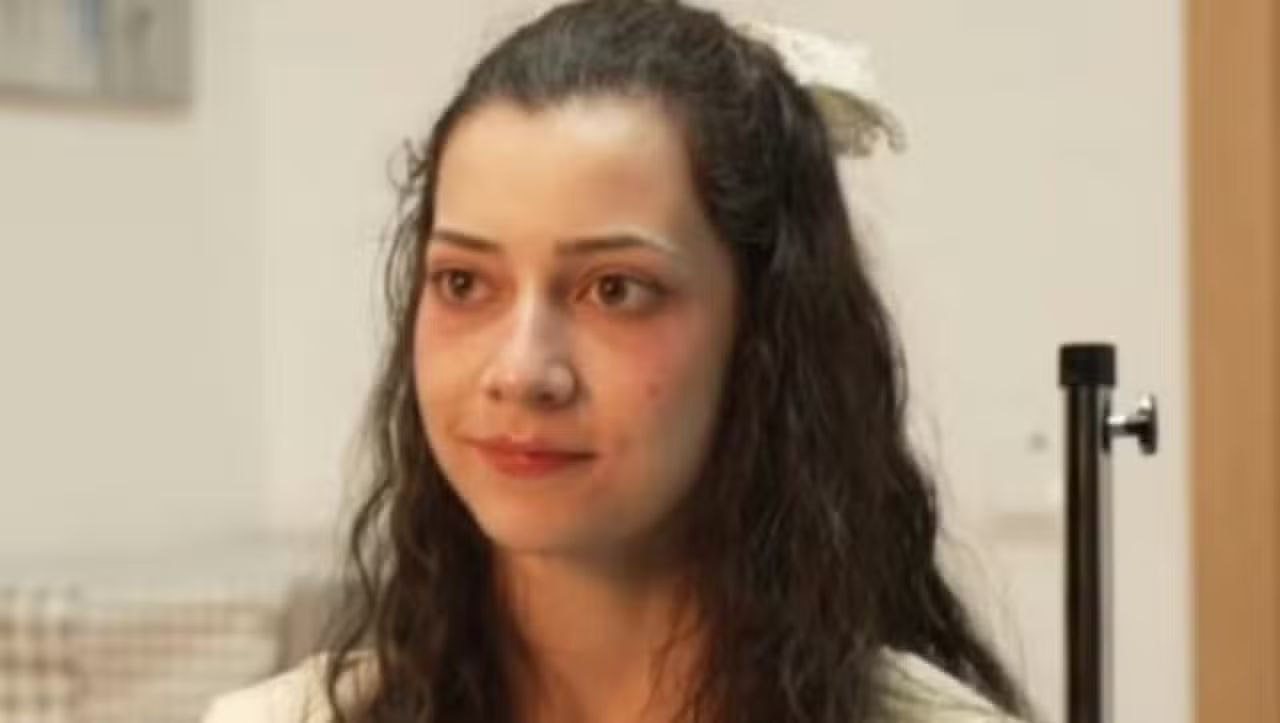
Noelia Castillo, a 25-year-old Spanish woman, ended her life this Thursday, the 26th, after having her request for euthanasia legally authorized. The procedure, carried out at Espanha, culminated a long and painful process that involved intense medical evaluations and legal disputes, lasting more than 600 days.
The young woman had been living with paraplegia and severe chronic pain since 2022, the result of a fall from a great height that drastically changed her life. Sua persistent search for a dignified death, supported by local legislation, was a testimony to his determination in the face of suffering considered irreversible.
An independent commission, made up of experts, was responsible for analyzing the case of Noelia in detail. Após rigorous evaluation, the panel concluded that her clinical situation met all the criteria established by Spanish law for euthanasia, confirming her right to choose.
The judicial path and the final decision
The path to authorizing the euthanasia of Noelia Castillo was marked by a complex judicial maze. Durante approximately 601 days, his case was debated in different instances, demonstrating the seriousness and caution with which Spanish legislation treats the matter. Authorization for the procedure was not immediate, facing resistance from her father, who sought Justiça to block his daughter’s decision.
However, the express will of Noelia, combined with the conclusions of the evaluation committee, prevailed. The final judicial decision reaffirmed the young woman’s right to autonomy over her own body and the choice to end her life under the conditions provided for by law, despite the painful family disagreement that permeated the process.
Understanding euthanasia legislation in Espanha
Espanha became one of the few countries in the world to legalize euthanasia and assisted suicide, with the approval of a law in March 2021. Essa advanced legislation allows people with serious and incurable illnesses that cause unbearable physical or psychological suffering to request assistance to die in a dignified and controlled way. The law is an important milestone in guaranteeing individual autonomy over the end of life.
For a euthanasia request to be approved, the patient must meet a series of strict requirements. Entre them, it is necessary to be of legal age, capable of making decisions and expressing their will repeatedly. Além In addition, the health condition must be characterized by unbearable and persistent suffering, caused by a serious and incurable illness, or by a serious, chronic and disabling situation.
The evaluation process involves the participation of multiple health professionals and guarantee and evaluation committees, who analyze each case individually. Essa multidisciplinary approach aims to ensure that all medical, ethical and legal aspects are considered, protecting both the patient, the professionals involved and society.
Noelia Castillo’s personal battle
Since the incident in 2022 that resulted in his paraplegia, Noelia Castillo has faced a reality of pain and limitation. Sua condition imposed constant and intense physical suffering, accompanied by profound emotional exhaustion. The young woman described her life as an unbearable burden, where chronic pain became an insurmountable barrier to any quality of life.
The fall, which occurred under circumstances that were not detailed, left her dependent and with little prospect of significant improvement. Essa loss of autonomy and the persistence of pain led her to seriously consider the future, culminating in the decision to seek euthanasia as the only way out of her torment.
His determination to go through with the procedure, despite legal and family adversities, reflects the depth of his suffering and the firmness of his conviction. Para Noelia, euthanasia represented not giving up, but the search for a dignified end to an existence marked by physical and mental anguish.



Reflections on autonomy and dignity
The case of Noelia Castillo reignites the debate about patient autonomy and the right to a dignified death. Spanish legislation, by allowing euthanasia, recognizes the individual’s ability to make sovereign decisions about their own life and, consequently, about their own end, especially when faced with conditions of irreversible and unbearable suffering.
Dignity, in this context, is not limited only to the way one lives, but also to the way one chooses to die. Para many advocates of euthanasia, ensuring a patient has control over the time and circumstances of their death, in the face of intractable suffering, is an act of deep compassion and respect for individuality. Society is compelled to consider the meaning of dignity when life becomes an intolerable burden.
The role of the family and legal challenges
Noelia’s decision to resort to euthanasia generated a complex family dynamic, evidenced by her father’s attempt to stop the procedure in Justiça. Essa opposition, often rooted in love, religious or ethical convictions, highlights the conflict between individual autonomy and the expectations and values of loved ones. The legal system then finds itself in the difficult position of arbitrating between fundamental rights and profound moral and emotional differences.
For families, facing a loved one’s desire for an assisted death is a devastating experience, permeated by feelings of anticipated grief, guilt and despair. Psychological support and transparent dialogue are crucial, although not always sufficient, to resolve such impasses. Justiça, in the end, seeks to ensure that the patient’s decision is free, informed and in compliance with legal guidelines, protecting the right to self-determination.
Precedents and public debate
Since the approval of its euthanasia law, Espanha has followed several cases that, like that of Noelia Castillo, fuel public debate. Embora each situation is unique, they contribute to the consolidation of legislation and social understanding on the subject, bringing to light essential discussions about the value of life, the nature of suffering and the limits of medical intervention.
These cases reverberate in different spheres, from medical and legal to ethical and philosophical. Society is constantly called upon to reflect on advances in medicine and bioethics, considering the implications of allowing assistance in dying in specific circumstances.
The euthanasia process: how it works in practice
The euthanasia procedure at Espanha is meticulously regulated to ensure that it is carried out with the utmost ethics and humanity. Após approval of the request, euthanasia is performed by healthcare professionals, usually a doctor or nurse, in an environment that guarantees the patient’s privacy and dignity.
The act itself consists of administering pharmacological substances that cause death quickly and painlessly, ensuring that the patient does not suffer during the process. Toda execution is documented and supervised, reiterating the commitment to the principles of the law and respect for the individual’s will.
Veja Tambem em News (EN)

Research reveals that parents are unaware of how their children use artificial intelligence

Samsung releases new system update with new features for Galaxy Watch 4 users

Digital retail reduces the value of the Galaxy S25 5G smartphone with bank bonuses and device exchange

Amazon’s wireless CarPlay adapter has a 50% discount and high approval ratings from drivers

Zach Cregger’s new Resident Evil ignores games and focuses on an unprecedented story with new characters

Rumor suggests that Nintendo is preparing a special edition of the Switch 2 with a remake of Ocarina of Time

Apple accelerates production of the iPhone 17e and develops new Air model with dual camera system

Epic Games platform releases twelve high-budget games at no permanent cost for PC users

PlayStation 5 Pro price drop accelerates digital retail sales and eliminates global stocks

New Galaxy Watch 9 firmware appears on server and confirms progress in software development

Apple’s commemorative project tests cell phone with 1.1 millimeter edge and curved screen for 2027
