
Scientists confirm expansion of the universe since the Big Bang 13.8 billion years ago with observed data

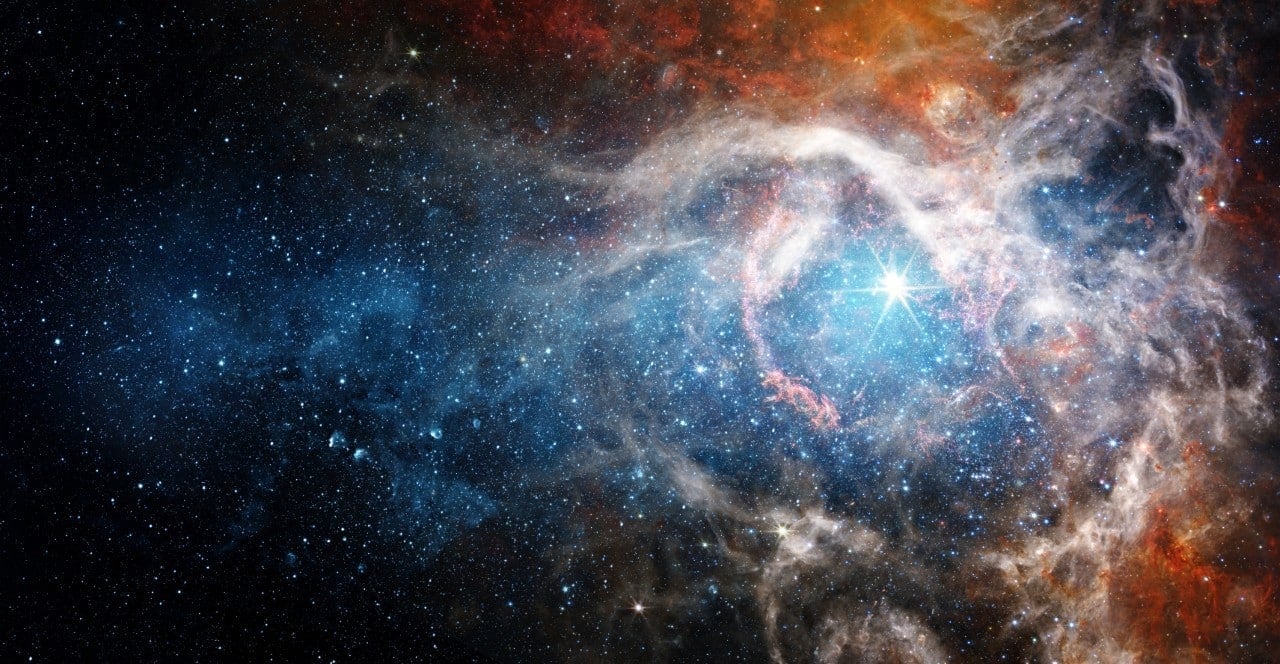
The Big Bang theory describes the universe as starting from an extremely dense and hot state about 13.8 billion years ago. Esse model indicates that space-time began to expand rapidly, giving rise to all the matter and energy observed today. The expansion continues to the present, with galaxies moving away from each other at rates measurable by ground-based and space-based observatories.
Astronomers observe that the speed at which galaxies move away increases with distance, according to the Hubble-Lemaître law. Essa proportional relationship was initially identified in 1929 and received an official name in 2018.
- The cosmic microwave background radiation was detected uniformly in all directions.
- It has an average temperature of around 2.7 Kelvin, compatible with cooling after expansion.
- The initial chemical composition includes high proportions of light hydrogen and helium formed in the first few minutes.
Observational evidence of cosmic expansion
The Hubble-Lemaître law demonstrates that more distant galaxies move away at greater speed. Essa observation contradicts ancient views of an eternal and unchanging universe. Medições modern refined telescopes confirm the large-scale pattern.
The cosmic microwave background represents the thermal remnant of the early universe. Ela was released when the cosmos cooled enough to allow neutral atoms to form, about 380,000 years after the expansion began. Essa signature persists like microwaves after stretching caused by continuous expansion.
Details about the early universe
The initial state of the universe had temperatures above thousands of Kelvin and extreme density. Nessa phase, fundamental particles interacted intensely before progressive cooling. Modelos cosmological descriptions describe the transition to phases where the first light nuclei were formed.
Theoretical calculations predict the observed abundance of light elements in the present-day cosmos. Essa agreement between prediction and measurements reinforces the consistency of the overall picture. Observações of large-scale structures also align with the evolution expected from initial fluctuations.
Space telescopes expand understanding of cosmic evolution
Telescópio Espacial James Webb has recorded bright galaxies at very early times, about 280 million years after Big Bang. Essas discoveries challenge some details of star formation models, but do not invalidate the main framework for the expansion that began 13.8 billion years ago. Dados spectroscopic scans confirm high redshifts consistent with cosmological distances.
Astronomers analyze these galaxies to refine estimates of star and heavy element formation in the young universe. The acceleration of the current expansion, attributed to dark energy, is integrated into the Lambda-CDM model that combines dark matter, dark energy and Big Bang. Medições of the constant of Hubble show convergence between different methods when refined.
Cosmic microwave background as a primordial record
This radiation fills the universe almost uniformly, with small anisotropies that correspond to the seeds of future structures. Satélites and Planck mapped these variations with high precision, allowing rigorous testing of cosmological predictions. The observed blackbody spectrum matches expectations of a universe that cooled after the initial event.
Recent studies explore whether contributions from early galaxies could influence fringe interpretations of the radiation, but the consensus maintains its origin as an echo of the early hot universe. The uniformity and pattern of fluctuations support the scenario of a cosmos that evolved from homogeneous and isotropic conditions.
Challenges and refinements in the cosmological model
Observations of mature galaxies at high redshifts motivate adjustments in galaxy formation parameters in the first few hundred million years. Esses adjustments involve more efficient star formation rates or revised feedback mechanisms. The core of the theory remains supported by multiple independent lines of evidence.
Researchers combine data from supernovae, gravitational lensing and baryonic acoustic oscillations to test global consistency. The Big Bang theory remains the framework that best explains the set of observations available in contemporary observational cosmology.
Abundance of light elements confirms primordial nucleosynthesis
In the first few minutes after Big Bang, conditions allowed the fusion of protons and neutrons into helium, deuterium and lithium nuclei. The predicted proportion of about 25% helium by mass aligns with measurements in poorly evolved regions of the cosmos. Essa agreement represents a successful quantitative prediction of the model.
Other signatures, such as the absence of heavier elements in significant quantities in the primordial material, are also verified. Essas chemical constraints complement the kinematic and thermal evidence for the expansive scenario.
Accelerated expansion integrates current data
The expansion rate of the universe increases over time due to the dominant influence of dark energy. Essa component represents about 68% of the total energy content and affects measurements on cosmological scales. Telescópios as well as Hubble and James Webb contribute to calibrating distances and speeds with greater precision.
Theoretical models incorporate this acceleration without altering the hot, dense beginning described by theory. The combination of independent data reinforces the robustness of the overall picture, even with tensions in specific parameters that motivate further investigation.



