
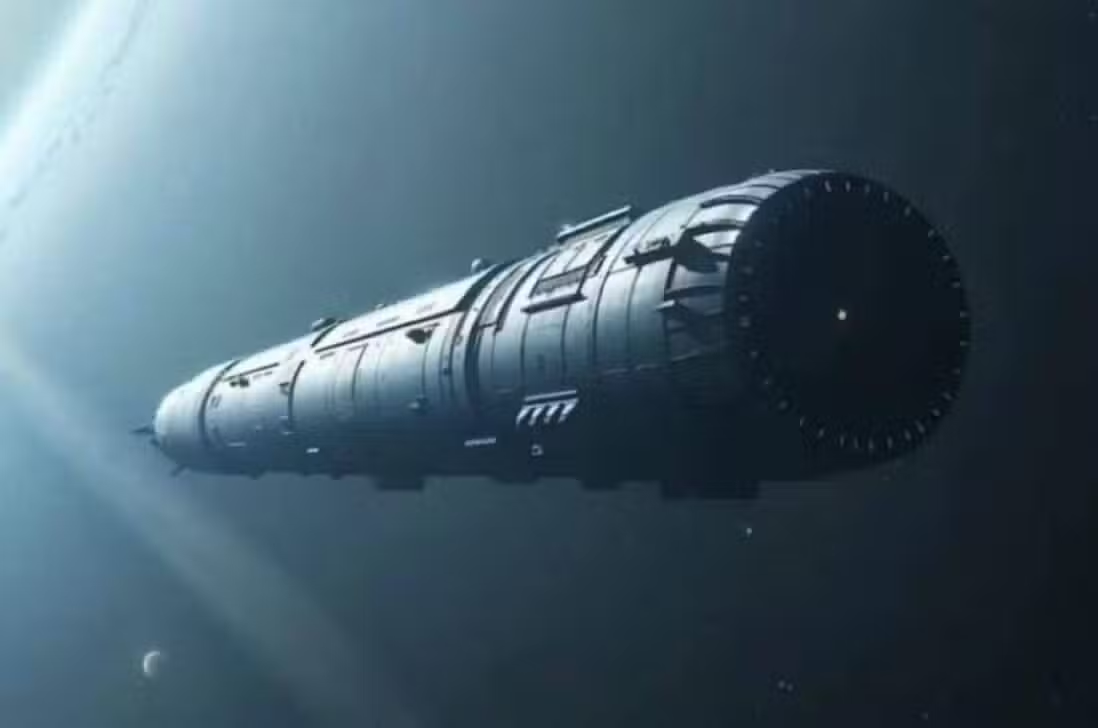
The exploration of deep space gains new contours with the development of architectural proposals focused on long-term intergenerational travel. The project called Chrysalis appears as a complex engineering solution to transport human beings beyond the known borders of Sistema Solar. The technical initiative aims to guarantee the survival and development of a crew during a continuous journey estimated at four hundred uninterrupted years through the cosmos.
The main structure consists of a colossal vessel measuring 58 kilometers in length, specifically designed to house up to 2,400 people simultaneously. The concept integrates advanced foundations of theoretical physics with very long-term urban planning strategies, creating a livable environment in a vacuum. Pesquisadores e engenheiros de diversas nacionalidades trabalham na formulação de um ecossistema totalmente autossustentável, capaz de suportar as condições extremas encontradas fora da órbita terrestre.
The model achieved global recognition by winning Project Hyperion, a scientific competition promoted by the organization Initiative for Interstellar Studies. The contest requires rigorous mathematical, structural and logistical responses to the biological obstacles inherent to interstellar crossings. The winning proposal establishes unprecedented technical guidelines and a practical development roadmap for the future of the global aerospace industry.
Operational details and architecture of the giant cylinder
The shape of the ship resembles an elongated cylinder, constructed from multiple concentric layers that operate independently and interconnected. The engineering team opted for this specific geometry to mitigate the severe structural stresses the hull will face over centuries of displacement. Durante the extensive phases of initial acceleration and final deceleration, the uniform distribution of physical stress becomes a determining factor in preserving the integrity of the vessel and the safety of all occupants on board.
Each internal ring of the structure performs an isolated function, separating the residential modules from the areas dedicated to heavy machinery and external protection shields. The modular architecture allows entire sections of the ship to be locked down, repaired, or even replaced without interfering with the vital operations of the rest of the complex. Para To prevent the crew’s bone and muscle deterioration, the housing modules maintain a constant rotation around the central axis, generating a continuous centrifugal force that simulates around ten percent of the Terra’s gravity, enough to carry out daily activities.
Internal division and vital support for crew
The organization of the internal space follows strict resource optimization criteria to ensure long-term maintenance of life. The ship’s zoning divides human, biological and industrial activities into highly specialized and monitored sectors.
– Residential sectors have autonomous climate control systems and artificial lighting programmed to respect the natural circadian cycles of the human body.
– Agricultural zones use high-density hydroponic cultivation techniques, responsible for both the production of fresh food and the continuous biological generation of oxygen for ventilation ducts.
– The industrial hubs operate with a focus on the full recycling of all waste generated and the automated manufacturing of replacement components essential for fleet maintenance.
Population dynamics during the secular crossing
Maintaining a metropolis isolated in space requires strict demographic control to avoid the rapid depletion of life support resources. The maximum population allowed on board is set at 2,400 inhabitants, a number mathematically calculated to maintain the ship’s ecological, social and productive balance during four centuries of uninterrupted travel.
Extensive green areas were incorporated into the interior design to simulate varied terrestrial biomes, including dense forests and artificial lakes that aid in natural air filtration. Além From a strictly biological function, these natural spaces play a fundamental role in preserving the mental health and psychological stability of successive generations that will be born and live exclusively inside the metallic cylinder.
Final fate and adaptation on the exoplanet’s surface
The central objective of the mission is to reach Proxima Centauri b, an exoplanet with a rocky composition located approximately 4.24 light-years away from Terra. Este celestial body is in the habitable zone of its host star, the red dwarf Proxima Centauri, indicating the strong astrophysical possibility of the existence of liquid water on its surface. The similarity of the planet’s mass to that of Terra facilitates the biomechanical readaptation of the colonizers, who will spend centuries subjected to reduced artificial gravity in space. Observações Recent astronomical studies indicate that the exoplanet completes its orbit in just 11 Earth days and suffers from frequent and intense stellar eruptions. Essa hostile weather condition will require the crew to construct underground shelters immediately after the landing crafts land. The transition from the millimeter-controlled environment of the generational ship to the wild and unpredictable surface of the new world represents the most critical stage of the entire journey, requiring extreme safety protocols to avoid lethal exposure to external radiation and ensure the safe establishment of the first human base.
Energy matrix and protection against cosmic radiation
Moving a physical structure of colossal proportions through interstellar space requires a revolutionary and highly stable propulsion system. The technical project foresees the use of advanced reactors based on direct nuclear fusion, powered by an efficient combination of deuterium and helium-3 isotopes.
This energy matrix provides the thrust necessary for gradual acceleration during the first years of the mission, until the spacecraft reaches ideal cruising speed. Power supply needs to be absolute and redundant, as both prime movers and complex life support systems depend entirely on this continuous generation of motive power.
The outer armor acts as a thick, regenerative shield against the numerous threats of the space vacuum. The physical barriers are designed to absorb kinetic impacts from micrometeoroids and block the lethal cosmic background radiation, ensuring the integrity of the crew’s DNA along the entire trajectory.
Orbital Construction and Space Manufacturing Logistics
The total mass of the vessel is estimated at 2.4 billion metric tons, which makes its construction on the surface of Terra absolutely impossible due to severe gravitational and aerodynamic restrictions. The assembly of the complex should take place in vast orbital shipyards, possibly located in the orbit of Lua, using raw materials extracted and processed by fleets of autonomous drones directly from asteroids or lunar soil.
Independent manufacturing capability is one of the central pillars for mission success and longevity. Impressoras Industrial-scale 3D and automated forges will allow crews to manufacture complex parts and perform heavy maintenance without relying on a finite initial inventory, ensuring the structure’s material self-sufficiency.
Psychological preparation and testing in extreme environments
Before the mission’s definitive launch, safety protocols require decades of rigorous testing with the first crew candidates and their immediate descendants. Simulações of prolonged isolation in bases built in Antártida and in inhospitable deserts will assess the group’s mental resilience and the effectiveness of life support equipment under conditions of confinement and real stress.
Technical feasibility and advances in aerospace science
The Chrysalis project proposal stands out in the scientific scenario for uniting astrophysics, architecture of confined environments and social sciences in a systemic, mathematical and viable model. The structure not only functions as a point-to-point transportation vehicle, but as a living ecosystem capable of anticipating mechanical failures and managing social crises over four hundred years. Redes of cutting-edge artificial intelligence will act as guardians of accumulated human knowledge and impartial advisors in resolving internal conflicts.
The realization of an intergenerational mission of this magnitude still depends on significant technological leaps in areas such as controlled nuclear fusion and large-scale space mining. However, detailed and informed planning provides a solid technical foundation for the next generations of engineers and scientists to continue expanding human presence permanently beyond Sistema Solar, ensuring continued space exploration.