
Asian documents reveal that new Galaxy Z Fold 8 smartphones adopt 45W fast charging
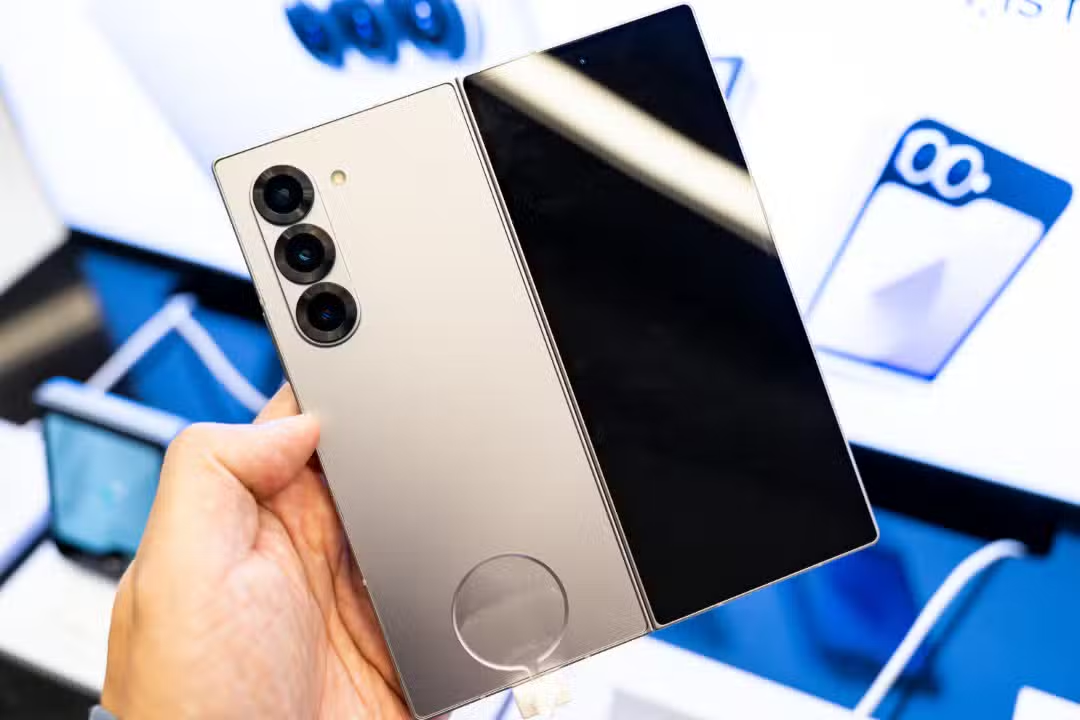
South Korean manufacturer Samsung has defined a substantial hardware upgrade for its next generation of smartphones with flexible screens. Documentos from Asian regulatory agencies attest that the brand’s future mobile devices will receive a significant increase in energy transfer speed. The devices will definitely abandon the 25W limit established in previous generations to adopt the faster 45W standard.
The change in recharge capacity meets a long-standing technical demand in the high-end electronics market. Consumers in this segment demand shorter plug times for devices that have large batteries and large screens. Implementing this technology required a complete rearrangement of the phones’ internal components to accommodate the new voltage controllers.

The main objective of this physical restructuring is to ensure adequate thermal dissipation during the rapid power supply process of the power cells. The approval process at China, conducted by the 3C certification authority, generally precedes the global announcement of products by a few months. The presence of devices in these government databases indicates that the electrical safety engineering and testing phase has already been fully completed.
International certification details
The state certifier’s database lists two specific model numbers, technically identified as SM-F9710 and SM-F9760. Essas registration numbers correspond directly to the new members of the brand’s premium foldable family that will hit shelves in the coming months. The technical documentation explicitly details support for 15V and 3A electrical combinations in rigorous laboratory testing.
This exact mathematical configuration results in a theoretical maximum power of 45W for wired charging of devices during peak transfer. Preliminary data extracted from security certifications points to specific engineering guidelines in the new mobile product line. Há confirmation of the immediate adoption of the 45W protocol for models with horizontal opening, aimed at corporate productivity.
The documentation also confirms the maintenance of the speed restricted to 25W for the compact version with vertical opening, known for its clamshell format. The aluminum chassis of the larger models required extensive restructuring to accommodate the new voltage controllers with complete safety against short circuits. Essa technical differentiation establishes a clear line of segmentation between the manufacturer’s own user profiles.
Electrical supply history
The transition to the new voltage marks the first major evolution in wired charging speed for this specific family of products in a long period of operation in the technology market. Desde the first models of the foldable series, the manufacturer strictly maintained the 25W ceiling, prioritizing the longevity of the battery cells and thermal stability to the detriment of pure charge replenishment speed. Testes independent tests carried out with the immediately previous generation demonstrated that a complete charge cycle required approximately 85 to 90 minutes at the socket.
The adoption of the new electrical standard has the practical objective of reducing this interval considerably, delivering a much higher battery percentage in the first thirty minutes of direct power connection. Essa certification standardizes the supply protocol across the Asian manufacturer’s ultra-premium segment, creating uniformity in its ecosystem. Anteriormente, only traditional devices from the brand’s most expensive series had access to this rapid replacement technology.
Modifications to the physical structure
The updated portfolio introduces unprecedented diversification into the book format, offering consumers two distinct physical profiles for the same fundamental device concept. The standard version maintains the design language already established in previous generations, focusing on extreme portability when the device is completely closed in the user’s pocket. Essa visual maintenance aims to serve customers who are already accustomed to the line’s classic ergonomics.
The new variant, however, features a noticeably wider screen aspect ratio, changing the ergonomics of both the external display and the internal high-resolution flexible panel. The wider chassis of the alternative model offers a crucial mechanical advantage in distributing the internal volume of parts essential for operation. Essa geometric change directly affects the way engineers position printed circuit boards.



A larger surface area allows for a completely different arrangement of the main logic board and dual batteries that power the operating system and applications. Isso facilitates passive cooling of components during high-power charging sessions, ensuring both book format variants share the same 45W capacity. The extra space acts as a natural heat sink generated by direct electrical current.
The materials engineering applied to the construction of the central hinge also underwent changes so as not to interfere with the flat cables that connect the two halves of the smartphone. Thermal insulation was reinforced in the areas most in contact with the user’s hands, avoiding tactile discomfort during intense use with the device connected to the socket. Todas these structural adaptations were validated by regulatory bodies before issuing the certificate of conformity.
Mobile Processing Requirements
The integration of a faster electrical system is part of a comprehensive package of updates designed to support the new generation of high-performance mobile processors that will power the devices. The equipment will use the advanced Snapdragon 8 Elite architecture, a microchip that requires extremely efficient power supply systems to maintain maximum performance in complex artificial intelligence and graphics processing tasks. The combination of a very high-performance processor with two high refresh rate screens generates substantial energy consumption in continuous daily use, requiring batteries capable of delivering and receiving charges in an optimized manner. On-chip intelligent power management works in conjunction with motherboard voltage controllers to prevent performance bottlenecks when the battery reaches critical levels. Essa synergy between processing hardware and power system is essential for the stability of the operating system in scenarios of extreme computational stress.
Devices aimed at extreme productivity and multitasking require the business user to be able to recover the charge quickly between business meetings or intense urban commutes, justifying the investment in the new 45W recharge technology. The ability to obtain a functional and long-lasting charge in short periods of time radically transforms the daily usability of the equipment, eliminating the cumbersome need to carry bulky external batteries on work trips. Continuous support for magnetic induction wireless charging has also been maintained by the brand’s engineering team, offering multiple versatile power supply options for different usage scenarios in modern offices, connected homes or vehicles retrofitted with in-dash charging docks. The flexibility of charging options consolidates the product’s positioning as a versatile work tool independent of long breaks connected to wires.
International market dynamics
The global high-cost smartphone sector has seen increasingly fierce competition over battery technologies, with several rival Asian manufacturers easily surpassing the 100W mark in their flagship devices aimed at mobile technology and gaming enthusiasts. Embora the South Korean giant adopts a historically more conservative stance in the development of power cells following widely publicized industrial incidents in the past, the definitive jump to 45W represents a strategic and calculated move to maintain commercial competitiveness without compromising the rigorous safety protocols established internationally by aviation and telecommunications agencies. The structural change aligns the new foldable phones with the minimum expectations set by other premium devices available on the global market, targeting the hardware upgrade primarily at corporate audiences and intensive users who cannot tolerate prolonged outages. Esses specific consumers use large screen devices as primary work tools, editing complex documents, financial spreadsheets and constant high-definition video communication. Adapting to modern fast charging standards prevents the brand from losing market share to direct competitors who use charging speed as the main selling point in aggressive advertising campaigns. The company’s strategy focuses on delivering a balanced experience, where the speed of energy replenishment does not compromise the long-term useful life of the equipment, ensuring that the consumer’s high financial investment is protected by safe charging cycles and monitored by artificial intelligence.
Thermal protection mechanisms
Managing the thermal output of a state-of-the-art processor operating simultaneously with a 45W power supply system within an articulated chassis requires engineering solutions of the highest complexity and millimeter precision. The manufacturer implemented size-enhanced vapor chambers and machine learning-based software algorithms to dynamically and intelligently regulate energy flow. Sensores of temperature distributed throughout the device’s housing sends data in real time to the central processor.
The operating system is programmed at root to allow maximum load only when the device’s main screen is off or when using extremely light applications in the background. The input voltage is automatically reduced if the user starts graphics-heavy games or recording high-resolution videos while the phone is plugged in. Essa preventive limiting prevents accelerated degradation of lithium ions and protects delicate internal components against prolonged thermal stress.
Final development steps
The public and official unveiling of the new communications equipment is scheduled for the major technology event that the company traditionally holds in the middle of the calendar year. Até the exact moment of the announcement to the specialized press, the software development teams continue to refine the source code responsible for battery management. The objective of this final phase of practical testing is to ensure that the transition to the new 45W voltage occurs in a perfectly stable, efficient and safe way for all future owners of the coveted line of premium foldables.
Veja Tambem em News (EN)

Research reveals that parents are unaware of how their children use artificial intelligence

Samsung releases new system update with new features for Galaxy Watch 4 users

Digital retail reduces the value of the Galaxy S25 5G smartphone with bank bonuses and device exchange

Amazon’s wireless CarPlay adapter has a 50% discount and high approval ratings from drivers

Zach Cregger’s new Resident Evil ignores games and focuses on an unprecedented story with new characters

Rumor suggests that Nintendo is preparing a special edition of the Switch 2 with a remake of Ocarina of Time

Apple accelerates production of the iPhone 17e and develops new Air model with dual camera system

Epic Games platform releases twelve high-budget games at no permanent cost for PC users

PlayStation 5 Pro price drop accelerates digital retail sales and eliminates global stocks

New Galaxy Watch 9 firmware appears on server and confirms progress in software development

Apple’s commemorative project tests cell phone with 1.1 millimeter edge and curved screen for 2027
