
Cornell University astronomers identify 45 rocky planets with the potential to harbor life
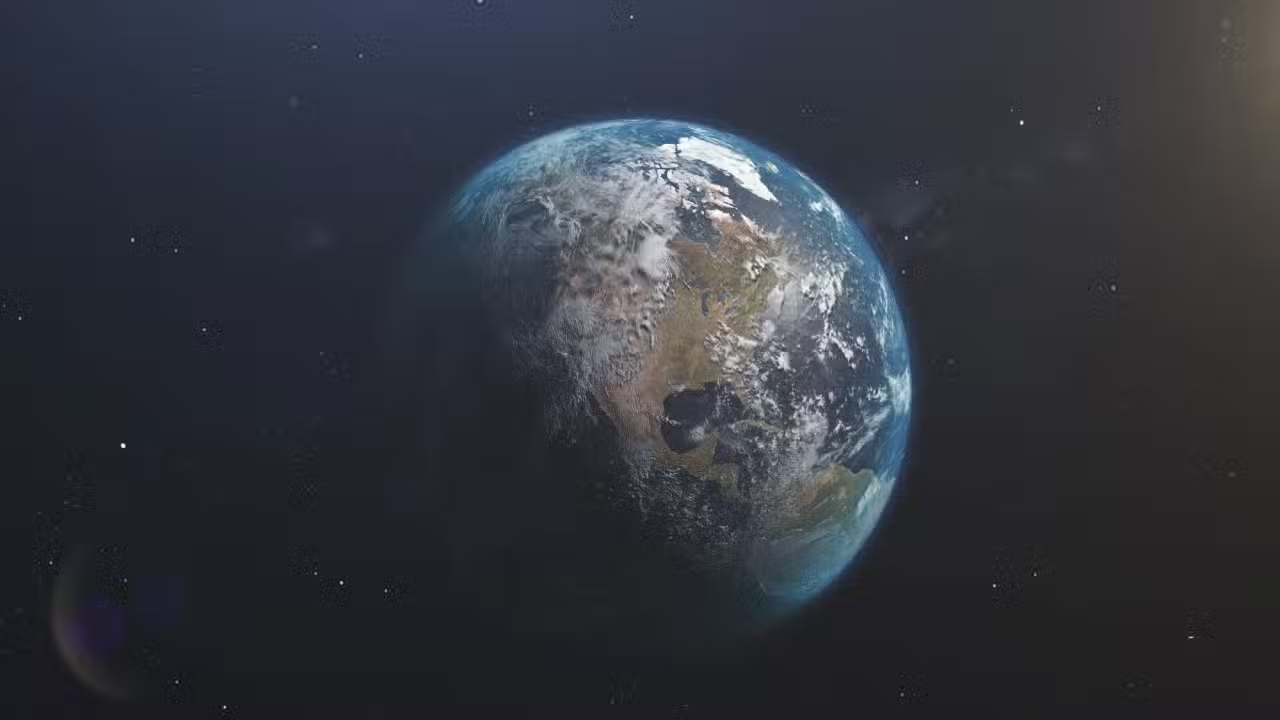
Recent research carried out by experts from Carl Sagan Institute, linked to Cornell University, in Estados Unidos, identified a select group of 45 rocky exoplanets with high potential for habitability. The scientific survey used rigorous criteria based on the configuration of our own Sistema Solar to filter which distant worlds have the characteristics closest to those found in Terra. Publicado originally in the magazine Monthly Notices of the Royal Astronomical Society, the study focuses on celestial bodies located in habitable zones, where the distance from the mother star allows for mild temperatures.
Researchers Abigail Bohl and Gillis Lowry conducted the analysis focusing on the presence of liquid water, an element considered fundamental for the emergence and maintenance of known biological systems. Atualmente, the international astronomical community has already cataloged more than six thousand exoplanets, but only a small fraction of this total has geological and atmospheric conditions compatible with life. The new list serves as a strategic guide to optimize observation time for large space telescopes, directing humanity’s focus to the most promising targets in the cosmos.
- Proxima Centauri b:
- TRAPPIST-1 System: Quatro rocky planets (d, e, f and g) orbiting a red dwarf star 40 light years away were included in the priority selection.
- Temperate zone exoplanets: The catalog includes worlds that receive intermediate levels of stellar radiation, situated between the parameters observed in Vênus and Marte.
- Rockyity criterion: Apenas planets with density confirmed as solid were included in the group of 45 selected by the Cornell team.
Methodology based on the thermal limits of the solar system
The strategy adopted by Cornell astronomers uses Terra as the gold standard of habitability to make direct comparisons with distant solar systems. Researcher Abigail Bohl explained that the mathematical model considers the limits of energy received by Vênus, which is excessively hot, and Marte, which is excessively cold for surface liquid water. By mapping exoplanets that lie exactly in this thermal range, scientists are able to rule out gas giants or barren rocks that would be unlikely to support complex biocycles.
The study also delves into the analysis of elliptical orbits, which can pose a significant challenge to a planet’s climate stability throughout the sidereal year. Excessively elongated Trajetórias causes extreme thermal variations, alternating between periods of intense heat and global freezing, which can make continuous biological evolution unfeasible. Through this screening, the list of 45 worlds was refined to include only those with more stable and circular orbits, increasing the chances of a predictable and hospitable climate.
Support for future high-tech space missions
The systematization of this data is considered a fundamental step towards planning the next decades of space exploration through orbital observatories. The detailed mapping will serve as a navigational chart for the operations of the James Webb telescope and the future Nancy Grace Roman Space Telescope, scheduled for launch in 2027. With pre-defined targets, space agencies can focus high-resolution spectroscopy on searching for biosignatures such as oxygen, methane and carbon dioxide in the atmospheres of these worlds.
The transition from simple detection to deep chemical analysis requires astronomers to know exactly where to point their most sensitive sensors. Gillis Lowry highlighted that the objective is to transform the search for life into a high-precision science, reducing the margin of error in missions that cost billions of dollars. The identification of these 45 rocky planets allows the international scientific community to establish a continuous observation protocol, monitoring variations in brightness and planetary transits with greater technical rigor.
Selection criteria for habitable exoplanets
Classifying a planet as potentially habitable depends on a series of geophysical variables that go beyond simple orbital distance. Além the temperature, the planet’s mass plays a crucial role in retaining a protective atmosphere against solar winds and harmful cosmic radiation. The 45 celestial bodies listed have dimensions that suggest the ability to maintain a magnetic field or a gaseous layer dense enough to protect possible life forms.
Scientists also evaluated the chemical composition of the host stars, since radiation emitted by red dwarfs or stars similar to Sol directly impacts atmospheric chemistry. Very unstable Estrelas, known for emitting frequent solar flares, can sterilize planetary surfaces even if they are in the theoretical habitable zone. The filter applied by Cornell University sought to balance all these factors to ensure that the final list represented the most promising in the galactic neighborhood.




Advances in astrophysics and detection of rocky worlds
The evolution of detection techniques, such as the transit method and radial velocity, has allowed researchers to refine the search for smaller, denser planets. At the beginning of exoplanet exploration, most finds consisted of gas giants, nicknamed “hot Jupiters” due to their ease of detection due to their large mass. With technological improvements, it became possible to identify planets with sizes similar to that of Terra, which paved the way for the current study focused exclusively on rocky surfaces.
This technological progress is what makes it possible to differentiate between a gaseous planet without a defined solid surface and a world where life could walk or swim. Cornell’s research reinforces the idea that the universe may be full of supportive environments, but qualitative screening is necessary to separate noise from actual signs of habitability. The focus on rocky planets is the absolute priority, as it is in this type of environment that the chemical interaction between soil, water and atmosphere reaches the balance necessary for biogenesis.
Technological barriers and the future of astronomy
While identifying these worlds is a scientific milestone, physical distance remains the biggest obstacle to direct exploration by space probes. Mesmo Proxima Centauri b, the nearest neighbor, would require thousands of years of travel with the chemical propulsion technology currently available in conventional rockets. Because of this, the current focus of astronomy remains on remote observation and spectral analysis, which allow us to “see” the composition of a world without the need to physically visit it.
The list of 45 planets sets a new benchmark for contemporary astrophysics by creating a regulatory framework for future academic and government investigations. By defining more rigorous screening criteria, the Cornell team helps avoid sensationalism and focuses limited science resources on targets with real potential for informative returns. The next step in the human journey to the stars depends entirely on our ability to interpret the light data that crosses the void of space.
Constant monitoring of neighboring star systems
The work of astronomers does not end with the publication of the list, requiring a continuous effort of surveillance and collection of new radiometric data. Sistemas like TRAPPIST-1 are monitored almost daily by networks of ground-based and space-based telescopes to identify any anomalies that confirm the presence of oceans or geological activity. The dynamic nature of the universe means that new data can raise or lower a planet on the habitability scale at any time as new measurements are taken.
This constant vigilance is essential to understanding how planetary systems evolve over billions of years and whether life is a common or rare phenomenon. The diversity of planets found suggests that nature has multiple ways of organizing solar systems, not all of them following the exact model of ours. However, by using Terra as an initial guide, science guarantees a solid starting point to explore the unknown with the security of parameters tested and approved by humanity’s very existence.
Veja Tambem em News (EN)

Research reveals that parents are unaware of how their children use artificial intelligence

Samsung releases new system update with new features for Galaxy Watch 4 users

Digital retail reduces the value of the Galaxy S25 5G smartphone with bank bonuses and device exchange

Amazon’s wireless CarPlay adapter has a 50% discount and high approval ratings from drivers

Zach Cregger’s new Resident Evil ignores games and focuses on an unprecedented story with new characters

Rumor suggests that Nintendo is preparing a special edition of the Switch 2 with a remake of Ocarina of Time

Apple accelerates production of the iPhone 17e and develops new Air model with dual camera system

Epic Games platform releases twelve high-budget games at no permanent cost for PC users

PlayStation 5 Pro price drop accelerates digital retail sales and eliminates global stocks

New Galaxy Watch 9 firmware appears on server and confirms progress in software development

Apple’s commemorative project tests cell phone with 1.1 millimeter edge and curved screen for 2027
