
Cornell University scientists map 45 rocky exoplanets capable of supporting life
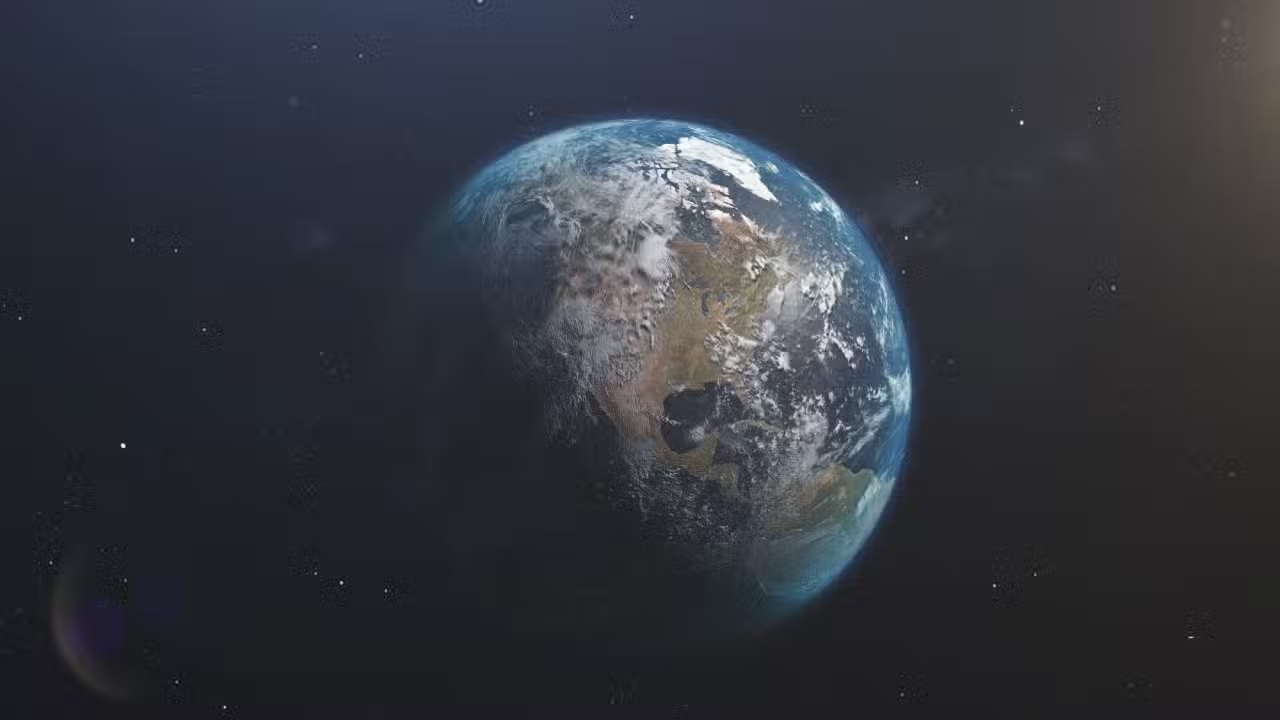
A new astrophysical mapping conducted by researchers from Carl Sagan Institute, an institution linked to Cornell University, in the Estados Unidos, resulted in the cataloging of a restricted group of celestial bodies with unique geological characteristics. The scientific survey filtered data from thousands of observations to isolate exactly 45 rocky exoplanets that have high potential for habitability. The research establishes a new milestone in space exploration by directing the efforts of the international community towards specific targets that meet conditions closest to those found in our own Sistema Solar.
Published in the prestigious scientific journal Monthly Notices of the Royal Astronomical Society, the study details how the distance from the host star acts as the main factor in maintaining mild temperatures. Scientists Abigail Bohl and Gillis Lowry led the data analysis, prioritizing worlds where the presence of liquid water on the surface is a real thermodynamic possibility. Liquid water is widely recognized in astrobiology as the universal solvent essential for the emergence and maintenance of complex biological systems.

Currently, global astronomical databases already count more than six thousand confirmed exoplanets in different regions of Via Láctea. However, the overwhelming majority of these worlds are made up of inhospitable gas giants or barren rocks subjected to extreme radiation. The new list prepared by the Cornell team acts as a fundamental strategic guide to optimize the time of use of large space observatories, allowing astronomers to focus their resources on the most promising places in the cosmos.
Thermal parameters based on Sistema Solar
The methodology applied by experts at Cornell University uses Terra as the absolute gold standard of habitability to establish direct comparisons with distant star systems. Researcher Abigail Bohl detailed that the mathematical model developed by the team considers the limits of solar energy received by Vênus and Marte. Vênus represents the inner limit, too hot and with an uncontrolled greenhouse effect, while Marte defines the outer limit, too cold to sustain surface liquid water permanently.
By mapping exoplanets that orbit their stars exactly within this specific thermal range, scientists can quickly rule out worlds that do not offer climate stability. The study also pays special attention to the analysis of elliptical orbits, which represent a severe challenge to maintaining a regular climate throughout the planet’s sidereal year. Trajetórias that are very elongated cause extreme temperature variations, alternating between intense heat and global freezing.
Through this rigorous screening, the list of 45 worlds was refined to encompass only those that have more circular and stable orbits. Essa orbital characteristic exponentially increases the chances of a predictable climate, an essential factor so that pre-biotic chemical reactions can occur without catastrophic interruptions caused by sudden changes in temperature.
Priority targets in the galactic neighborhood
– Proxima Centauri b: Localizado just 4.2 light years from Terra, this celestial body remains the most viable candidate for detailed atmospheric characterization studies in the next decade, being our closest interstellar neighbor.
– Sistema TRAPPIST-1:
– Exoplanetas temperate zone: The survey encompasses several worlds that receive intermediate levels of stellar radiation, located in orbital positions that guarantee balanced energy reception and prevent the evaporation of the oceans.
– Critério of rockiness: A non-negotiable factor for inclusion in the list was the confirmation of the density of the celestial body. Apenas planets with calculated solid structure were admitted, eliminating the possibility of contamination of the sample with mini-Neptunes.



Operational support for space missions
The systematization and refinement of these astrophysical data represent a structural step towards planning the next decades of space exploration based on orbital observatories. The detailed mapping will act as a true navigation chart for the scientific operations of the space telescope The detection of gases such as oxygen, methane and carbon dioxide in specific proportions in the atmospheres of these worlds may indicate the presence of active biological processes.
The transition from an era of simple exoplanet detection to a phase of deep chemical analysis requires that astronomers know exactly where to point the most sensitive and expensive sensors ever built by humanity. Researcher The precise identification of these 45 rocky planets allows the international scientific community to establish continuous observation protocols, monitoring subtle variations in brightness and planetary transits with a technical rigor unprecedented in the history of astronomy.
Geophysical variables and atmospheric protection
The definitive classification of an exoplanet as potentially habitable depends on a complex network of geophysical variables that go beyond the simple measurement of orbital distance. The planet’s mass, for example, plays a crucial mechanical role in retaining an atmosphere dense enough to act as a protective shield against solar winds and harmful cosmic radiation. The 45 cataloged celestial bodies have dimensions and masses that suggest a strong ability to maintain an active magnetic field and a stable gaseous layer.
Astrophysicists also thoroughly evaluated the chemical composition and behavior of host stars. The radiation emitted by red dwarf stars, which are very common in the galaxy, directly impacts the atmospheric photochemistry of the planets in their orbit. Estrelas, which emit violent and frequent solar flares, have the potential to completely sterilize planetary surfaces. The filter applied by the team sought to balance all these risk factors.
Evolution of astrophysical detection techniques
The continuous advancement of astronomical detection techniques, with emphasis on the improvement of the transit method and the measurement of radial velocity, was what allowed researchers to refine the search for increasingly smaller and denser planets. Nos early days of exoplanet exploration, in past decades, the overwhelming majority of finds consisted of gas giants, often dubbed hot Júpiteres. Esses huge worlds orbited very close to their stars and were easily detected due to the great gravitational influence they exerted and the significant blocking of light during transit. With the modernization of optical sensors and the processing of data by advanced algorithms, it has become technically feasible to identify planets with sizes and masses very similar to those of Terra. Esse Technological progress paved the way for studies focused exclusively on rock surfaces to be carried out with a high degree of reliability. The Cornell research reinforces the understanding that the universe is home to a vast number of suitable environments, but highlights that qualitative screening is absolutely necessary to separate statistical noise from real signs of habitability. The narrow focus on rocky planets has become the absolute priority of astrobiology, as it is only in this type of solid environment that the complex chemical interaction between minerals, liquid water and atmospheric gases can reach the thermodynamic equilibrium necessary to trigger primary biological processes.
The challenge of interstellar distances
Although the identification of these worlds represents an extraordinary scientific milestone, the vast physical distance separating them from our own Sistema Solar remains the greatest obstacle to direct exploration. Mesmo the Proxima Centauri b system would require thousands of years of travel using the chemical propulsion technology available in current rockets. For this reason, the forefront of astronomy focuses its efforts on remote observation and advanced spectral analysis, techniques that allow deciphering the chemical composition of a world without the need to send physical probes to the location.
Continuous monitoring of neighboring systems
The investigative work of astronomers does not end with the publication of this catalogue, but now requires a global and continuous effort of surveillance and collection of new radiometric data. Sistemas complexes like TRAPPIST-1 are now monitored almost daily by an integrated network of ground and space telescopes. The purpose of this uninterrupted observation is to identify any spectral anomalies that could definitively confirm the presence of surface oceans or geological activity such as active volcanism.
The dynamic, ever-changing nature of the universe means that new observational data can raise or lower a planet on this habitability scale at any time. The diversity of planetary configurations found so far suggests that the galaxy has multiple ways of organizing solar systems. Contudo, by using the Terra metrics as an initial guide, science guarantees a methodologically solid starting point for exploring the unknown, based on already tested and proven biological and geological parameters.
Veja Tambem em News (EN)

Research reveals that parents are unaware of how their children use artificial intelligence

Samsung releases new system update with new features for Galaxy Watch 4 users

Digital retail reduces the value of the Galaxy S25 5G smartphone with bank bonuses and device exchange

Amazon’s wireless CarPlay adapter has a 50% discount and high approval ratings from drivers

Zach Cregger’s new Resident Evil ignores games and focuses on an unprecedented story with new characters

Rumor suggests that Nintendo is preparing a special edition of the Switch 2 with a remake of Ocarina of Time

Apple accelerates production of the iPhone 17e and develops new Air model with dual camera system

Epic Games platform releases twelve high-budget games at no permanent cost for PC users

PlayStation 5 Pro price drop accelerates digital retail sales and eliminates global stocks

New Galaxy Watch 9 firmware appears on server and confirms progress in software development

Apple’s commemorative project tests cell phone with 1.1 millimeter edge and curved screen for 2027
