Developer details Forza Horizon 6 system requirements on PC and confirms map in Japan
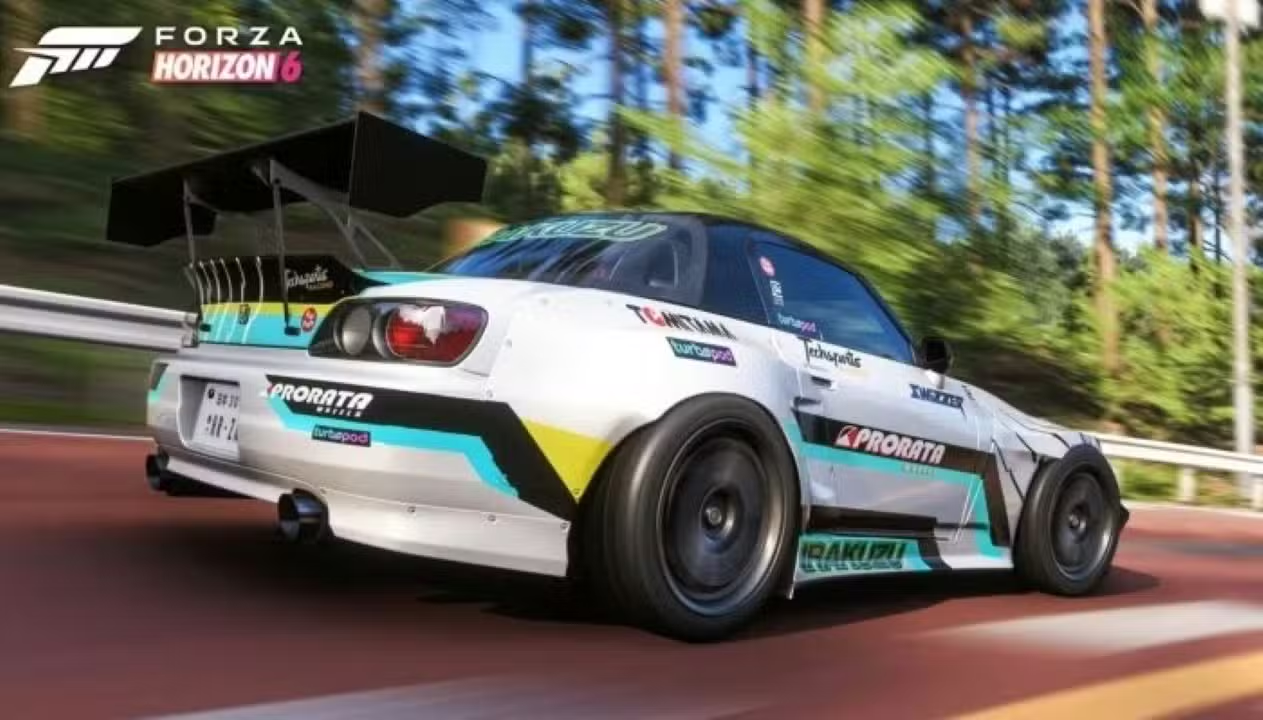
Playground Games has made official the hardware configurations needed to run the new chapter of its main open-world racing franchise on computers. The title, which transports the traditional automobile festival to the landscapes of Japão, is scheduled for release on May 19, 2026 in the Xbox Series X|S and PC ecosystems, through Microsoft Store and Steam. The developer also confirmed that a version intended for the PlayStation 5 is in development, expected to hit the market in the months following the original launch, marking a significant expansion in the multiplatform distribution strategy of the automobile franchise.
The game’s initial collection will feature more than five hundred and fifty real detailed and licensed vehicles. Virtual racers will have the freedom to explore the vast Asian map at their own pace, taking part in a wide variety of events, closed circuits and clandestine street races.
The project’s technical infrastructure was designed to natively support monitors with ultrawide aspect ratios and fully unlocked frame refresh rates. The graphics engine has received major updates to the global illumination system and physically calculated reflections to increase immersion.
Initial specifications guarantee access on modest machines
The entry level was structured to deliver a fluid experience at 1080p resolution, maintaining the rate of sixty frames per second with graphics adjustments at a low level. Essa optimization allows computers built a few years ago to remain relevant for running software.
To achieve this performance metric, the system requires processors such as the Intel Core i5-8400 or the AMD
The RAM memory requirement was set at sixteen gigabytes, a standard that has become established in the contemporary gaming industry to avoid crashes. Storage must be on a solid state drive, eliminating official support for old mechanical hard drives.
This hardware base also makes it possible to run the title on modern portable gaming devices. Aparelhos like the Steam Deck and ROG Ally have been tested and approved to run the Japanese map with acceptable thermal and visual stability.
Essential components for assembling the system
To facilitate technical understanding by consumers, the developer structured an objective list with the minimum components required for the graphics engine to start rendering the open world. The list of parts demonstrates the optimization effort of the software engineering team.
- Processor Intel Core i5-8400 or AMD Ryzen 5 1600
- NVIDIA GeForce GTX 1650, AMD Radeon RX 6500 XT or Intel Arc A380 graphics card
- 16GB RAM
- SSD Storage
- Windows 10 or 11
The presence of a properly updated Windows 10 or 11 operating system is essential for supporting the latest graphics libraries. Using outdated system versions may prevent image reconstruction and memory management technologies from running correctly.
Mid-range performance focuses on improved resolution
The configuration recommended by the development team raises the visual quality to 1440p resolution, guaranteeing the same sixty frames per second, but with the graphic parameters adjusted to the high level. Nesta hardware range, players begin to notice sharper textures on vehicles, more accurate shadows cast by the sun on Japanese mountains, and a greater density of foliage and urban elements on highways. Central processing now demands more robust chips, with the Intel Core i5-12400F or the AMD Ryzen 5 5600X being recommended, which can handle the complex physics of high-speed cars without generating processing bottlenecks.
To keep up with the increase in resolution without compromising the fluidity of driving, the recommended video cards move up a significant step on the market performance scale. The developer suggests using the NVIDIA GeForce RTX 3060 Ti, the AMD Radeon RX 6700 XT or the Intel Arc A580. The amount of RAM memory in the system remains unchanged at sixteen gigabytes, demonstrating that the main limiter for the visual leap lies in the graphics processing capacity and reading speed of the SSD, which remains a non-negotiable requirement to avoid screen interruptions while loading the vast open world.



Extreme level requires cutting-edge hardware
The extreme level was designed for enthusiasts who have monitors with 4K resolution and want to maintain the rate of sixty frames per second with the graphics in the ultra preset. The computational requirement jumps drastically in this rendering category.
The processors recommended for this intensive task are the Intel Core i7-12700K or the AMD Ryzen 7 7700X. The graphics cards needed to push this amount of pixels include high-cost models like the NVIDIA GeForce RTX 4070 Ti or the AMD Radeon RX 7900 XT.
The system’s RAM memory needs to be expanded to twenty-four gigabytes, ensuring enough space to allocate very high definition textures without resorting to virtual memory. Storage now specifically requires an SSD with NVMe protocol for ultra-fast data transfers.
Full ray tracing elevates visual realism
The maximum level of graphical fidelity, called Extreme RT, activates all ray tracing options available in the graphics engine, keeping the resolution target at 4K and sixty frames per second. Este mode calculates the physical behavior of light, shadows and reflections in real time during races.
To support this massive processing load, RAM must reach the thirty-two gigabyte mark. The graphics cards required represent the top of the current hardware food chain, listing NVIDIA GeForce RTX 5070 Ti and AMD Radeon RX 9070 XT as basic requirements for full effects activation.
Built-in image enhancement technologies
To make it possible to execute such heavy configurations without sacrificing the responsiveness of the controls, the title natively incorporates the latest upscaling technologies based on artificial intelligence and spatial algorithms. Desde the first day of launch, players will have access to NVIDIA DLSS 4, AMD FSR versions 3 and 4, and Intel XeSS 2.1. Essas tools work by rendering the game internally at a lower resolution and reconstructing the image to the monitor’s native resolution, filling in the missing pixels with extreme mathematical precision. In practice, this means that a gamer with a mid-range graphics card can activate advanced graphics features and use upscaling to recover lost frames per second, resulting in a visually rich and mechanically responsive experience, essential for a racing simulator where quick reflexes are key to success on the track.
Asian setting offers geographic diversity
The recreation of Japão promises to deliver the most vertical and diverse map in the history of the racing franchise. Drivers will be able to move seamlessly between sunny coastal roads, narrow passes in snow-covered mountains and metropolitan centers densely lit by neon signs, all integrated into the local automotive culture.
Multiplatform launch and availability in services
The distribution strategy aims to maximize the player base within the first twenty-four hours of commercial availability. Assinantes from services Game Pass Ultimate and PC Game Pass will have full access to the title at the exact moment the servers are activated globally by the publisher.
The engineering team has also dedicated considerable resources to ensuring native compatibility with a wide range of simulation peripherals. Volantes racing pedals from different manufacturers, pedals with force feedback and traditional controls have pre-configured calibration profiles in the software options menu.
Veja Tambem em News (EN)

Research reveals that parents are unaware of how their children use artificial intelligence

Samsung releases new system update with new features for Galaxy Watch 4 users

Digital retail reduces the value of the Galaxy S25 5G smartphone with bank bonuses and device exchange

Amazon’s wireless CarPlay adapter has a 50% discount and high approval ratings from drivers

Zach Cregger’s new Resident Evil ignores games and focuses on an unprecedented story with new characters

Rumor suggests that Nintendo is preparing a special edition of the Switch 2 with a remake of Ocarina of Time

Apple accelerates production of the iPhone 17e and develops new Air model with dual camera system

Epic Games platform releases twelve high-budget games at no permanent cost for PC users

PlayStation 5 Pro price drop accelerates digital retail sales and eliminates global stocks

New Galaxy Watch 9 firmware appears on server and confirms progress in software development

Apple’s commemorative project tests cell phone with 1.1 millimeter edge and curved screen for 2027