
Japanese space telescope unravels 50-year-old mystery about X-rays in the star Gamma Cassiopeia

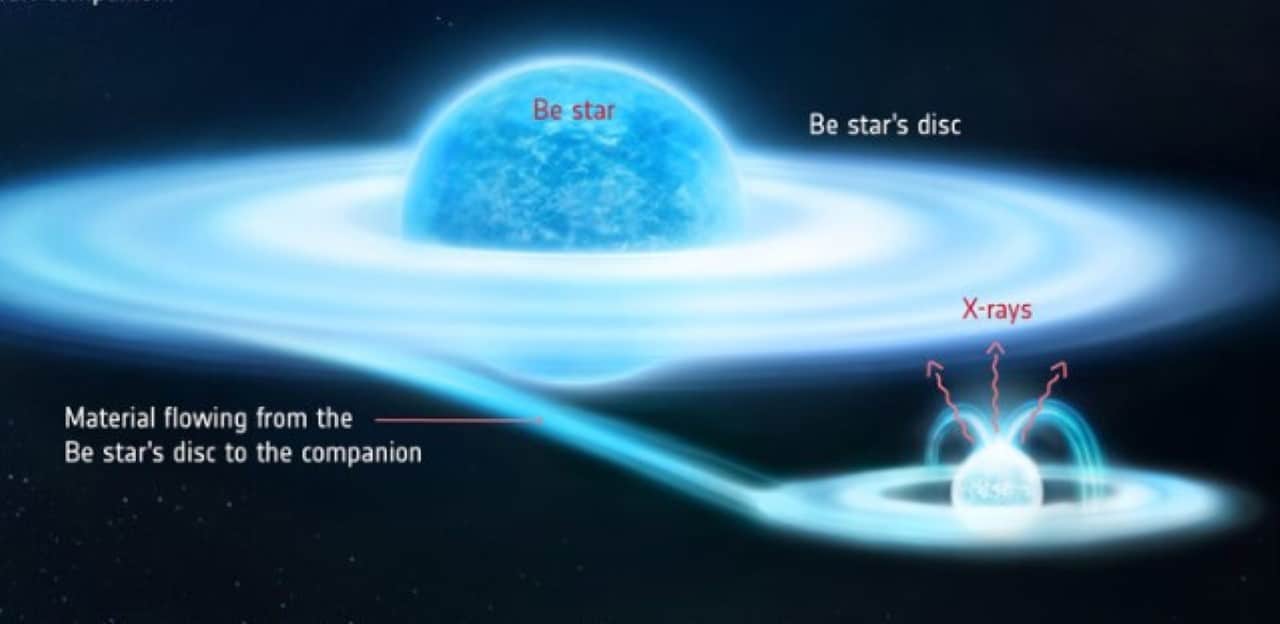
Scientists from Universidade of Liège have solved an astronomical puzzle that has intrigued researchers for almost five decades about energetic anomalies in outer space. The investigation determined that the extreme radiation originating in the Gamma Cassiopeia system does not come from the main star, but from a magnetic white dwarf in continuous orbit around the massive star.
The elucidation of this phenomenon occurred through the analysis of data captured by the XRISM space observatory, operated by international agencies under the leadership of Japão. The mapping of superheated plasma revealed orbital dynamics previously restricted to the field of modern physics hypotheses, transforming the understanding of energy emission in complex stellar systems.
XRISM solves the 50-year mystery of a famous star 🌟
An invisible companion consuming material from the star gamma-Cas has been revealed as the culprit for curious X-rays coming from the stellar system 👉https://t.co/B3HEm2w1SY pic.twitter.com/qk1Ngzk1vv
— ESA Science (@esascience)March 24, 2026
The binary system presents unique physical characteristics that defied astronomical observation models:
– The primary star of type Be has an exceptionally high rotation speed by known standards.
– The celestial body ejects matter continuously, forming a dense circumstellar disk around it.
– Historical X-ray measurements indicated intensity levels forty times higher than the established standard.
– The plasma located in the interaction region reaches temperatures that exceed the mark of one hundred million degrees Celsius.
The discovery ends a long academic debate that began in 1976 and establishes new parameters for the observation of celestial bodies with atypical energy signatures. The detailed mapping provides a robust database for investigating other systems spread across Via Láctea that exhibit similar behavior.
Orbital dynamics and the mapping of energy emissions
For decades, ground-based and orbital observatories recorded radiation levels that did not match the isolated behavior of the main star. The team of astrophysicists carried out rigorous monitoring campaigns to cover the system’s complete orbital period, which has an estimated duration of two hundred and three Earth days.
The spectra captured demonstrated that the signatures of the hot plasma underwent velocity changes perfectly synchronized with the orbit of a secondary body. Essa constant variation accompanied the movement of the compact companion, definitively eliminating the hypothesis that the star Be was the primary generator of the X-rays detected by the instruments.
Microcalorimeter technology on board the satellite
The success of the research depended fundamentally on the technical capacity of the Resolve microcalorimeter, a very high-resolution instrument installed at the Japanese space observatory. The equipment was able to analyze X-ray spectra with a level of detail that surpassed all previous space missions aimed at studying high energies.
This technological precision allowed researchers to identify extremely subtle orbital movements in the plasma. Tais variations went completely unnoticed by the sensors used in the last decades of astronomical exploration, limiting the advancement of theories on mass transfer.
The instrument’s extreme cooling technology ensured the stability necessary to accurately capture individual photons. Strategic planning of observations ensured uninterrupted data collection during different phases of the binary system cycle, providing an unprecedented volume of information.
Continuous space mass transfer process
The mechanical functioning of the system is based on an uninterrupted process of transferring matter between the two stars that make up the binary structure. Devido to its extremely accelerated rotation, the massive Be-type star ejects colossal volumes of gas and dust, forming a vast equatorial disk around it that extends millions of kilometers into space.
A significant portion of this ejected material ends up being captured by the gravitational force of the neighboring white dwarf. Essa constant interaction modifies the structure of the stellar environment and creates a second, much denser and more dynamic accretion disk around the compact object.
The object’s intense magnetic field acts like a gigantic gravitational funnel, directing the flow of high-speed matter directly toward its magnetic poles. The force of attraction accelerates the particles to extreme speeds before they reach the surface of the white dwarf.
During the violent impact of this matter with the rigid surface, the accumulated kinetic energy is instantly converted and released in the form of very high intensity X-rays. Spectroscopic measurements indicate that a considerable part of this radiation is reflected by the star’s dense surface, generating the complex pattern that reaches detectors in Earth orbit.
Reclassification of binary systems in astronomical catalogs
The results obtained by the European team confirm the existence of a specific category of systems composed of Be stars and white dwarfs in the process of magnetic accretion. Levantamentos updated statistics point out that this configuration represents about ten percent of all Be type stars cataloged by space agencies around the world. The change in speed of the spectral lines was calculated at approximately two hundred kilometers per second, providing unprecedented mathematical precision for the study. The data completely ruled out the possibility of the white dwarf being devoid of a magnetic field, as well as invalidating the model that suggested the presence of a neutron star at the location.
The information collected demonstrates that these systems are predominantly associated with the most massive stars in the observable universe. Essa constatação contraria frontalmente as previsões teóricas formuladas no passado, que calculavam uma população muito mais numerosa e formada principalmente por astros de menor porte e densidade. The discovery requires an immediate update to astronomical catalogs and mathematical models that describe the evolution of binary systems over time. The data prove that magnetic interaction plays a central role in energy dissipation during mass transfer between high-density stellar components.
Visual characteristics and location in the Northern Hemisphere constellation
The Gamma Cassiopeia system constitutes the central point of the constellation that bears the same name, forming the characteristic design of the letter W in the night sky, being one of the most traditional and studied targets of modern astronomical observation. The celestial body is located at a distance of five hundred and fifty light years from the planet Terra, positioning itself as a natural laboratory of excellence for conducting detailed astrophysical studies on gravitational interaction. Observadores located in the northern hemisphere of the globe can view the star with the naked eye on nights with favorable atmospheric conditions and low light pollution, standing out in the sky. The use of small commercial telescopes already makes it possible to monitor the periodic variations in brightness caused by the constant ejection of material from the main star towards outer space. The direct correlation with orbital motion definitively ruled out the theory of magnetic reconnection on the surface of the primary star, consolidating the importance of continuous long-term observation. The evidence irrefutably confirms that the very high temperature material is physically linked to the magnetic white dwarf, redefining the understanding of energy distribution in the system. Cross-referencing these recent data with historical records formed a complete overview of the evolution of X-ray emission in the region over the last few decades. The detailed mapping provides a robust database for investigating other star systems spread across Via Láctea that exhibit similar behavior, transforming space research methods.
Impact on gravitational wave detection
The in-depth understanding of the mechanics of accretion in these binary systems provides fundamental data for the analysis of cosmic events of extreme violence. With dozens of similar objects already duly identified in Via Láctea, researchers now have a validated and tested physical model to study the emission of gravitational waves generated in the final stages of life of massive stars, expanding science’s ability to monitor the transformations of the universe.
Advances in understanding celestial mechanics
The satellite’s ability to maintain focus on the target and record the smallest energy fluctuations provided the volume of information necessary for scientists to model the behavior of matter with absolute precision. Current space technology demonstrates that phenomena previously considered anomalous follow strict physical patterns when observed with the appropriate instrumentation.
The joint work of space agencies consolidates the Japanese observatory as an indispensable tool for contemporary astrophysics. The validation of complex theories about celestial mechanics paves the way for new missions focused on unraveling the energetic processes that govern the formation and evolution of galaxies.



