


The North American space agency has maintained a continuous and uninterrupted effort to reestablish communication with the spacecraft that has been orbiting the red planet since 2014. The signal from the equipment was lost in early December last year, the exact moment when the device was supposed to resurface from the hidden side of the celestial body after a standard orbital maneuver.
To date, the engineers and scientists responsible for the mission have not detected any response or telemetry, even after carrying out several contact attempts carried out shortly after the end of the period known as solar conjunction.
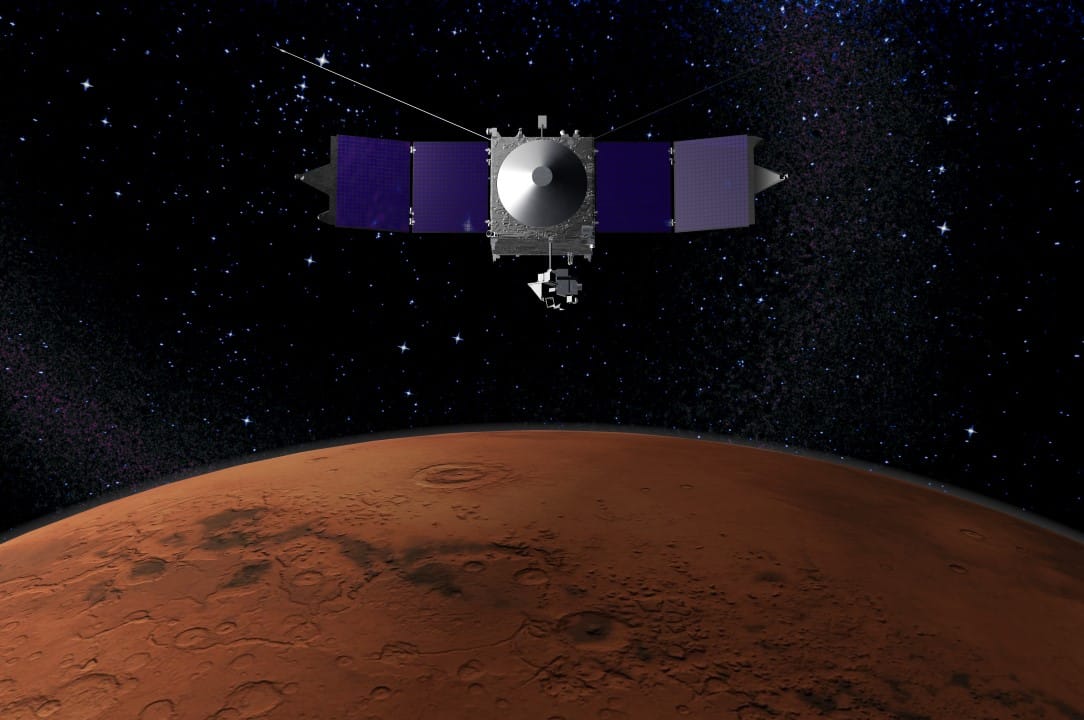
During an event focused on planetary sciences held in the state of Texas, the director responsible for the planetary exploration department, Louise Prockter, confirmed that the technical teams maintain the expectation of locating the equipment in deep space.
Before the signal was abruptly interrupted, the data packets received by the terrestrial antennas indicated that all subsystems were operating within normal limits. However, subsequent analysis of telemetry fragments pointed to the following technical scenarios:
– The equipment started an unexpected rotation around its own axis.
– The spacecraft deviated from its orbital trajectory previously calculated by the navigators.
– High gain antennas have lost direct alignment with receiving stations on Terra.
Technical efforts for deep space tracking
Engineering teams targeted the deep space network’s giant dishes and Green Bank observatory facilities to try to pick up any radio emission, however faint, coming from the spacecraft.
In addition to resources based on Terra, surface exploration vehicles, such as the Curiosity rover, have received specific commands to monitor possible transmissions originating from Martian orbit. Essas coordinated listening actions occurred immediately after the end of the solar conjunction, an astronomical phenomenon that completely blocked interplanetary communications between mid-January and the start of the following operational cycle.
Director Louise Prockter categorically highlighted that the equipment has not yet been officially classified as inoperative or lost in combat. The technical working group dedicates full shifts to processing the latest available navigation data, with the aim of building an accurate timeline of events leading up to the communications blackout. The special committee formed to investigate the anomaly continues to evaluate windows of opportunity for sending blind reset commands. Experts focus their analysis on the following mission critical points:
– Avaliação of the state of charge of the onboard batteries after months without ideal solar orientation.
– Cálculo of thermal degradation rates of scientific instruments exposed to space cold.
– Simulação of alternative trajectories that the equipment may have taken after the attitude failure.
Operational history and scientific discoveries
The equipment completed more than twelve years of continuous operation in the harsh environment of space, far exceeding the expected lifespan of its primary mission, which had been designed to last just one Earth year.
Throughout its journey, the device collected a massive amount of crucial data about the thinning process of the ancient Martian atmosphere, providing key pieces for understanding how the planet transitioned from a potentially habitable world to the frigid desert observed today.
Solar conjunction dynamics and radio blocking
The phenomenon of solar conjunction occurs when Sol is positioned exactly between Terra and Marte, creating a natural plasma barrier that severely interferes with radio waves used to control interplanetary missions.
This celestial alignment forced a planned period of absolute communications silence that lasted approximately two weeks, a standard safety measure adopted to prevent commands corrupted by solar radiation from causing irreversible damage to flight systems.
Active search operations resumed in full force shortly after this solar interference dissipated, but the persistent silence of the equipment indicates that the orientation failure that occurred before the blockage may have compromised the reception capacity of the omnidirectional antennas.
Interplanetary data relay infrastructure
Launched in 2013, the mission’s central purpose was to investigate the dynamics of volatile gases and the interaction of the solar wind with the upper Martian atmosphere, measuring the exact rate of loss of molecules to the vacuum of space.
In addition to its primary scientific role, the orbiter played a critical role in the agency’s telecommunications architecture, acting as a high-speed relay that retransmitted about twenty percent of all data generated by surface vehicles.
With the temporary unavailability of this communication node, other veteran spacecraft, such as the Mars Reconnaissance Orbiter and the Mars Odyssey, needed to take on a significantly greater workload to ensure the flow of scientific and engineering data.
The gas tracking orbiter operated by the European agency was also integrated into this collaborative effort, adjusting its flyby windows to provide additional relay support and prevent data accumulation in the memories of rovers exploring Martian craters.
Strategic planning for future missions
The prolonged absence of this important orbital asset has accelerated internal discussions about the urgent need to modernize and expand telecommunications infrastructure dedicated to the red planet. Systems engineers are evaluating several conceptual proposals for the development of a new generation of relay satellites, designed specifically to support the increasing volume of data required by advanced robotic exploration missions and future manned expeditions.
The involvement of the private aerospace sector appears as a viable alternative to accelerate the implementation of this new interplanetary communication network. Parcerias strategies are being designed to enable the launch of constellations of small commercial satellites into Martian orbit, which would guarantee continuous and redundant radio coverage, mitigating the risks associated with the loss of individual and aging equipment.
Continuity of investigations and constant monitoring
The collection of information compiled over the last decade will continue to yield scientific publications and discoveries for many years to come, serving as a basis for comparative climate models between the geological evolution of Terra and that of other rocky bodies in the inner solar system. The flight operations team, widely recognized by the astronomical community for its resilience and capacity for innovation, maintains the frequency scanning routine using the deep space network’s seventy-meter diameter antennas. The anomaly review committee works without a strict deadline for formally terminating contact attempts, basing its daily decisions on thorough analysis of historical telemetry and mathematical modeling of the drifting spacecraft’s thermal behavior. Surface missions continue with their drilling and soil analysis schedules unchanged, demonstrating the robustness of the international collaborative relay network that underpins continued scientific exploration of the Martian environment.
Assessment of emergency protocols
Contingency protocols remain activated in mission control centers, ensuring that any anomaly in the radio spectrum is immediately investigated by teams on duty.
The remaining orbital fleet ensures the stability of daily operations, maintaining the flow of scientific discoveries while the fate of lost equipment remains under constant evaluation.
Deep space monitoring
The space agency reiterates its commitment to planetary exploration and keeps its listening channels open, awaiting any signal that may emerge from the Martian silence in the coming weeks.



