

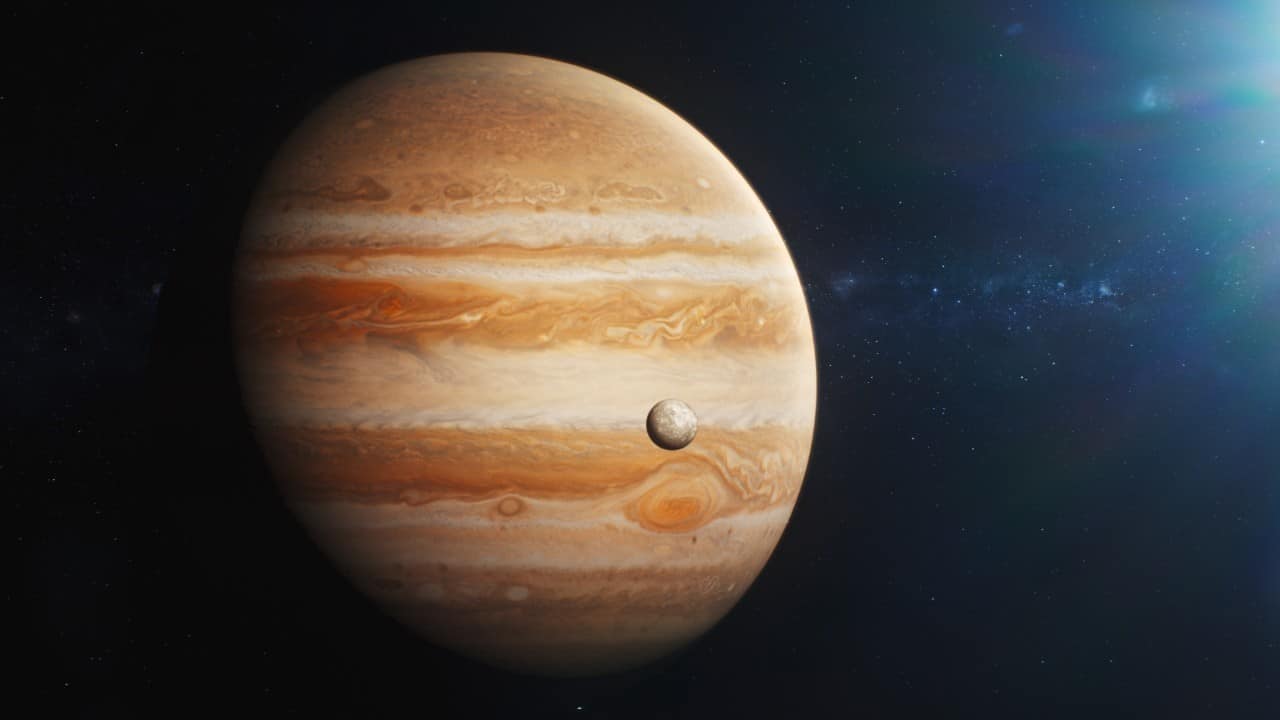
An in-depth analysis of data collected by the Juno space probe, operated by the North American space agency, revealed that the electrical discharges in the atmosphere of Júpiter have a strength significantly greater than those recorded in the terrestrial environment. The scientific survey focused on capturing radio emissions during flybys over isolated storm formations on the largest planet in the solar system. Records indicate that a considerable portion of these meteorological events release an amount of energy that is equivalent to, at least, a hundred times the power of a common lightning strike in Terra.
The team of researchers identified intense electrical activity in four superstorms classified as stealth, which occurred between the years 2021 and 2022. Esses phenomena were located specifically in the northern equatorial band of the gas giant. During this observation period, the absence of multiple simultaneous storms in the same region created an ideal window of opportunity, allowing the spacecraft’s instruments to precisely locate the origin of electromagnetic pulses detected in deep space.
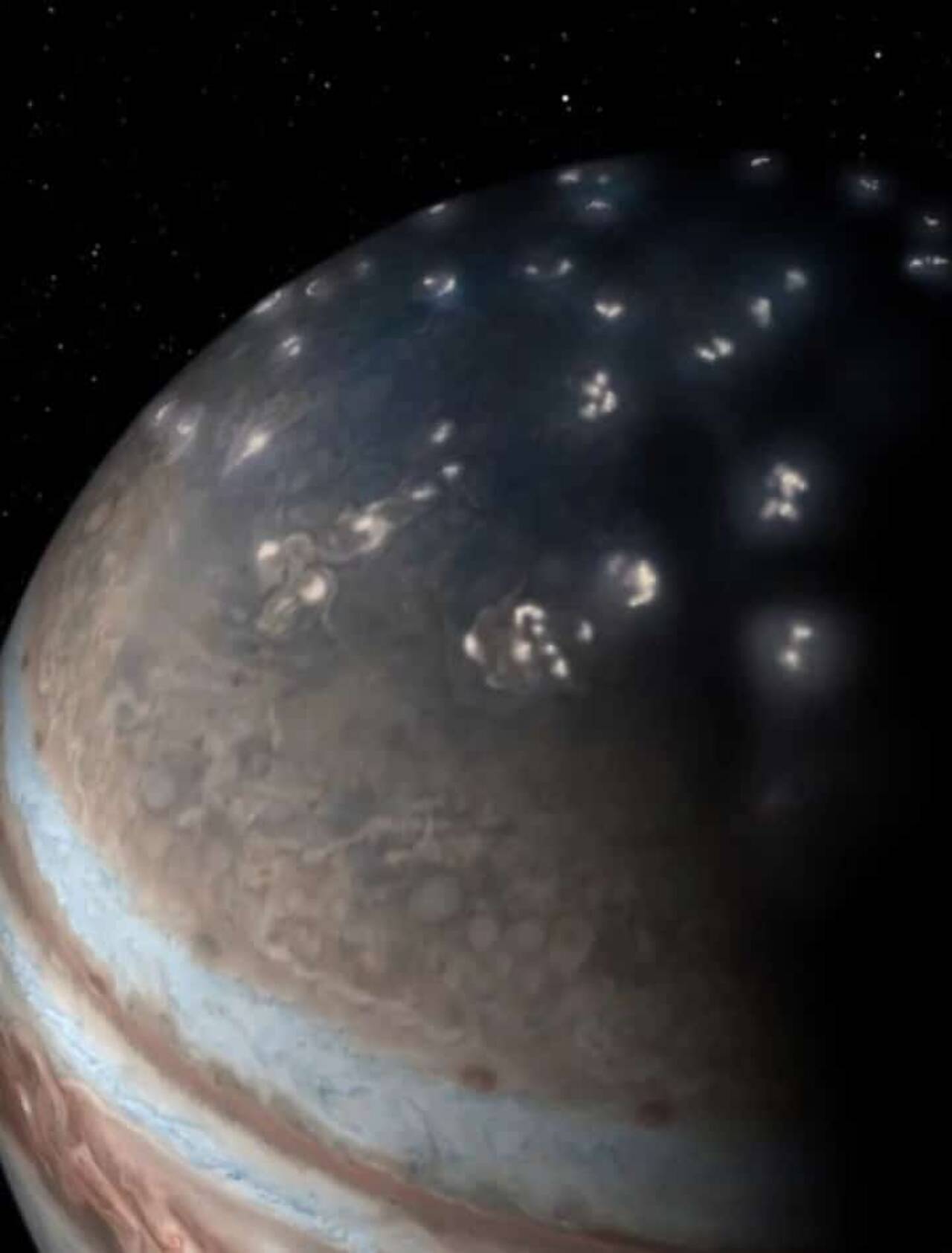
During the closest passages to Jupiter’s atmosphere, the probe recorded a constant average of three bright flashes per second. The final database used for the study counted 613 microwave pulses, providing robust material for understanding extraterrestrial climate dynamics.
– The pulses analyzed showed an extreme variation in power, starting from levels equivalent to Earth’s lightning to peaks hundreds of times higher.
– Precise measurements were made possible by the microwave radiometer attached to the probe, a piece of equipment designed to cross the planet’s dense cloud layers.
– The mapping of the storms was supported by images captured by Telescópio Espacial Hubble and by networks of amateur astronomers around the world.
Monitoring stealth storms in the equatorial belt
The use of instruments based on radio emissions has allowed scientists to circumvent long-standing limitations imposed by observations on the night side of the planet. Historicamente, Júpiter’s thick clouds obscured the visible flashes of electrical discharges, which made estimates of released energy inaccurate and often underreported. The radiometer effectively overcame this physical barrier, since radio waves can cross multiple atmospheric layers without suffering significant interference from gaseous density or suspended particles.
The isolation of a single active storm at a time was the determining factor in the success of the measurement. Essa rare meteorological condition occurred during a natural pause in convective activity in the northern equatorial band. The stealth superstorms monitored featured cloud towers with modest heights compared to other gigantic Júpiter formations, but demonstrated a unique ability to maintain prolonged electrical activity over several months. Statistical analysis of the 613 pulses confirmed that the instrument was able to capture a full spectrum of events, correcting the bias of previous space missions that detected only the most extreme lightning strikes and created the false premise that all Jupiterian lightning was invariably super lightning.
Atmospheric dynamics drive the intensity of discharges
The chemical composition of Júpiter’s atmosphere is one of the central factors in explaining the violence of its storms. The environment is dominated almost entirely by hydrogen, in stark contrast to the mixture of nitrogen and oxygen that makes up Terra’s atmosphere. Essa structural difference fundamentally alters the moist convection process, which is the engine responsible for the formation of charged clouds and the subsequent release of electrical discharges.
On the giant planet, the moist air becomes substantially heavier relative to the surrounding gas. Essa physical characteristic requires that there be a much greater accumulation of thermal energy in the lower layers so that the air can rise and generate the instability necessary for a storm. Quando this energy finally breaks the density barrier, the release occurs explosively.
As a direct consequence of this fluid dynamics, Jovian storms are able to reach heights that exceed the 100 kilometer mark from their base. Na Terra, storm formations rarely exceed 10 kilometers in altitude. Essa vast vertical distance provides a much larger space for the friction of particles and the condensation of water vapor, amplifying the final power of the electrical discharges generated in the process.
Radio emissions overcome visual observation barriers
The mission’s microwave radiometer operated at a specific frequency of 600 MHz, recording the electrical pulses as sharp anomalies in the planet’s brightness temperature. Essa technical approach allowed measuring the power of the discharge directly at its generating source.
By measuring the energy at the source, the researchers drastically reduced the mathematical uncertainties that are often associated with signal attenuation by clouds or the immense distance between the probe and the event. In specific overflights, the proximity was such that hundreds of pulses were recorded every few minutes.
To establish a comprehensible parallel, scientists compared Jovian radio emissions with terrestrial databases obtained at different wavelengths. Mathematical modeling required complex extrapolations to align the energy spectra of the two planets.
Depending on the spectral model adopted for this data conversion, the maximum power of the rays in Júpiter can be calculated as equivalent to that of common discharges in
Electrical event distribution and telescope support
Previous surveys had already mapped a trend towards greater occurrence of lightning near the poles of Júpiter. The recent data fills an important gap by focusing on equatorial storms during periods of general atmospheric calm, allowing frequency and intensity to be mapped at different latitudes.
The accuracy of this mapping depended heavily on a visual support network. Enquanto the probe picked up the invisible radio signals, telescopes in Earth orbit and observatories on the ground confirmed the exact positions of the cloud masses, ensuring that each radio pulse was associated with the correct storm.
Cloud and charged particle formation mechanisms
The physics behind the formation of rays in Júpiter follows fundamental principles that are observed in terrestrial meteorology, involving the rapid rise of water vapor that condenses when reaching altitudes with freezing temperatures. Esse process generates a vast amount of electrically charged particles. As liquid droplets and ice crystals collide violently in updrafts and downdrafts, they separate by weight and charge, creating immense electrical potential differences that inevitably result in massive discharges. Embora the cycle is analogous to that of Terra, it operates under extreme conditions of crushing gravity, colossal atmospheric pressures and a distinct chemical composition. The scientific community is still investigating whether the main driver of this disproportionate force is the atmosphere dominated by hydrogen or the monumental height of the cloud towers, which extends the distances covered by discharges and the accumulation of thermal energy.
Variability of spectra in gaseous bodies in the solar system
Recent measurements indicated that the power of the pulses varied widely and unpredictably within the same storm analyzed. Enquanto some electrical events approached the typical values recorded in summer storms in Terra, others exceeded these marks by several orders of magnitude. Essa high variability suggests that Júpiter is not just a producer of superlightning, but rather a complex environment that hosts a full and diverse spectrum of electrical activities, depending on the microclimatic conditions of each cloud.
The space mission, which has been in orbit around the giant planet since 2016, continues to provide the most detailed and continuous set of data ever obtained on extraterrestrial meteorological phenomena. The technological ability to detect emissions through thousands of kilometers of opaque clouds represents a significant methodological advance. The accumulated data not only unlocks the secrets of Júpiter, but also offers valuable parallels that help meteorologists understand in greater depth the extreme weather phenomena occurring in Terra itself.



