
Sony’s corporate decision bars the creation of a modern version of the classic Jak and Daxter by Bluepoint
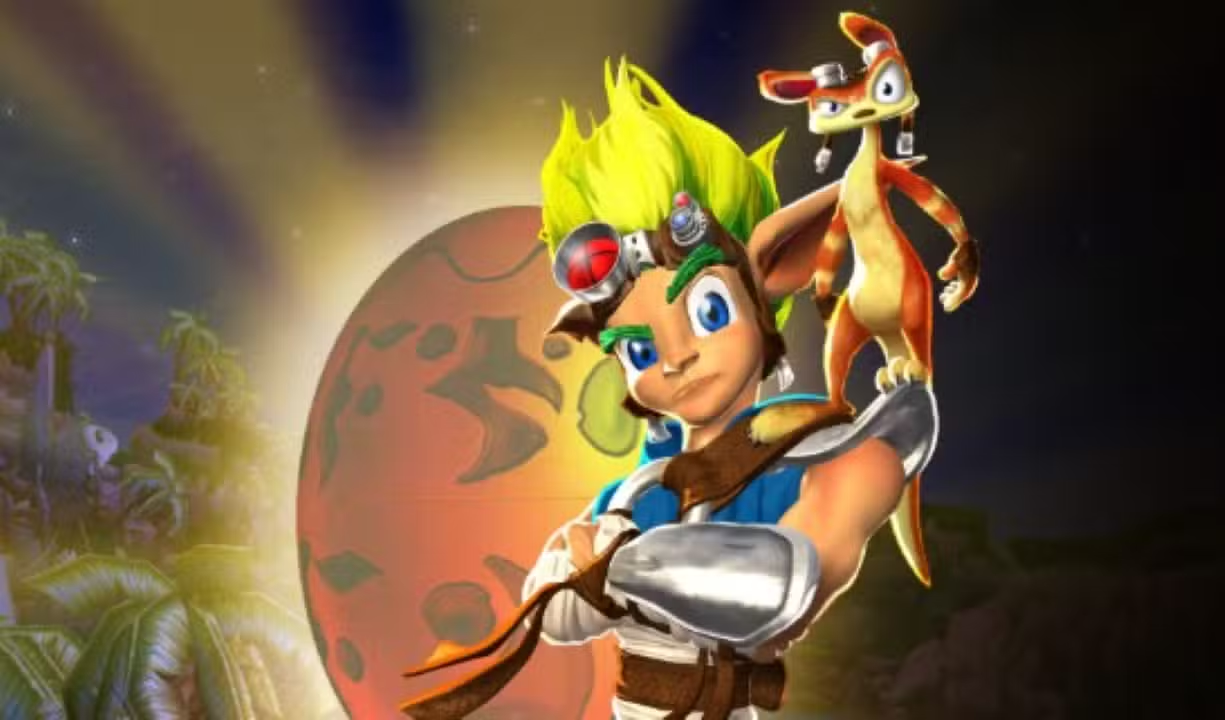
Sony Interactive Entertainment has made the official decision not to move forward with a project to recreate the Jak and Daxter franchise, recently presented by Bluepoint Games. The partner studio, widely known in the technology market for revitalizing old works with high fidelity, had structured a complete plan to bring the original PlayStation 2 title to the visual and mechanical standards of the current generation of consoles. The refusal occurred during the preliminary design phases of the software, blocking any progress to the active development stage by engineers and artists. Essa behind-the-scenes movement highlights the Japanese distributor’s conservative stance in relation to the recovery of intellectual properties that have been inactive for years in its official catalogue. The global electronic games market has seen a strong trend towards revitalizing brands from the past, moving significant amounts annually with nostalgic products. However, the internal choices of large corporations follow strict sales projection and public engagement criteria, prioritizing franchises with guaranteed financial returns in the short and medium term. The interruption of this specific project raises technical and commercial debates about the management of partner studios and the feasibility of rescuing classic mascots. Allocating large-scale budgets requires solid justifications to shareholders, something that three-dimensional platform titles struggle to prove in today’s competitive landscape dominated by games-as-a-service.
Experts in the digital entertainment sector point out that modernizing a legacy code requires investments comparable to those of a completely new production. The profound restructuring of collision systems, enemy artificial intelligence and level design requires numerous teams and years of exclusive dedication to the project.
The scope of work proposed by the developer encompassed fundamental technical points for the functioning of the updated software on modern hardware, detailing the following engineering goals:
– Complete Refatoração camera code for current dual analog control standards.
– Implementação of textures in native 4K resolution with strictly stable frame rates.
– Regravação spatial audio and updated orchestration of the entire original soundtrack.
– Native Adaptação of commands for the haptic feedback features of next-generation controls.
Commercial focus and strategies
Portfolio management at a hardware manufacturer requires rigorous choices about which game genres receive direct funding from corporate headquarters. The current scenario presents increasing development costs, forcing companies to minimize operational risks with genres that show fluctuations in interest among global consumers.
The distributor’s internal assessment indicated that the target audience for a traditional platform game would not justify the investment of high amounts of initial capital. Technology companies are increasingly betting on titles with the potential for massive financial returns, directing heavy resources towards action and survival narratives with strong cinematic appeal.
Leak of technical documents
The case gained widespread notoriety in the technology community after the unofficial circulation of unpublished conceptual arts on forums specializing in information security and games. The leaked images detail in detail what the visual update of the protagonists and the reconstruction of the original scenarios would look like. Todo the material has been theoretically adapted to support modern resolutions and new graphics rendering technologies.
The design documents illustrate an aesthetic transition planned to move away from the polygonal appearance characteristic of the early 2000s, adapting the work to current standards. The art team’s intention was to replace the old models with versions with high polygon counts and photorealistic textures. Essa change would maintain the stylized visual identity that has defined the brand since its creation, but with contemporary visual fidelity required by the market.
Software engineers who analyzed the material point out that modernization would require a profound restructuring of the graphics engine used by the developer. The transition from a system designed for tube televisions to ultra-high definition monitors reveals the technical challenges of preserving the original gameplay. The physics of the environment would need to be rewritten from scratch to avoid collision failures that would break the user experience.
Partner developer history
Bluepoint Games has consolidated its reputation in the technology sector by focusing almost exclusively on modernizing old codes with great historical importance in the industry. The studio takes responsibility for delivering results that respect the original physics and programming logic established by the creators.
The technical team completely replaces visual assets and sound libraries for high-definition televisions, ensuring an impeccable audiovisual presentation. Previous Projetos demonstrated the group’s technical ability to use contemporary graphics engines without altering the end user’s sense of control.



This delivery history validated the studio’s competence to take on an intellectual property with highly specific and demanding movement mechanics. The proposal to recreate the franchise represented a logical move within its area of activity in the high-budget digital entertainment market.
The North American company has built a trusting relationship with Sony over the last decade, delivering products that have achieved immediate critical and commercial success. The rejection of this specific project demonstrates that, even with a largely positive track record, corporate decisions depend primarily on rigorous financial projections.
Evolution of intellectual property
The original series was conceived by Naughty Dog and released in the early 2000s, establishing new engineering standards for three-dimensional platform games on the international market. The title introduced a seamless open world with no visible loading screens, representing a significant software innovation for the processing and memory limitations of hardware at the time. The gameplay dynamics, which alternated between a protagonist focused on direct action and a sidekick focused on comic relief, became a trademark of the product. The initial success guaranteed high acceptance rates from specialized critics and a significant volume of units sold globally, consolidating the brand in the Japanese manufacturer’s entertainment ecosystem.
With the advancement of console generations and the change in consumer profiles, the narrative and mechanics have undergone substantial evolution, moving from a light and colorful tone to visibly more complex visual and thematic approaches. Developers incorporated vehicle driving systems, use of tactical equipment, and structured missions in large-scale dystopian urban environments. Essa transition occurred more evidently from the second game in the saga, directly reflecting the changes in the preferences of the consumer public in that specific decade. Players began to demand more mature and diverse interactive experiences in terms of control and campaign progression, forcing the franchise to quickly adapt to the new demands of technology retail.
Hiatus in the console market
The last major release of the franchise occurred in 2004, followed only by smaller titles developed by third-party studios for portable platforms until the end of that decade, without the same commercial impact. Desde therefore, the brand remains in a severe state of dormancy in the global market, sporadically receiving only high definition adaptations for later systems without content additions or significant structural improvements to the source code. The prolonged absence of new narrative material or in-depth redesigns has turned intellectual property into a niche item within the vast video game industry. Atualmente, the series’ commercial relevance is sustained primarily by the affective memory of its original user base, making it difficult for executives to justify massive investments in high-budget recreations. The original creator has completely redirected its internal efforts towards newer and more realistic intellectual properties, achieving successive global sales records and dozens of awards in the digital entertainment sector. Returning to a platform-focused project would require an extremely complex marketing alignment, which could divert financial and human resources from franchises considered more profitable and safer for the corporation’s shareholders in the current fiscal year.
Reaction from the gaming community
The announcement of the cancellation quickly mobilized social media platforms, where consumers actively debated the company’s stance regarding the preservation of its classic software catalog. Organic interest in intellectual property has been reignited by the leaked images, signaling that appreciation for traditional platform mechanics remains measurable among a dedicated portion of console users, even if the absolute numbers are insufficient to approve large-scale budgets at board meetings.
Current production costs
The interactive entertainment sector is experiencing a period of strong dependence on previously established brands, with recreations occupying significant and strategic portions of major publishers’ annual release calendars. Empresas competitors have achieved significant financial success by remaking classic works of various genres, proving to shareholders that there is a real and profitable demand for family experiences packaged in modern technological clothing.
However, the specific three-dimensional platform segment presents particular commercial barriers that scare away risky investments by equity funds and global distributors. The decision to summarily shelve the project reflects a pragmatic and cold reading of this current competitive scenario, where the corporation chooses to direct its working capital towards action genres that dominate global user engagement and retention metrics.
Veja Tambem em News (EN)

Research reveals that parents are unaware of how their children use artificial intelligence

Samsung releases new system update with new features for Galaxy Watch 4 users

Digital retail reduces the value of the Galaxy S25 5G smartphone with bank bonuses and device exchange

Amazon’s wireless CarPlay adapter has a 50% discount and high approval ratings from drivers

Zach Cregger’s new Resident Evil ignores games and focuses on an unprecedented story with new characters

Rumor suggests that Nintendo is preparing a special edition of the Switch 2 with a remake of Ocarina of Time

Apple accelerates production of the iPhone 17e and develops new Air model with dual camera system

Epic Games platform releases twelve high-budget games at no permanent cost for PC users

PlayStation 5 Pro price drop accelerates digital retail sales and eliminates global stocks

New Galaxy Watch 9 firmware appears on server and confirms progress in software development

Apple’s commemorative project tests cell phone with 1.1 millimeter edge and curved screen for 2027
