
Apple confirms closure of MAC Pro to prioritize efficiency of m ultra line processors
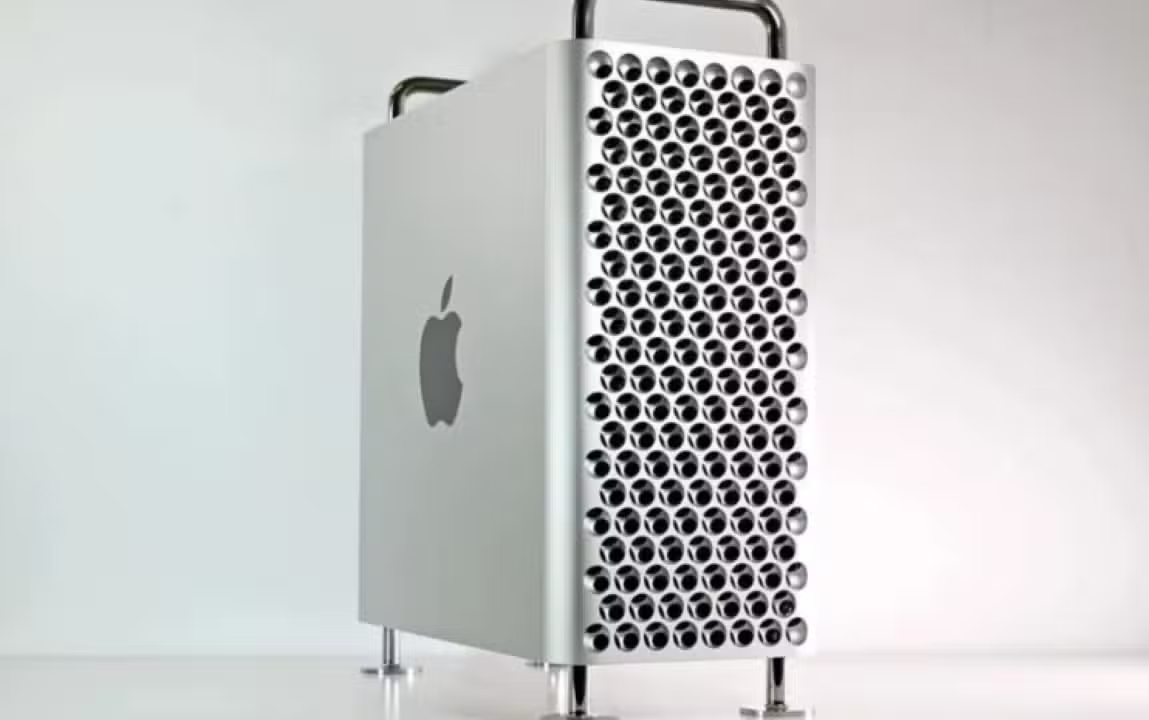
Apple officially confirmed this Thursday the definitive discontinuation of the Mac Pro, ending a cycle of attempts to maintain a modular tower in its portfolio of professional desktops. The decision signals a structural change at the Cupertino giant, which now focuses all of its high-performance hardware efforts on the Mac Studio line and the vertical integration of its processors. The move comes at a time when the system-on-chip architecture, known as SoC, has made traditional component modularity less efficient within the brand’s ecosystem.
The Mac Pro’s trajectory has been marked by engineering challenges and a mixed reception from high-end users, especially after the transition to Apple’s proprietary silicon. Embora the model launched in 2019 tried to revive the expandable tower format, subsequent updates with M2 Ultra chips ended up limiting the memory and graphics processing upgrade capacity. Especialistas from the industry point out that maintaining a large and expensive chassis no longer made sense when equivalent performance began to be delivered by considerably smaller and cheaper devices.
The discontinuation also affects luxury peripherals that accompanied the workstation, such as the Pro Display XDR monitor, which is no longer sold to make way for more versatile options. The technology market interprets this inventory clearing as preparation for a new generation of devices optimized for contemporary demands, such as local artificial intelligence processing. Sem or Mac Pro, the Apple simplifies your production line and eliminates the need to manage components that conflict with your ultra-efficient, sealed hardware philosophy.
Technological integration and the end of traditional modularity
The main technical reason for the end of the Mac Pro lies in the incompatibility between the design of traditional towers and the M series chip strategy. By integrating RAM memory and graphics cores directly into the processor, the Apple eliminated the possibility of user expansion, which was the biggest attraction of old workstation models. As a result, the computer’s internal slots have become underutilized, serving only very specific storage cards or video processing cards that have lost relevance in the current market.
- The unified memory of the Ultra chips offers speeds that modular components can hardly achieve on traditional buses.
- The lack of support for external third-party GPUs, such as those on the Nvidia, has alienated professionals who depend on specific cores for heavy rendering.
- The cost of maintaining and purchasing a large chassis has become unjustifiable for IT departments looking to optimize space.
- The energy efficiency of the new processors allows maximum performance to be achieved without the need for massive cooling systems.
This paradigm shift reflects how Apple prioritizes a controlled user experience over freedom of hardware configuration. Para the company, the stability guaranteed by the closed architecture compensates for the loss of users who preferred to build their own specifications over time. The video and cinema market, which was the central focus of the Mac Pro, had already been migrating to the Mac Studio due to its portability and ease of integration into modern workflows.
Consolidation of mac studio as a professional reference
The Mac Studio now takes over as the most powerful computer in the Apple, offering the M3 Ultra chip as the top of the brand’s performance chain. The Este device was designed from the ground up to maximize the capabilities of the Apple silicon while avoiding the waste of physical space that existed in the Mac Pro design. The rapid acceptance of the Studio by software developers and video editors validated the thesis that raw performance is valued more than the ability to swap internal parts.
Apple has identified that the vast majority of its enterprise customers prefer full upgrade cycles rather than partial replacements of internal components. By offering a compact box with all the necessary connections, the company is able to deliver a ready-to-use solution that caters to everything from musicians to data scientists. The strategy of funneling high-end chips into the Mac Studio also helps mitigate supply chain issues by focusing demand on a single hardware format.
Challenges in the artificial intelligence and robotics market
The accelerated advancement of generative artificial intelligence and deep machine learning has imposed new demands that the old Mac Pro design could not meet competitively. Modern Workstations for AI require clusters of GPUs that operate interdependently, something the current Apple architecture manages better through its silicon interconnect fabric than through PCIe slots. The decision to discontinue the tower model allows Apple engineering to focus on how to scale these integrated chips to compete with cloud processing servers.
Companies working in the development of robotics and industrial automation have also sought solutions that offer high processing power with lower electrical consumption. The Mac Studio, with its performance density per watt, presents itself as a more suitable tool for these environments than a 20 kilo tower. Apple intends to use the savings generated by simplifying the line to accelerate the development of cores dedicated exclusively to processing neural networks in its future releases.



Corporate sector reaction and hardware replacement
Technology departments at major Hollywood studios and advertising agencies have already begun planning the transition of their remaining technology parks. Muitos professionals who used the 2019 Mac Pro as their main station saw modularity as a way to extend the useful life of the initial investment through board changes. With the announcement of the end of the line, the tendency is for this equipment to be gradually replaced by ecosystems based on Studio Display and Mac Studio, which offer a smaller ecological footprint.
Replacing the Pro Display XDR with the Studio Display XDR also reinforces this trend of making professional setup more accessible and practical for everyday life. The new monitor maintains the image quality needed for color correction and image editing, but eliminates niche features that made the previous product excessively expensive. Essa’s more pragmatic approach helps Apple maintain its relevance in a market where competition from high-performance PCs equipped with Windows remains intense and highly customizable.
Impact on content production and workflows
The forced migration to non-modular systems requires creative professionals to rethink the way they store and process large volumes of data. Sem the internal slots for high-speed SSD storage expansion, the use of external solutions via Thunderbolt 4 has become the mandatory standard for anyone working with 8K videos or extensive music libraries. Embora this adds cables to the desktop, the transfer speed of these modern ports has been sufficient for most demanding professional applications.
- Audio professionals now rely almost exclusively on external interfaces, abandoning internal DSP processing cards.
- The heat management in the Mac Studio has proven superior in long file export sessions, reducing acoustic noise in the studio environment.
- The new hardware’s ease of transport allows editors to take their complete workstations between different film sets with ease.
- Connector standardization simplifies remote technical support as there are no internal hardware variations caused by user modifications.
The shift in focus to Mac Studio also reflects a cultural adaptation within Apple itself, which appears to have accepted that the future of professional computing is no longer about the size of the case, but about the intelligence of the silicon. The company is now betting that optimizing software and hardware in a closed system is the shortest path to delivering the power needed for the next decades of technological innovation.
Longevity and support for current Mac Pro users
Despite the end of sales, Apple will maintain technical support and spare parts availability for Mac Pro owners for the next few years, in accordance with the warranty laws of several countries. Usuários who have invested heavily in machines equipped with Intel or M2 Ultra processors will not be left destitute immediately, receiving operating system updates for a considerable period. However, the development of new software features will begin to prioritize the unique capabilities of M3 and higher chips.
This long-term support is critical for companies that operate on strict capital budgets and cannot afford to replace machines every two years. Apple has a track record of maintaining support for discontinued hardware for around five to seven years, giving the second-hand market and businesses plenty of time to adapt to the new reality. The resale value of these tower models, however, is expected to suffer a sharp drop now that the platform’s evolutionary path has been officially ended by the manufacturer.
Prospects for the next generation of professional desktops
With the departure of the Mac Pro, industry rumors now turn to what the Apple holds for the future M4 Ultra chip and how it will be implemented in the Mac Studio. Espera The company is expected to double its unified memory capacity to meet the growing demands of large-scale language models that run locally. The absence of a tower allows chip designers to focus on architectures that don’t need to worry about the physical compatibility of external components or thermal limits of legacy chassis.
The strategy is now clear: Apple wants to be the leader in integrated performance, offering maximum power in the smallest possible space. Essa vision eliminates the engineering redundancies that kept Mac Pro alive just for the sake of visual tradition and format. By fully embracing the Mac Studio concept, the brand simplifies its message for the professional consumer and reaffirms its confidence in the technical superiority of its own processors over competitive modular components.
Veja Tambem em News (EN)

Research reveals that parents are unaware of how their children use artificial intelligence

Samsung releases new system update with new features for Galaxy Watch 4 users

Digital retail reduces the value of the Galaxy S25 5G smartphone with bank bonuses and device exchange

Amazon’s wireless CarPlay adapter has a 50% discount and high approval ratings from drivers

Zach Cregger’s new Resident Evil ignores games and focuses on an unprecedented story with new characters

Rumor suggests that Nintendo is preparing a special edition of the Switch 2 with a remake of Ocarina of Time

Apple accelerates production of the iPhone 17e and develops new Air model with dual camera system

Epic Games platform releases twelve high-budget games at no permanent cost for PC users

PlayStation 5 Pro price drop accelerates digital retail sales and eliminates global stocks

New Galaxy Watch 9 firmware appears on server and confirms progress in software development

Apple’s commemorative project tests cell phone with 1.1 millimeter edge and curved screen for 2027
