
Final Fantasy X: ten iconic moments that impact more intensely in new playthrough
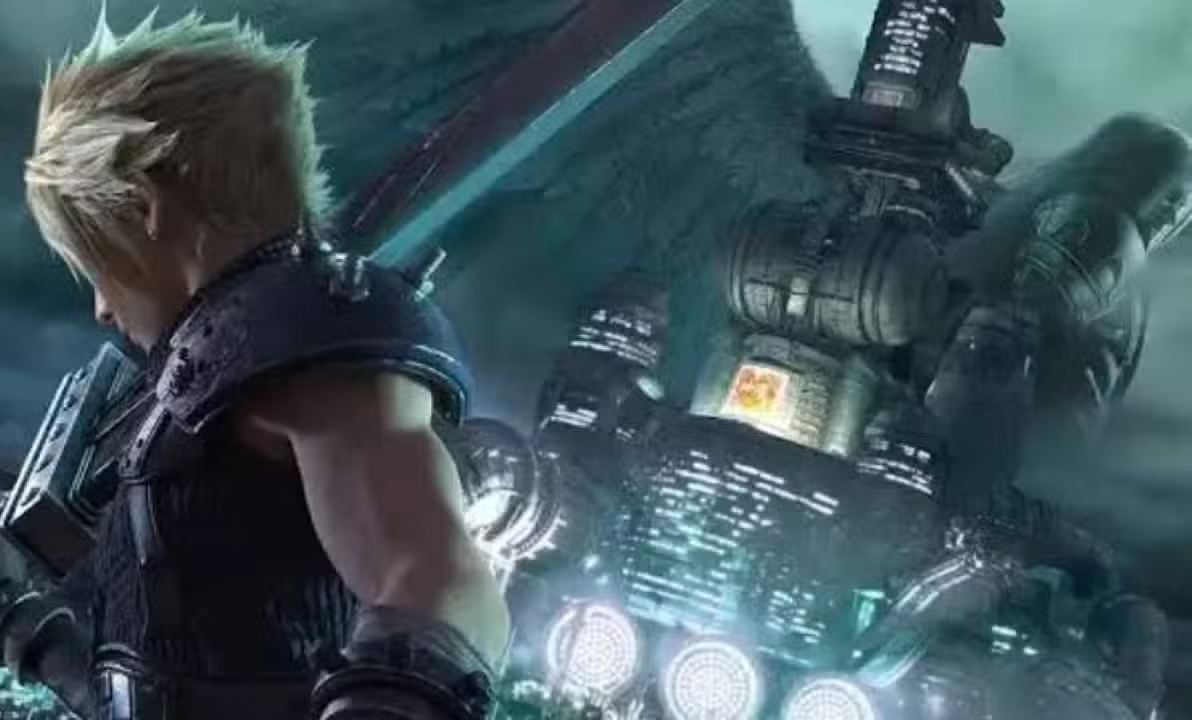
Final Fantasy The journey of Tidus, Yuna and their companions through Spira, a world haunted by the creature Sin, is an epic saga of love, sacrifice and the search for truth. However, the true magic of the game often reveals itself not on the first, but on subsequent playthroughs, when the understanding of events and the fate of the characters takes on a new and painful depth.
Upon revisiting Spira, players realize that many of the moments that seemed simple or even joyful in the first experience now turn into dark omens or disguised goodbyes. The initial innocence of the protagonist Tidus, an athlete from Zanarkand projected into the future, reflects the naivety of the player who embarks on the adventure without knowing the weight of the cycle of life and death of Cada smile, each victory and each moment of hope are colored by prior knowledge that drastically alters the perception of the entire story.
Recognizing the impending tragedy of Spira
The first time you play Final Fantasy X, the plot unfolds as a gradual discovery, where the player and Tidus learn about the world of Spira, the religion of Há a sense of mystery and adventure, with each new city and revelation adding layers to the complexity of the universe. However, upon replay, this same journey takes on a melancholic tone, as each step of Yuna’s pilgrimage to obtain Final Aeon is now viewed with full awareness of his tragic fate.
Moments of apparent lightness, such as the group’s first interactions or celebrations in villages, become almost unbearable, as the player knows that joy is ephemeral and that the final sacrifice is getting closer. Yuna’s journey is not just a quest to save Spira, but an inexorable march towards his own annihilation, a fact that the first playthrough obscures with the promise of a solution. The second time, sadness sets in from the beginning, and with each step, the weight of inevitability becomes more palpable, transforming the adventure into an announced tragedy.
Delving deeper into the weight of the summoners’ sacrifice
The mechanics of summoner sacrifice are a central pillar of Final Fantasy X’s narrative, but its true brutality is only fully understood after the story’s conclusion. In the first playthrough, the focus is on the search for a solution to Sin, and the idea of sacrifice is presented as a heroic and necessary act. Yevon’s faith promotes this vision, and players tend to accept it as part of the challenge.
However, upon revisiting the game, each summoner the party encounters, each previous success story in defeating Sin, takes on a new and dark meaning. The player realizes that these heroes did not find salvation, but rather a brutal and repetitive end. The realization that Yuna is being guided to the same destiny, without a true long-term alternative, turns admiration into anguish. The cycle of death and rebirth of Sin, perpetuated by the Yevon system itself, is a devastating revelation that gives new meaning to the entire journey.
The shocking truth about Sin and Jecht
The identity of Sin is one of the biggest twists of Final Fantasy X, revealing himself to be Jecht, the father of Tidus, imprisoned and transformed by the entity. On the first playthrough, this revelation is a narrative shock that redefines the relationship between Tidus and his father, as well as adding a personal layer to the mission to defeat Sin. The emotional complexity is immense, but the prospect of a second play deepens this pain even further.



When replaying, every memory of Jecht, every flashback of Tidus with his father, and even Tidus’s initial interactions with Auron, are viewed through the lens of this cruel truth. Jecht’s rude and distant behavior, which previously could be interpreted as character flaws, is now understood as a man’s struggle against his own destiny and impending transformation. Jecht’s pain, which manifests itself through Sin, and his desire to be stopped by his son, become evident in dialogues and scenes that previously went unnoticed. The music, visuals and lines gain an emotional weight that transcends the first experience, transforming the villain into a tragic and misunderstood figure. The final fight is not just against a monster, but against the memory and sacrifice of a father.
The goodbyes that resonate the strongest
Final Fantasy Tidus’s farewell to Zanarkand, at the beginning of the game, is a clear example. Inicialmente, is seen as the beginning of an adventure in an unknown world. However, with the understanding that Zanarkand is a “dream” and that Tidus is part of that dream, the opening scene takes on the character of an eternal and painful goodbye.
Another memorable moment is the goodbye between Yuna and Tidus in the final scene, one of the most emotional points in the game. The first time, the sadness is overwhelming. In the second, knowing that this is Tidus’s inevitable fate from the moment he appears in Spira, the scene is even more heartbreaking. Cada romantic interaction between the two, every promise made and every moment of happiness they share, are seen through the prism of an imminent separation with no return. The beauty of the relationship is overshadowed by the tragedy that defines it, making the experience of revisiting these moments an exercise in melancholy and appreciation of the ephemeral.
The narrative architecture and fate of Zanarkand
The revelation that Zanarkand, Tidus’s hometown, is a manifestation of a dream and that its inhabitants are “dreams” that will disappear with Sin’s defeat, is one of the game’s most impactful twists. Essa information, which arrives at an advanced point in the narrative, recontextualizes the entire plot and the existence of Tidus himself. When replayed, the narrative architecture of Final Fantasy X reveals itself with even greater mastery, as clues and details about the true nature of Zanarkand and Seemingly innocent Diálogos comments on Spira’s past and history, and even visual elements, take on new meaning, revealing the screenwriters’ ingenuity in planting the seeds of revelation from the beginning. The player’s perception of the reality of Spira and the fragility of Tidus’s existence is completely altered, transforming the re-experience into a journey of rediscovery and admiration for the construction of the plot.
The lingering emotional impact of Final Fantasy
Final Fantasy X’s ability to evoke even stronger emotions in subsequent playthroughs is a testament to its timeless narrative and the depth of its characters. With each return to Spira, the player not only revisits a story, but experiences it with an expanded consciousness, transforming the adventure into a richer but more bittersweet experience. It’s this depth that earns the game its place as a classic, whose relevance and emotional power persists decades after its original release, continuing to touch and challenge those who venture into its lands.
Veja Tambem em News (EN)

Research reveals that parents are unaware of how their children use artificial intelligence

Samsung releases new system update with new features for Galaxy Watch 4 users

Digital retail reduces the value of the Galaxy S25 5G smartphone with bank bonuses and device exchange

Amazon’s wireless CarPlay adapter has a 50% discount and high approval ratings from drivers

Zach Cregger’s new Resident Evil ignores games and focuses on an unprecedented story with new characters

Rumor suggests that Nintendo is preparing a special edition of the Switch 2 with a remake of Ocarina of Time

Apple accelerates production of the iPhone 17e and develops new Air model with dual camera system

Epic Games platform releases twelve high-budget games at no permanent cost for PC users

PlayStation 5 Pro price drop accelerates digital retail sales and eliminates global stocks

New Galaxy Watch 9 firmware appears on server and confirms progress in software development

Apple’s commemorative project tests cell phone with 1.1 millimeter edge and curved screen for 2027
