
New study proves that stellar winds distort radio signals and alter search for alien life
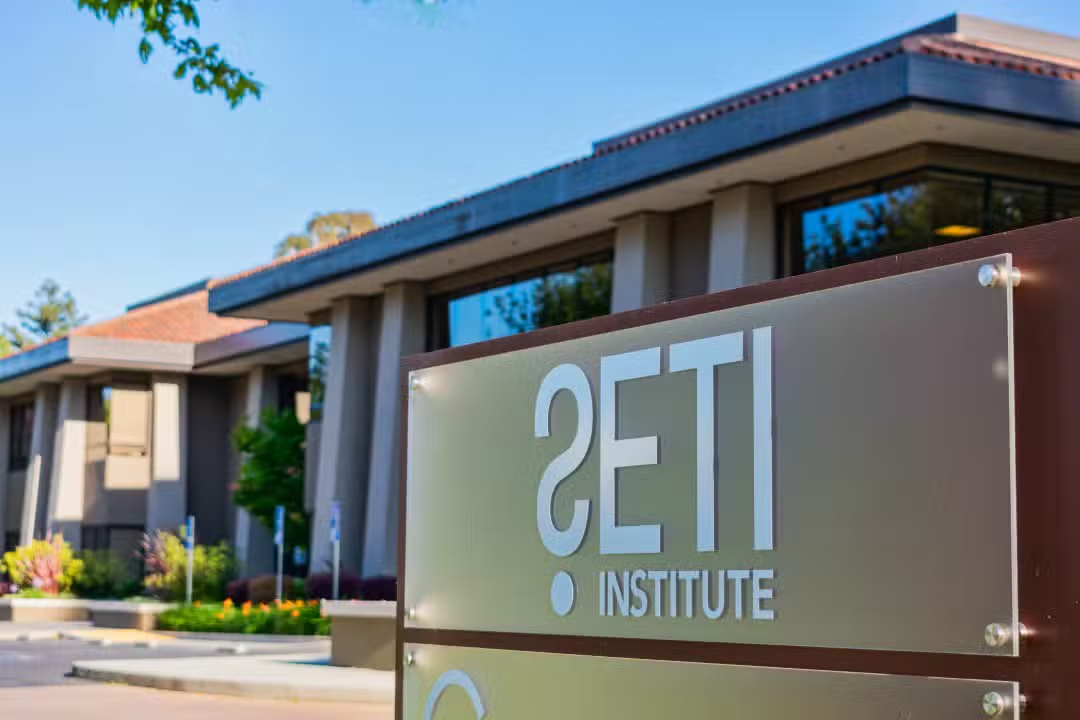
Recent research proposes a profound change in the way astronomy centers search for intelligence outside of Terra. The scientific survey details the behavior of electromagnetic waves as they traverse deep space and how the environment around other stars directly affects this propagation. The discovery highlights flaws in traditional space listening methods and suggests an immediate update to tracking protocols.
The main focus is on ultra-narrowband emissions, historically tracked by radio telescopes during continuous nighttime observations. The data indicates that these transmissions undergo severe modifications before they even leave their planetary systems of origin. Essa physical change creates a significant barrier to capture on Terra, making the signals almost unrecognizable to current equipment.
The research, led by astronomers Vishal Gajjar and Grayce C. Brown, uses records from old space missions to support new high-precision computer simulations. Work published in The Astrophysical Journal demonstrates the need to update search parameters to prevent real transmissions from being discarded. The methodological review promises to optimize the time of use of large international observatories.
Plasma dynamics in electromagnetic propagation
The distortion of signals occurs fundamentally due to the presence of turbulent plasma in the interplanetary medium, an environment shaped by the natural and constant activity of stars. The uninterrupted emission of stellar winds and violent coronal mass ejections form an invisible barrier capable of altering the original signature of any artificial transmission. Esse complex physical process works identically to what is routinely observed in the behavior of Sol in relation to nearby planets. The energy released by the star directly interferes with communications and the stability of the waves that cross the space vacuum, creating a scenario of extreme electromagnetic instability.
When a highly concentrated electromagnetic wave passes through this chaotic scenario, it loses its initial precision and suffers a phenomenon known in astrophysics as spectral broadening. In practice, a signal emitted at an exact and clear frequency ends up spreading across a much wider spectrum, arriving at its final destination considerably weakened and diffuse. Essa structural transformation presents a direct obstacle to current detection systems, which have been programmed to ignore broad noise and look for only isolated spikes of energy. The new reality requires an immediate recalibration of tracking equipment so that it can identify these changed patterns.
Interplanetary probe records
To substantiate the hypotheses raised in the study, the team of scientists analyzed a vast database generated by space missions launched in the 1960s and 1970s. The radio transmissions sent by the probes Mariner 4, Pioneer 6, Helios 1,
This equipment has provided crucial and unprecedented information about the behavior of radio waves as they travel over vast distances. The records demonstrated in practice the occurrence of spectral broadening when signals cross the interplanetary medium dominated by strong solar activity.
Measurements confirmed that the intensity of the distortion reaches critical levels during periods of intense solar storms. Esse natural phenomenon severely degrades the quality of communication and spreads the original frequency across a spectrum much larger than that initially designed by engineers.
The use of this historical data provided a solid and real basis for current research, eliminating exclusive dependence on theoretical models. With this empirical information, scientists were able to map exactly how magnetic turbulence affects artificial transmissions in deep space.
Stellar proximity and communication degradation
Specific observations made by the Helios series probes, which operated in orbits very close to Sol, revealed a clear and undeniable pattern of degradation. The data indicates that signal distortion increases exponentially the shorter the distance between the radio wave trajectory and the emitting star.



From these direct measurements, astronomers have built advanced simulation models to predict wave behavior in other planetary systems. Esses mathematical models allow projecting the reaction of different frequency bands when passing through the plasma of stars with characteristics different from those of Sol.
Behavior of red dwarfs in the galaxy
The investigation pays special attention to M-type stars, popularly classified by the astronomical community as red dwarfs. Esses celestial bodies represent approximately 75% of the entire stellar population existing in Via Láctea, being fundamental targets in the search for life outside of Terra.
Despite having smaller dimensions and lower surface temperatures than Sol, red dwarfs have very high magnetic activity. Esse volatile behavior creates extremely hostile space environments, where the broadening effect of radio signals becomes much more pronounced and frequent than in conventional solar systems.
Mathematical calculations indicate that the probability of a coronal mass ejection coinciding exactly with a transmission is less than 3%. However, when this statistical coincidence occurs, the signal distortion can be multiplied by more than a thousand times in relation to the parameters observed under normal spatial conditions.
Limitations of Traditional Scanning Methods
Historically, algorithms developed for spatial tracking have been tightly calibrated to exclusively look for extremely narrow and isolated frequency peaks. Essa technical guideline was based on the basic premise that natural astrophysical processes cannot produce such concentrated emissions, transforming the clear signals into the perfect signature of an intentional artificial technology. The big problem with this approach is that it completely disregarded the severe physical changes imposed by the interstellar medium during the wave’s long path. The current model categorically proves that a distant civilization could send a perfectly narrow signal, but the reception at Terra would be completely different due to the relentless action of stellar winds and turbulent plasma. Essa observation forces the scientific community to rethink decades of established listening protocols. Evidence indicates that many genuine transmissions may have gone unnoticed by radio telescopes simply because software filters mistakenly classified them as natural background noise from the galaxy. The discovery requires research centers to immediately expand the acceptance criteria for their scanning software. Essa structural upgrade will allow computers to stop discarding slightly wider signals and start considering the actual way transmissions arrive after traveling light years.
Adjustments to monitoring frequencies
Given the evidence presented by the simulations, the main recommendation is a strategic change in the observatories’ listening priorities. The technical guidance is to direct the focus of searches to higher radio frequencies, which demonstrate much greater resistance to interference caused by stellar plasma.
Analysis shows that signals emitted in the 100 megahertz band can undergo a broadening of up to 100 hertz even under calm spatial conditions. On the other hand, higher frequencies are able to cross magnetic turbulence while maintaining superior structural integrity, which greatly facilitates identification by terrestrial receivers.
New guidelines for astronomical investigation
Adapting detection systems will require heavy investments in new processing software capable of operating with more flexible and intelligent tolerance margins. Astrophysics teams will continue to monitor nearby stars to validate predicted distortion rates, ensuring that future scans of the night sky will be considerably more accurate in identifying electromagnetic anomalies.
Veja Tambem em News (EN)

Research reveals that parents are unaware of how their children use artificial intelligence

Samsung releases new system update with new features for Galaxy Watch 4 users

Digital retail reduces the value of the Galaxy S25 5G smartphone with bank bonuses and device exchange

Amazon’s wireless CarPlay adapter has a 50% discount and high approval ratings from drivers

Zach Cregger’s new Resident Evil ignores games and focuses on an unprecedented story with new characters

Rumor suggests that Nintendo is preparing a special edition of the Switch 2 with a remake of Ocarina of Time

Apple accelerates production of the iPhone 17e and develops new Air model with dual camera system

Epic Games platform releases twelve high-budget games at no permanent cost for PC users

PlayStation 5 Pro price drop accelerates digital retail sales and eliminates global stocks

New Galaxy Watch 9 firmware appears on server and confirms progress in software development

Apple’s commemorative project tests cell phone with 1.1 millimeter edge and curved screen for 2027
