
Observatories capture mysterious frequency during death of massive star in deep space
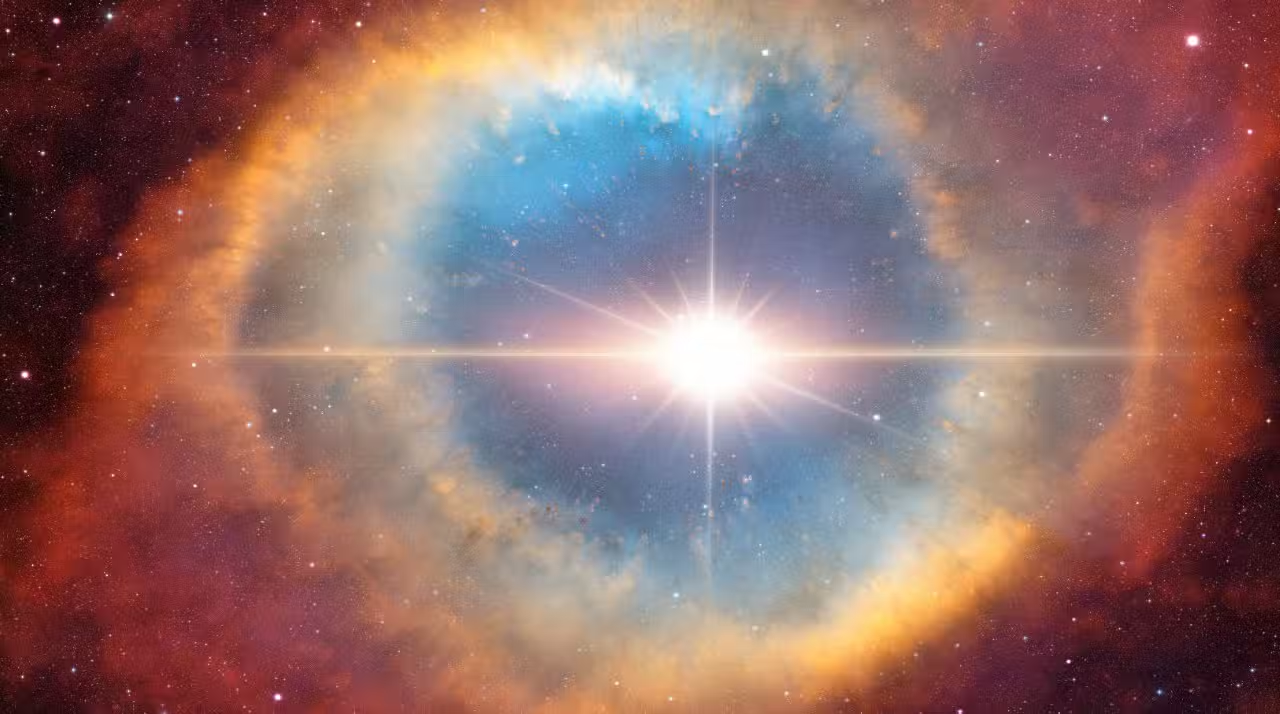
An international team of scientists recorded an unprecedented anomaly during the observation of a supernova located millions of light years from Terra, using a global network of advanced detectors. The phenomenon, characterized by a rapid and increasing variation in emission frequency, was isolated from a vast volume of raw astronomical data after months of rigorous processing. The detection of this specific pattern contradicts current theoretical models about the final stages of stellar evolution, indicating that the collapse of the core of giant stars involves substantially more complex physical processes than modern astrophysics has documented to date. Signal capture required the triangulation of information from multiple terrestrial installations, ensuring the necessary cross-validation to confirm the authenticity of the event and rule out any possibility of interference or local instrumental noise.
The identification of this pattern occurred through multi-messenger astronomy, a technique that combines the reading of gravitational waves with the observation of electromagnetic radiation in different spectrums. Este integrated method allows researchers to form a complete technical picture of the stellar explosion, correlating the exact moment of internal collapse with the visible light emission that reaches optical telescopes afterwards.
The preliminary analysis of the collected data revealed unique characteristics about the dynamics of the cosmic event, which differ from previously cataloged observations of supernovae:
– Frequência of emission outside the known mathematical standards for the dispersion of stellar matter.
– Prolonged Duração of the signal during the most critical phase of the collapse of the progenitor star’s core.
– Incompatibilidade with traditional simulations of gravitational wave generation in high-density environments.
Anomaly in the emission of gravitational waves
Gravitational waves function as ripples in the space-time fabric, generated by the most violent and energetic processes in the observable universe. In the case of this specific supernova, the frequency variation captured does not align with the standard signature expected for the simple ejection of the star’s outer layers, suggesting a profound asymmetry in the mass distribution during the explosion.
The researchers point out that this discrepancy in the data points to the formation of transient states of matter under extreme levels of pressure and temperature. The anomaly acts as a direct signature of the chaotic movements occurring deep within the dying star, a region that remains completely invisible to conventional optical telescopes due to the surrounding dense cloud of debris.
Formation of compact objects in space
The transition from a massive star to a compact object represents one of the most critical and violent moments in stellar evolution. Quando the nuclear fuel runs out, the force of gravity forces the nucleus to collapse on itself in fractions of a second, resulting in a shock wave that destroys the original structure of the celestial body.
The remnant of this process is typically a highly magnetized neutron star or black hole, depending strictly on the initial mass of the parent star. The newly discovered signal provides direct metrics on the exact fraction of time in which this new celestial body acquires its final shape and density.
Fluctuations in the frequency of the captured signal indicate that the newly formed compact object may be oscillating rapidly or that the nuclear matter is experiencing severe resonances. Compreender these internal dynamics is a fundamental step in mapping how the densest objects in the universe establish their structural stability after the chaos of the explosion.



Investigation of high energy phenomena
High-energy physics uses these cosmic events as natural laboratories to test fundamental laws that cannot be replicated in Terra. The conditions of extreme gravity and nuclear density present in the core of a supernova far exceed the capabilities of any human-engineered particle accelerator.
The detailed study of this frequency variation allows scientists to investigate the behavior of subatomic particles when subjected to absolute gravitational stress. The data obtained is used to refine the equations of state that describe matter in environments where the laws of classical physics are no longer applicable.
The phenomenon also offers valuable information about nucleosynthesis, the mechanism responsible for creating heavy chemical elements. Substâncias essential to the formation of rocky planetary systems are forged in the heart of these explosions and then violently ejected into the interstellar medium.
Accurately mapping the chemical distribution in the universe depends on technological ability to interpret the subtle signals emitted during stellar collapse. Cada new detection of gravitational anomalies adds concrete data to the understanding of how matter is recycled and distributed across galaxies over billions of years.
Advances in astronomical observation technology
The success of this detection is intrinsically linked to the development of modern observation infrastructures, such as kilometer-long laser interferometers. Estes instruments have a sensitivity calibrated to measure variations smaller than a fraction of the diameter of a proton in the structure of space-time. The continuous improvement of the optical and seismic isolation components of these detectors, combined with the use of machine learning algorithms to filter cosmic and terrestrial noise, has allowed scientists to identify patterns that would have gone completely unnoticed by the equipment used in the past decade.
Logistical coordination between different facilities around the globe ensures that a transient event is monitored simultaneously on multiple wavelengths. Quando a gravitational wave warning is issued by automated systems, radio telescopes, space X-ray observatories and ground-based optical telescopes are quickly redirected to the source coordinates. Esta integrated approach not only certifies the primary discovery, but also enriches astronomical catalogs with complementary information, establishing a rigorous protocol for verifying unprecedented astrophysical phenomena.
Computer simulations and theoretical modeling
To decode the massive volume of data collected, the scientific community resorts to the development of complex three-dimensional hydrodynamic models, run on high-performance supercomputers. Estas virtual simulations attempt to recreate the extreme conditions of stellar collapse, incorporating dozens of simultaneous variables, such as rotation rates, intense magnetic fields and the transport of neutrinos from the nucleus. The procedure consists of adjusting the mathematical parameters iteratively until the virtual model produces a synthetic signal identical to that captured by physical observatories. Este reverse engineering work requires gigantic computational power, since the physics involved moves between Einstein general relativity and quantum mechanics. The recently recorded anomaly forces theorists to review their fundamental premises and add new layers of calculation to the source codes, promoting a technical evolution in the way astrophysics simulates the internal mechanisms of the universe.
Expansion of the global detector network
Building next-generation facilities and upgrading current interferometers will exponentially increase the volume of cosmic events cataloged annually. With more accurate equipment coming online, researchers are seeking to determine whether this specific frequency variation is a rare, isolated occurrence or a standard, undocumented step in the death of certain classes of supermassive stars.
Veja Tambem em News (EN)

Research reveals that parents are unaware of how their children use artificial intelligence

Samsung releases new system update with new features for Galaxy Watch 4 users

Digital retail reduces the value of the Galaxy S25 5G smartphone with bank bonuses and device exchange

Amazon’s wireless CarPlay adapter has a 50% discount and high approval ratings from drivers

Zach Cregger’s new Resident Evil ignores games and focuses on an unprecedented story with new characters

Rumor suggests that Nintendo is preparing a special edition of the Switch 2 with a remake of Ocarina of Time

Apple accelerates production of the iPhone 17e and develops new Air model with dual camera system

Epic Games platform releases twelve high-budget games at no permanent cost for PC users

PlayStation 5 Pro price drop accelerates digital retail sales and eliminates global stocks

New Galaxy Watch 9 firmware appears on server and confirms progress in software development

Apple’s commemorative project tests cell phone with 1.1 millimeter edge and curved screen for 2027
