Preparations advance for NASA’s Artemis 2 mission: crew explores lunar orbit
Agência Espacial Americana (NASA) intensifies preparations for the Artemis 2 mission, a crucial milestone in the resumption of human deep space exploration. The Esta mission, which will take a crew of four astronauts on a journey around the Lua, represents the first manned flight of the Artemis program and a fundamental step toward humanity’s return to the lunar surface. Launch is currently scheduled for September 2025, marking a significant advancement in the space exploration capability of the Estados Unidos and its international partners. The journey will test the Orion spacecraft’s systems and human-onboard flight procedures before landing missions.
The Artemis 2 mission does not aim for a lunar landing, but rather a circumlunar orbit, where astronauts will fly around the Terra natural satellite. The primary objective is to validate all critical systems of the Orion spacecraft, including life support, communications and navigation, in a crewed deep space environment. Esta validation is essential to ensure the safety and success of future Artemis missions, which include the landing of astronauts on Lua. Data collected during this flight will be crucial to refining technologies and operational strategies for eventual long-term human presence on Lua and later on Marte.
Mission details and scientific objectives
Artemis 2 will last approximately ten days and will follow a free return trajectory, which means that, after the translunar injection, the trajectory of Orion will use the gravity of Lua to propel the capsule back to Terra. Esta approach offers an important safety profile, as the ship would automatically return in the event of main engine failure following the translunar burn. The maximum distance of Terra will be about 400,000 kilometers, surpassing any distance traveled by humans since the Apollo missions.
During the flight, the crew will carry out a series of tests and checks, evaluating the Orion’s performance in real spaceflight conditions. Isso includes manipulation of the spacecraft, testing communications with mission control on Terra, and evaluating the comfort and functionality of onboard systems for astronauts. Além In addition, the mission will allow the collection of data on radiation exposure outside low Earth orbit, a critical factor for long-duration missions. The experience gained with Artemis 2 will be directly applied to the planning and execution of Artemis 3, which aims to land astronauts at the lunar south pole.
The historic crew and their roles
The Artemis 2 crew is made up of four highly experienced astronauts, representing a significant international collaboration. Christina Koch, Victor Glover, and Reid Wiseman are from NASA, while Jeremy Hansen represents Agência Espacial Canadense (CSA). Wiseman will act as commander, leading flight operations and being responsible for the safety and success of the mission. Glover will be the pilot, responsible for maneuvering the Orion capsule and ensuring its stability during the different phases of the flight.
Koch and Hansen are mission specialists, with duties that include conducting experiments, monitoring systems, and communicating with mission control. Christina Koch, who holds the record for the longest continuous spaceflight by a woman, will bring her extensive experience in long-duration operations. Victor Glover, the first African-American to serve on a lunar mission, and Jeremy Hansen, the first Canadian to participate in a lunar flight, underscore the inclusive and global character of modern space exploration. The choice of these astronauts reflects the diversity and capacity necessary to face the challenges of such a complex mission.
SLS rocket technology and challenges
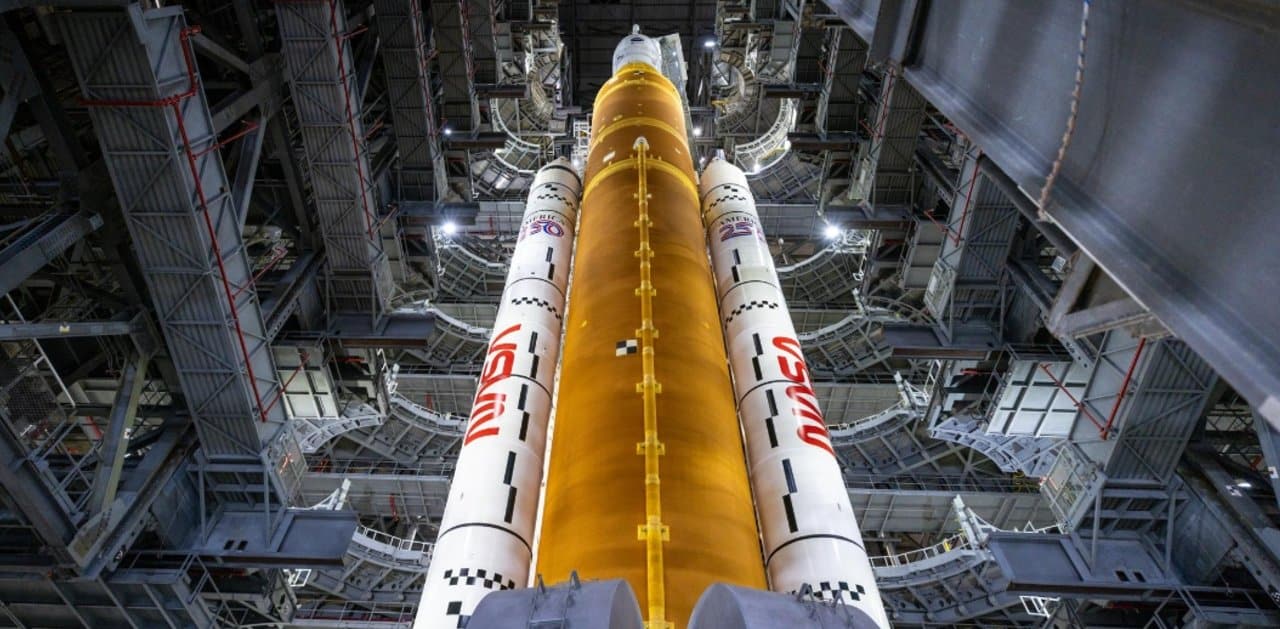
The launch of Artemis 2 will be carried out by the Space Launch System (SLS), the most powerful rocket in the world. The SLS is a centerpiece of the Artemis program, designed to transport large payloads and the Orion spacecraft into deep space. Sua propulsion capacity is unparalleled, surpassing even the Saturn V of the Apollo missions. The first stage of the SLS, with its powerful solid-fuel thrusters and four RS-25 engines, generates millions of pounds of thrust to escape Earth’s gravity.
The construction and development of the SLS has not been without challenges, including delays and high costs, but its functionality is considered essential to NASA’s ambitious goals. The integration of all its components, from engines to control systems, is a meticulous process that requires rigorous testing and verification. The performance of the SLS on unmanned flight Artemis 1 demonstrated its capability and reliability, paving the way for this manned mission. The complexity of operating a vehicle of this magnitude requires impeccable coordination between engineers and flight controllers.
Astronaut training and preparation
The Artemis 2 astronauts underwent intensive, mission-specific training, which ranged from flight simulations and emergencies to familiarization with the Orion systems. Este training is designed to prepare them for all possible contingencies, ensuring they are able to react to any unexpected situation during their space journey. Eles practiced using spacesuits, docking procedures (although there is no docking on this mission, knowledge is essential), and operating the spacecraft controls.
In addition to technical training, the astronauts also underwent rigorous physical and psychological conditioning regimes, essential to withstanding the rigors of deep space. Team cohesion is a crucial aspect, and the training included activities to strengthen communication and collaboration between the four crew members. Preparation involved detailed simulations of each phase of the mission, from launch to return and landing on Oceano Pacífico, allowing the team to refine their collective skills and knowledge.
The Artemis program and the future of exploration
The Artemis 2 mission is a vital stepping stone in the Artemis program, which aims to establish a sustainable human presence on Lua and eventually pave the way for manned missions to Marte. The program includes several phases:
* Artemis 1:Voo unmanned test of Orion and SLS, completed successfully.
* Artemis 2:Voo manned test around Lua.
* Artemis 3:Pouso manned on the lunar surface, with the first woman and first person of color on the Lua.



This ambitious plan is not just limited to landings; NASA and its partners plan to build the Gateway lunar space station, an orbital platform that will serve as an outpost for lunar missions and as a starting point for future trips to Marte. International cooperation, through agreements such as Acordos Artemis, is fundamental to the success and sustainability of these initiatives. The program represents a global effort to expand the limits of human exploration and knowledge.
Implications for the space industry
The Artemis program, and Artemis 2 in particular, has vast implications for the global space industry. The development and manufacturing of components for the SLS, Orion and the Human Landing System (HLS) generates thousands of jobs and drives technological innovation. Empresas private companies such as SpaceX and Blue Origin are actively involved, developing landing systems and other technologies that are crucial to the success of the program. Esta collaboration between government agencies and the private sector is a model for future major space initiatives.
The demand for new materials, advances in robotics, life support systems and efficient propulsion stimulates research and development in diverse areas of engineering and science. Investment in the Artemis program not only advances space exploration, but also generates tangible economic and technological benefits in Terra, with applications that can range from new energy technologies to improvements in communications and medical systems. The mission also serves as a catalyst for public interest and the next generation of scientists and engineers.
Strict security and protocols
Crew safety is the top priority for NASA and its partners. Todos aspects of the Artemis 2 mission are subjected to rigorous safety reviews and testing protocols to mitigate risks. From the design and construction phase of the Orion spacecraft and SLS rocket, to astronaut training and launch and recovery procedures, each step is meticulously planned and reviewed. Launch abort systems and emergency return capabilities are constantly evaluated to ensure maximum protection.
The mission control team, based at Johnson Space Center at Houston, will monitor the spacecraft 24/7 throughout the mission. Eles will be prepared to respond to any anomaly and make critical decisions in real time. Experience accumulated over decades of human spaceflight, from the Apollo program to Estação Espacial Internacional, is applied to ensure that Artemis 2 is as safe as technologically possible. Transparency and continuous communication between all teams involved are essential to maintaining the highest security standards.
Global expectations and scientific impact
The Artemis 2 mission is eagerly awaited by scientists, space enthusiasts and the general public around the world. Representa a new chapter in human exploration, reigniting the fascination with Lua and deep space. The success of this mission will have a profound scientific impact, providing valuable data on human physiology in extended space flights outside the protection of Earth’s magnetic field and testing essential technologies for future interplanetary missions.
In addition to the technical and scientific aspects, Artemis 2 also carries strong symbolism. Ela demonstrates humanity’s ability to overcome complex technological challenges and collaborate internationally towards common goals. The images and stories from the Artemis 2 astronauts will inspire millions, encouraging interest in science, technology, engineering and mathematics (STEM) among new generations. The mission will reinforce the leadership of the Estados Unidos and Canadá at the forefront of space exploration, opening new doors for research and development.
Schedule and next steps
With the launch of Artemis 2 projected for September 2025, NASA and its partners are in a race against time to finalize the final preparations. The Orion spacecraft is undergoing final testing and integrations, while the SLS rocket is being assembled on the Kennedy Space Center, on the Flórida. Astronauts continue their training, improving their skills and familiarity with equipment and procedures. The launch window is a critical period that requires favorable weather conditions and the readiness of all systems.
After Artemis 2, attention will turn to Artemis 3, which aims to land at Lua. The timeline for future missions will largely depend on the results and lessons learned from Artemis 2. The journey to Lua is closer than ever, with Artemis 2 ready to take humanity back into orbit with our celestial neighbor.
Veja Tambem em News (EN)

Research reveals that parents are unaware of how their children use artificial intelligence

Samsung releases new system update with new features for Galaxy Watch 4 users

Digital retail reduces the value of the Galaxy S25 5G smartphone with bank bonuses and device exchange

Amazon’s wireless CarPlay adapter has a 50% discount and high approval ratings from drivers

Zach Cregger’s new Resident Evil ignores games and focuses on an unprecedented story with new characters

Rumor suggests that Nintendo is preparing a special edition of the Switch 2 with a remake of Ocarina of Time

Apple accelerates production of the iPhone 17e and develops new Air model with dual camera system

Epic Games platform releases twelve high-budget games at no permanent cost for PC users

PlayStation 5 Pro price drop accelerates digital retail sales and eliminates global stocks

New Galaxy Watch 9 firmware appears on server and confirms progress in software development

Apple’s commemorative project tests cell phone with 1.1 millimeter edge and curved screen for 2027