
Research reveals that moons of wandering planets maintain liquid water for up to 43 billion years
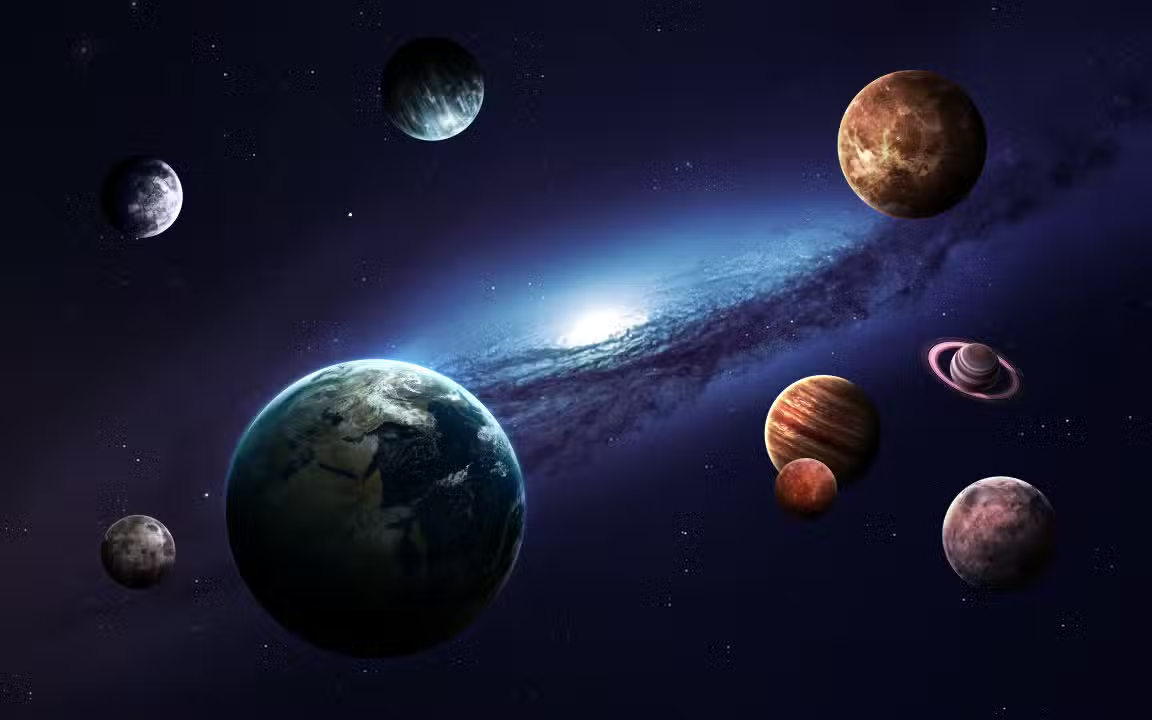
A new astrophysical study demonstrates that moons orbiting celestial bodies ejected from their stellar systems have the ability to retain oceans on their surfaces for extremely long periods, even in the total absence of a host star. The theoretical model developed by researchers at Universidade Ludwig Maximilian and Munique points out that the combination of heating generated by gravitational forces and a dense atmosphere creates favorable conditions for maintaining moisture in a liquid state. Esses celestial bodies, which roam the darkness of interstellar space, are now emerging as promising targets in the search for habitable environments outside our solar system. Computer simulation indicates that water can remain unfrozen for up to 43 billion years, a time considerably longer than the current age of the universe.
Internal heating mechanism and gravitational friction
The absence of a central star means that these moons receive no light or thermal radiation to heat their surfaces. The heat necessary to prevent the oceans from freezing completely comes from a rigorous physical process known as tidal heating, which acts directly on the geological structure of the natural satellite.

This phenomenon occurs due to the intense gravitational attraction exerted by the giant wandering planet, with a mass similar to that of Júpiter, on its moon of a size comparable to that of Terra. The elliptical orbit causes the moon to be constantly stretched and compressed by gravitational forces as it approaches and moves away from the parent planet.
This continuous deformation generates significant internal friction in the moon’s deep rock layers. The mechanical energy of this friction is converted into heat, which propagates from the core to the crust, providing the essential thermal energy to maintain liquid water at the surface, creating a dynamic and heated environment from below.
Atmospheric composition and advanced thermal retention
In addition to the heat generated internally by the rocky core, the presence of a thick atmosphere acts as an insulating blanket fundamental to the preservation of the global oceans. Modelos Previous astronomers focused on carbon dioxide as the main greenhouse gas capable of trapping heat on these dark worlds. However, the new research reveals that water vapor itself plays a much more efficient and aggressive role in capturing the infrared radiation emitted by the moon’s heated surface.
The simulation demonstrates that an atmosphere composed predominantly of water vapor and other volatile compounds creates a greenhouse effect powerful enough to stabilize surface temperatures at adequate levels. Essa Complex atmospheric dynamics prevent internal heat from escaping quickly into the frigid vacuum of space, ensuring that water does not freeze instantly and remains fluid for tens of billions of years, vastly exceeding estimates from older models based on carbon dioxide concentrations alone.
Geophysical conditions for biological development
The prolonged existence of oceans raises profound questions about the possibility of biological development on these worlds devoid of starlight. The absence of photosynthesis does not exclude habitability, changing the paradigms of spatial biology.
In Terra, entire ecosystems thrive in the ocean depths, far from sunlight, relying exclusively on chemosynthesis around hydrothermal vents. The moons of wandering planets have the potential to harbor very similar geological and chemical environments on their seabeds.
The constant interaction between liquid water and the heated rocky mantle at the bottom of these alien oceans generates complex chemical reactions. Essas reactions provide the minerals, nutrients, and thermal energy needed to support microscopic extremophile life forms.
The 43 billion year period of environmental stability provides vast time for prebiotic chemical processes to evolve into structured living organisms. Essa oceanic longevity transforms these lonely moons into astrobiological laboratories of high value for science.
Astronomical observation and detection techniques
Direct detection of rogue planets and their respective moons represents a formidable technical obstacle for contemporary astronomical instrumentation. Como These celestial bodies do not orbit a star, they do not reflect starlight significantly, and they do not cause the periodic dips in brightness that telescopes typically use to identify exoplanets through the transit method. The main currently viable technique is gravitational microlensing, a phenomenon predicted by general relativity that occurs when the wandering planet’s gravity bends and magnifies the light of a distant star located at the bottom of its trajectory. However, identifying the subtle signature of a moon orbiting this planet during a microlensing event requires extreme instrumental precision and continuous monitoring of the sky. The development of next-generation space telescopes, equipped with highly sensitive infrared sensors and adaptive optics, will be crucial to capturing the faint thermal glow emitted by these worlds and confirming the presence of water vapor-rich atmospheres.
Planetary ejection dynamics in the universe
The formation of planetary systems is a chaotic process marked by violent gravitational interactions between young celestial bodies in formation. Durante In these early phases of orbital consolidation, gas giant planets often migrate from their original positions, disrupting the stability of their neighbors.



In these turbulent migrations, gravitational force can eject smaller planets or even other gas giants out of the stellar system permanently. Esses expelled worlds take their natural satellites with them, beginning a solitary journey through deep interstellar space as independent and self-sufficient systems in terms of internal energy.
Structural parameters for ocean maintenance
Detailed analysis of computer simulations establishes specific and rigorous parameters for the survival of these isolated oceans in deep space.
– The mass of the moon must be strictly comparable to that of Terra to guarantee a gravity capable of retaining a dense atmosphere and preventing the escape of gases into space.
– The wandering planet needs to have a mass equivalent to that of Júpiter to generate adequate and continuous tidal forces on the satellite.
– The moon’s orbit must maintain a stable eccentricity over millennia to ensure that internal geological friction does not abruptly cease.
– The initial fraction of water in the moon’s composition directly affects the resulting atmospheric pressure and the efficiency of the greenhouse effect generated by steam.
Evolution of the habitable zone concept
The discovery that rogue moons may harbor oceans upends the traditional definition of the habitable zone in astrophysics. Anteriormente, this classification was based solely on the ideal distance between a planet and its host star.
Habitability now formally expands into deep, dark space. The maintenance of liquid water depends on internal geophysical factors, volcanism and local orbital dynamics, proving that stellar energy is not the only engine capable of sustaining environments conducive to the chemistry of life.
Astrophysical relevance and galactic mapping
The publication of this detailed data reinforces the need to diversify targets in the search for extraterrestrial life. Modern astrophysics is beginning to recognize that the universe is home to an immense number of dark, wet worlds, invisible to traditional star-focused detection methods, but perfectly capable of supporting fundamental biological processes in their hidden oceans.
Future mapping of the galaxy will need to account for the vast population of rogue planets, which recent estimates suggest exceed the number of stars visible in Via Láctea. Observational confirmation of the presence of water in these solitary systems will represent an unprecedented scientific milestone, demonstrating that liquid water is a resilient and widely distributed element, capable of withstanding the most extreme conditions in the cosmos through complex internal physical mechanisms.
Veja Tambem em News (EN)

Research reveals that parents are unaware of how their children use artificial intelligence

Samsung releases new system update with new features for Galaxy Watch 4 users

Digital retail reduces the value of the Galaxy S25 5G smartphone with bank bonuses and device exchange

Amazon’s wireless CarPlay adapter has a 50% discount and high approval ratings from drivers

Zach Cregger’s new Resident Evil ignores games and focuses on an unprecedented story with new characters

Rumor suggests that Nintendo is preparing a special edition of the Switch 2 with a remake of Ocarina of Time

Apple accelerates production of the iPhone 17e and develops new Air model with dual camera system

Epic Games platform releases twelve high-budget games at no permanent cost for PC users

PlayStation 5 Pro price drop accelerates digital retail sales and eliminates global stocks

New Galaxy Watch 9 firmware appears on server and confirms progress in software development

Apple’s commemorative project tests cell phone with 1.1 millimeter edge and curved screen for 2027
