
Reducing lunar illumination to 60% optimizes topographic mapping and benefits space missions
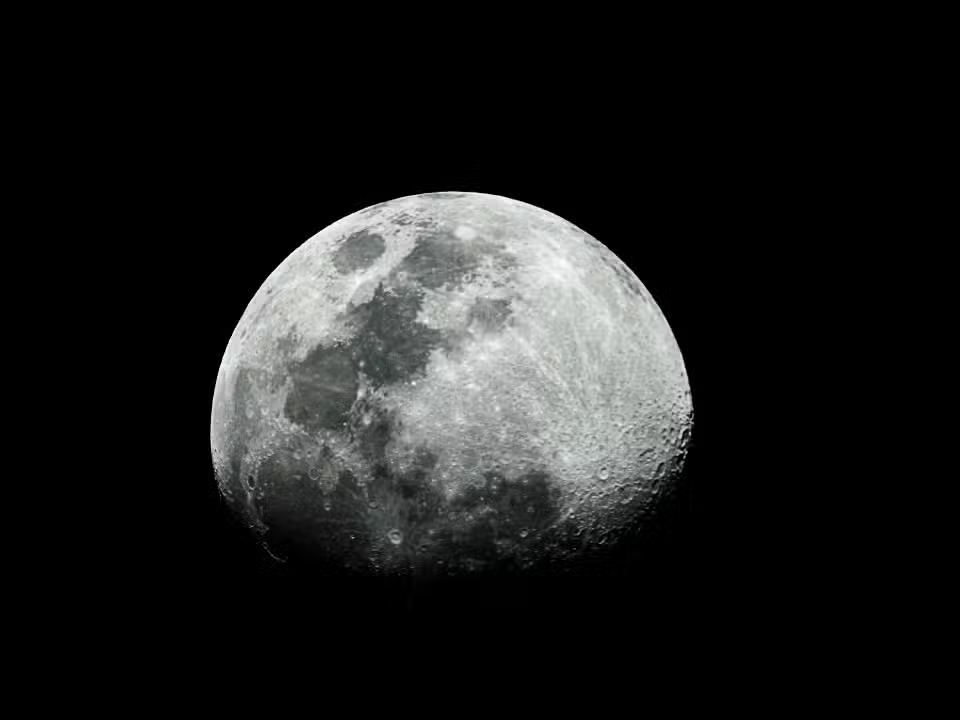
The natural satellite of Terra periodically reaches a specific phase of its visual cycle, marking exactly 60% illumination on its side facing our planet. Este regular astronomical phenomenon significantly alters nighttime observation conditions and directly affects operations at ground-based observatories across the globe. The transition to this phase gradually decreases the brightness in the night sky, creating a technical window of opportunity for collecting high-precision spatial data.
Astronomy experts use this natural reduction in light interference to record images of the cosmos and the lunar surface itself in very high resolution. Brightness control allows you to optimize the use of long-range telescopes, which often suffer from light saturation during the full moon phase. With reduced lighting, optical sensors are able to capture subtle details that would normally be obscured by the excess photons reflected by the satellite’s surface.
The practical advantages of this dimmed lighting period include the following operational factors:
– Melhoria significant visual contrast of lunar topography during mapping.
– Redução drastic glare in large diameter telescopic sensors.
– Condições ideal for tracking objects close to Earth orbit.
The mathematical precision of this event strictly follows the laws of celestial mechanics, providing an exact timeline for planning international scientific activities. Durante this period of favorable illumination, the main task of space research agencies focuses on detailed mapping of craters, plains and complex rock formations.
Impact of the terminator line on geological analysis
The visual border that separates the illuminated area from the dark region of the moon, technically known as the terminator line, gains special prominence under reduced lighting conditions. The oblique incidence of sunlight in this transition zone casts long, well-defined shadows on the satellite’s rocky, rugged terrain. Esta lateral lighting acts as a natural relief revealing tool, highlighting textures and elevations that would go unnoticed under direct vertical lighting, common in other lunar phases.
This play of light and shadow provides a natural discovery of the deepest geological features of the natural satellite. Montanhas Wide, deep valleys and the rims of ancient craters take on a three-dimensional appearance under the lenses of modern telescopes. Esta enhanced visualization allows astronomers to make precise elevation measurements from observation stations on Terra, calculating the height of formations based on the length of shadows cast over the adjacent plains.
Technical adjustments for high-resolution astrophotography
Professionals and institutions dedicated to deep space photography adjust their precision equipment to take advantage of the drop in natural light pollution. The waning or waxing phase that hits the 60% mark offers a rare technical balance, where there is enough light to focus on the details of the moon, but not enough to obscure the background stars and other nearby celestial bodies.
The astrophotography process at this stage requires meticulous calibration of the image sensors and camera exposure times. Equipamentos photographic cameras coupled to motorized telescopes continuously follow the rotation of the Terra to avoid motion blur, guaranteeing the absolute sharpness of photographs captured during hours of uninterrupted observation.
The resulting images go through advanced processing software that stacks multiple photographs to reduce digital noise generated in electronic sensors. Este method reveals subtle details of the mineralogical composition of the lunar surface, differentiating areas rich in titanium and iron based on colorimetric variations captured by high-sensitivity instruments.
Orbital synchronization and astronomical predictability
The relative position between the Terra, the moon and the sun determines the exact percentage of illumination visible each night in our planet’s skies. The lunar translation movement around Terra occurs at an average speed of 3,600 kilometers per hour, constantly changing the angle of incidence of sunlight on the satellite’s dusty surface.
This complex gravitational dynamic keeps the moon in a synchronous rotation, meaning it takes exactly the same time to rotate around its own axis as it does to orbit Terra. Consequentemente, terrestrial observers always see the same face of the satellite, regardless of the percentage of illumination recorded by astronomical instruments.



The stability of this orbit is fundamental for the predictability of astronomical events and for the organization of the global scientific calendar. Tabelas of ephemerides calculate years in advance the exact times when illumination will reach the specific mark, allowing international surveys and time allocations on large telescopes to be precisely scheduled.
The continuous monitoring of these orbital variables also serves to calibrate spacecraft navigation instruments. Sondas and artificial satellites use the position of the moon and its illumination phase as fixed reference points when adjusting trajectories in interplanetary missions and Terra low-orbit operations.
Strategic mapping for future landing missions
Topographic maps updated during these observation windows provide critical data for the development and safety of future manned or robotic landing missions. Engenheiros of aerospace companies analyze high-contrast images to identify risk areas, such as dense boulder fields or steep slopes, that could compromise the physical integrity of landers during final descent.
In addition to ensuring the safety of space hardware, the detailed study of lunar geology helps in the search for essential mineral resources, such as ice deposits located in permanently shadowed craters at the poles. Partial illumination facilitates observation of regions adjacent to the poles, helping scientists plot safe exploration routes for automated rovers, optimizing the energy consumption of surface vehicles and increasing the overall efficiency of missions.
Data processing and three-dimensional modeling
The integration of captured photographs with geographic information systems results in the creation of highly accurate digital elevation models. Pesquisadores at technology institutes process terabytes of visual data using advanced photogrammetry algorithms, which calculate the depth and altitude of geological formations based on the length and slope of shadows cast on the surface. Este digital collection not only serves the scientific community for studies on the formation of the solar system and the history of meteorite impacts, but is also available for training artificial intelligence systems aimed at autonomous navigation in deep space. Continuous three-dimensional modeling ensures that lunar maps remain strictly up-to-date, reflecting any new surface changes caused by recent micrometeoroid impacts, making the database robust and reliable for all space agencies involved in long-term extraterrestrial infrastructure planning.
Calibration of optical instruments in observatories
Large ground-based observatories take advantage of the moon’s intermediate luminosity to test and calibrate new photon-capturing sensors before more complex observation missions. The moderate intensity of the light prevents saturation and potential damage to ultrasensitive detectors, which could be harmed if exposed to the full brightness of a full moon without the use of suitable attenuation filters, ensuring that spectrographs and wide-field cameras operate at maximum efficiency when pointing at more distant and darker targets in the universe.
Minimizing terrestrial atmospheric distortions
Observations made from the surface of Terra face the ongoing challenge of atmospheric turbulence, a phenomenon that distorts light from space and impairs the clarity of captured images. Layers of air at different temperatures and densities act like constantly moving lenses, causing stars to twinkle and blur the fine surface details of planets and natural satellites.
During the 60% illumination phase, the reduced dispersion of lunar light in the Earth’s atmosphere significantly improves the local astronomical visibility index. Esta reduction in photon scattering allows ground-based telescopes to achieve higher optical resolutions, facilitating the recording of accurate topographic data and the observation of deep star fields with a considerably lower level of interference.
Veja Tambem em News (EN)

Research reveals that parents are unaware of how their children use artificial intelligence

Samsung releases new system update with new features for Galaxy Watch 4 users

Digital retail reduces the value of the Galaxy S25 5G smartphone with bank bonuses and device exchange

Amazon’s wireless CarPlay adapter has a 50% discount and high approval ratings from drivers

Zach Cregger’s new Resident Evil ignores games and focuses on an unprecedented story with new characters

Rumor suggests that Nintendo is preparing a special edition of the Switch 2 with a remake of Ocarina of Time

Apple accelerates production of the iPhone 17e and develops new Air model with dual camera system

Epic Games platform releases twelve high-budget games at no permanent cost for PC users

PlayStation 5 Pro price drop accelerates digital retail sales and eliminates global stocks

New Galaxy Watch 9 firmware appears on server and confirms progress in software development

Apple’s commemorative project tests cell phone with 1.1 millimeter edge and curved screen for 2027
