

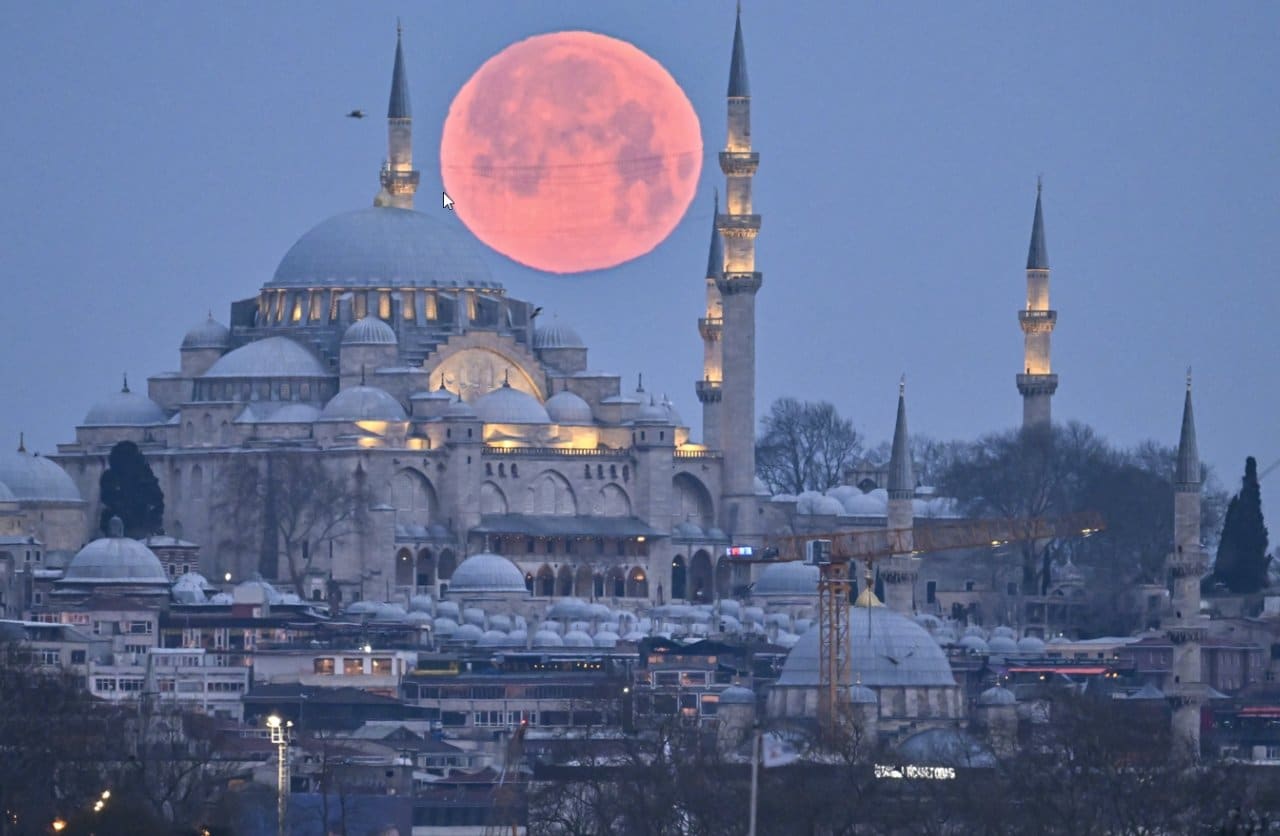
Millions of people around the world are preparing to observe one of the most anticipated celestial phenomena of the year: April’s full pink moon. Este event, which will reach its peak on April 2, promises a visual spectacle in the night sky, although the name “pink” does not refer to its actual color, but rather to an ancient tradition.
The name “pink moon” has deep origins in popular culture and ancient calendars, which associated lunar cycles with seasonal and natural events. Instead of a literally pink hue on the natural satellite of Terra, the name celebrates the flowering of a species of wildflower from América of Norte, the creeping phlox (Phlox subulata), which blooms intensely in shades of pink at this time of year.
This lunar event is not just a visual treat for astronomy enthusiasts and skywatchers; it carries significant cultural and religious importance. April’s full moon plays a key role in determining the date of the Christian Páscoa and the Jewish Páscoa, connecting celestial cycles to ancient traditions.
The True Shade of the April Full Moon
Apesar From its evocative name, April’s Pink Moon is unlikely to display a rosy tinge to most observers. On the night of its fullness, when the natural satellite is lower on the horizon, its appearance tends to be more orange or reddish.
This optical phenomenon is the result of the scattering of sunlight reflected by the moon as it passes through the Earth’s atmosphere. Particles in the atmosphere scatter shorter-wave colors, such as blue and violet, allowing longer-wave colors, such as red and orange, to reach our eyes with greater intensity, especially when the moon is close to the horizon.
Ancestral names and global meanings
The tradition of naming full moons is a legacy of indigenous peoples and agricultural cultures that used lunar cycles as a natural calendar to mark seasons and events important for subsistence. The pink moon is just one of many names given to this lunar phase, reflecting the diversity of interpretations around the globe.
In addition to the “pink moon”, this period is also known by other names, such as “moon of the grass sprouts”, indicating the flowering of vegetation after winter, or “moon of eggs”, referring to the time of spawning and rebirth. In the context of people who depended on fishing, it may be called the “full fish moon”, when schools of fish move up rivers to spawn, while in colder regions, the name “cracking ice moon” marks the transition to a milder climate.
These names underscore the deep connection between humanity and the rhythms of nature, providing a rich tapestry of cultural meanings that predate modern calendars. Cada name carries with it the history of a time, a people and their relationship with the environment, making observing the full moon not only an astronomical experience, but also an anthropological one.
Visibility forecast in the territory
The ability to observe the full pink moon will largely depend on local weather conditions. A cold front could move in, bringing clouds and rain in some regions, which could make it difficult to see the phenomenon.
For those looking for a clear view of the celestial event, the areas with the highest probability of clear skies are generally those with lower humidity and fewer clouds. It is essential that night sky enthusiasts consult weather forecasts specific to their location.
In some parts, such as the north and some coastal regions, there may be a better chance of clear periods. Contudo, the presence of clouds can be a significant challenge for observation in a large part of the territory.
Staying up to date with local weather reports is the best strategy for planning a full moon viewing. Mesmo with clouds, the grandeur of the full moon can manifest itself in brief clearings, offering unique moments for those who pay attention.
The crucial relationship between the full moon and Easter
April’s pink moon has a special relevance for the Christian calendar, as its occurrence is a determining factor for the date of Páscoa. The celebration always takes place on the first Sunday after the first full moon that follows the spring equinox in the northern hemisphere.
This complex calculation, established centuries ago, ensures that Páscoa is linked to an astronomical event and the beginning of spring. In 2026, the spring equinox in the northern hemisphere will occur on March 20. Como the full pink moon rises on April 2, it becomes the first full moon after the equinox.
This means that the Christian Páscoa will be celebrated on the Sunday following the full moon, on April 5th. The rule is clear: if the full moon falls on a Sunday, the Páscoa is transferred to the subsequent Sunday, preventing the celebration from coinciding exactly with the lunar event that defines it.
Historical challenges in defining Easter
Throughout history, the definition of the date of Páscoa was the subject of debates and disagreements within Igreja Cristã. The use of different calendars — the Gregorian and the Julian — by different parts of the Igreja resulted in variations in the date of the celebration in various parts of the world for centuries.
Attempts at unification were complex, leading to situations in which, although many Eastern European countries have adopted the Gregorian calendar for civil purposes, they still use the Julian calendar to mark Orthodox festivals. Essa duality contributed to the perpetuation of distinct Páscoa dates between Western and Eastern traditions. Adicionalmente, the astronomical equinox naturally fluctuates between March 20th and 21st. Para to standardize the calculations, Igreja Cristã symbolically fixed the date of the equinox on March 21 for its own purposes, ensuring a stable basis for determining Páscoa. Essa decision aims to regularize the calculation and avoid the complexity of annual variations in the real equinox, solidifying the date of the lunar event as the main marker for the festivity.
The Jewish lunar cycle and Passover
In the Jewish calendar, the new moon marks the beginning of each lunar month, and the full moon always occurs halfway through the month. The Jewish Páscoa, or Pessach, begins in the middle of the month of Nisan, which is the first month of the Hebrew calendar. Este period coincides directly with the arrival of the April full moon, reiterating the interconnection between celestial cycles and religious traditions.
Tips to better observe the phenomenon
Para For those who want to appreciate the beauty of the full pink moon, some recommendations can optimize the experience:



