
Hubble Telescope shares new image of the M4 cluster with up to 40,000 white dwarfs


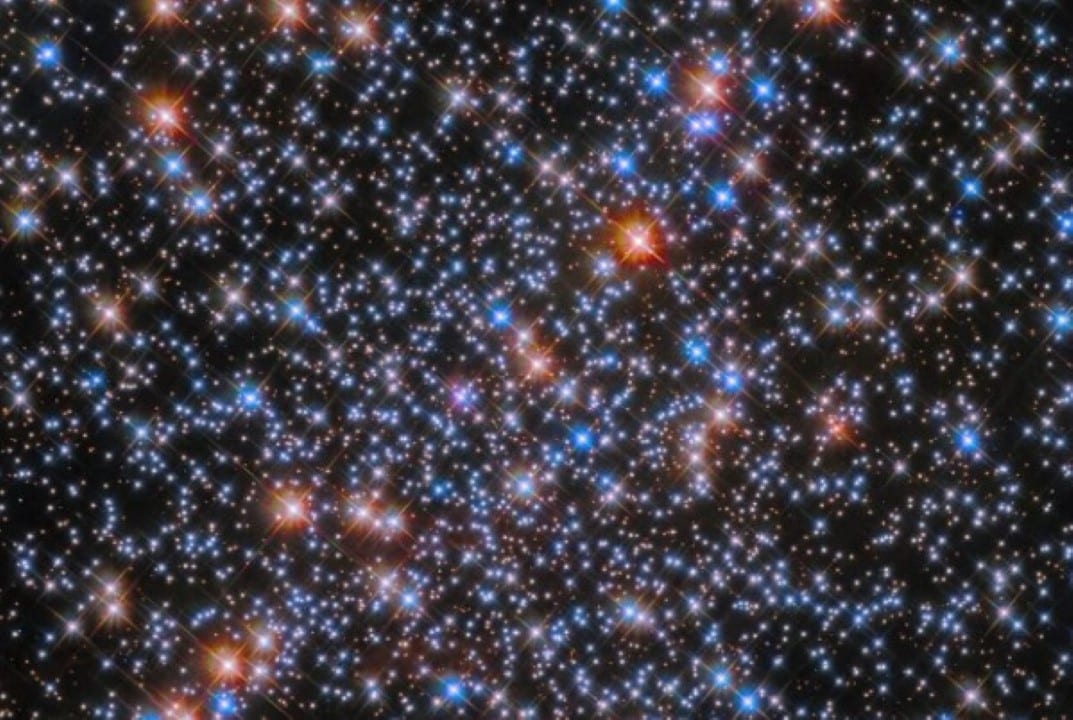
Telescópio Espacial Hubble captured a new image of the globular cluster M4, located in the direction of the constellation Escorpião. Esse celestial object is approximately 6 thousand light years from Terra and brings together hundreds of thousands of stars grouped in a spherical shape by the force of gravity. The recently released image highlights stellar density and allows studies on cosmic evolution in one of the closest clusters to our solar system.
Astronomers consider M4 a natural laboratory for understanding the first generations of stars. The observations combine data from different Hubble instruments, which reveals variations in temperature, age and composition among the group’s stars.
- The cluster is home to stars formed around 13 billion years ago.
- Estimates indicate the presence of up to 40 thousand white dwarfs in its interior.
- The spherical structure results from the mutual gravitational attraction of the stars.
Characteristics of ancient stars in M4
The stars that make up M4 emerged in the early stages of the universe, with an age close to 13 billion years. The Essa mark brings the cluster closer to the estimated age of the universe, which is around 13.8 billion years. Therefore, these stars function as stellar fossils that record conditions of initial galactic formation.
Research based on observations of Hubble makes it possible to map the gradual cooling of these stars over time. Analysis of its properties helps refine models about the chronology of Via Láctea and other similar systems.
White dwarfs reveal stellar evolution
White dwarfs represent the final phase of relatively low-mass stars, similar to Sol. In M4, projections indicate the existence of up to 40 thousand of these compact objects. Cada white dwarf has a diameter close to that of Terra, but it concentrates a mass equivalent to around 60% of the solar mass, which results in an extremely high density.
During evolution, these stars go through a red giant phase, in which they expand their outer layers and release gas and dust. Após this loss, what remains is the core that becomes a white dwarf. Sem active nuclear fusion, these remnants slowly cool and serve as cosmic clocks to determine the age of star clusters.
Astronomers use measurements of the temperature and brightness of white dwarfs to calibrate universal time scales. In the case of M4, the data reinforce independent estimates about the formation of the first stars in the galaxy.
Mass concentration in the center of the cluster
Observations accumulated over 12 years by Hubble, combined with data from Gaia’s Agência Espacial Europeia telescope, revealed a significant mass concentration in M4’s core. Analysis of the movement of the central stars indicates excess mass equivalent to about 800 times the mass of Sol in a very compact region.
This configuration suggests the possible presence of an intermediate-mass black hole. Objetos in this category fill the gap between stellar-mass black holes, formed by the collapse of massive stars, and supermassive ones located in galactic centers.
The team responsible for the study, which includes researchers from Space Telescope Science Institute, considers that the detected mass probably corresponds to a single black hole. Detection is based on precise variations in stellar orbits influenced by central gravity.
Importance of observations for astronomy
M4 stands out for its relative proximity, which facilitates detailed observations with instruments such as the Advanced Camera for Surveys and the Wide Field Camera 3 for Hubble. Essas tools capture a wide range of wavelengths and allow us to distinguish stars of different ages and chemical compositions within the cluster.
Data like these contribute to understanding how globular clusters formed and evolved throughout cosmic history. The potential presence of an intermediate black hole also opens up avenues for investigating the formation and growth of these rare objects in the universe.
Technical details of the released image
The image shared in March 2026 uses information collected by Hubble’s cameras to highlight the brightness and distribution of stars in M4. The combination of filters allows us to visualize subtle differences between stellar populations, including the oldest and cooling white dwarfs.
This visual representation helps both the public and the scientific community appreciate the complexity of the object. The cluster continues to be monitored to refine core mass measurements and confirm dynamic characteristics.
The globular cluster M4 offers ongoing opportunities to study the processes that shaped Via Láctea. Novas observations with space telescopes focus on details that reveal the history of the oldest stars accessible to human investigation.



