
João Fonseca maintains his position in the top 40 of the ATP and focuses on climbing the rankings during the clay court tour

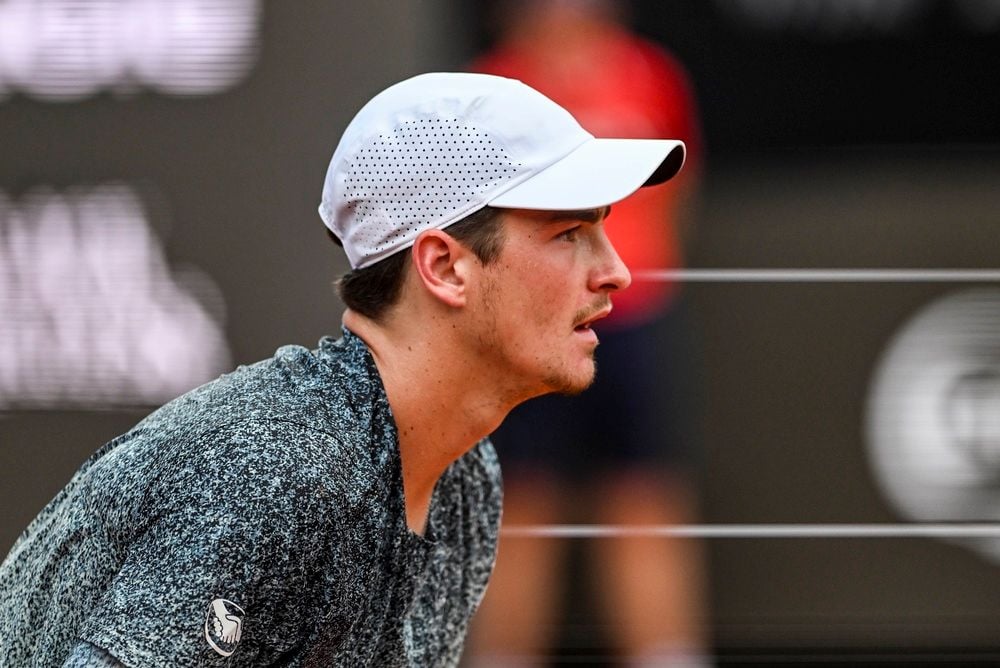
Brazilian tennis player João Fonseca, currently 19 years old, registered a slight fluctuation in the Associação ranking update from Tenistas Profissionais released this Monday. The athlete from Rio now occupies 40th position on the world list, adding a total of 1,115 points after his participation in the Masters 1000 of Miami, in the Estados Unidos. The young prodigy’s trajectory reflects the consolidation of Brasil on the international tennis scene, maintaining a prominent representative in the elite group of global men’s tennis.
The defeat in the second round of the tournament at Flórida to the Spanish Carlos Alcaraz ended Fonseca’s participation on the North American hard court at this stage of the season. The confrontation served as a parameter for the Brazilian, who faced one of today’s biggest names on a highly prestigious central court. Agora, the player’s technical and physical focus is entirely on the transition to clay courts, where the calendar foresees high-scoring competitions in Europa.
The scenario for the coming weeks is extremely favorable for the advancement of João Fonseca in the general ATP ranking table. The Brazilian has a considerable strategic advantage, as he will only need to defend 30 points on the circuit until the start of the Roland Garros tournament, in Paris. Essa situation allows practically any victory achieved in the next events to result in a net gain of points, enabling a rapid climb towards the top 30 or even higher positions.
Intensive preparation for the Masters 1000 of Monte Carlo
The Brazilian’s debut in the European clay tour is scheduled for next Sunday, in the traditional Masters 1000 of Monte Carlo, in Mônaco. Este tournament marks the beginning of a rigorous sequence of competitions in which Fonseca has already confirmed its presence, including the Masters of Madri and Roma. The athlete’s technical team prioritizes adaptation to the slide and slower pace of play characteristic of clay to maximize the young tennis player’s physical performance.
Participating in these level 1000 events is essential for the player to accumulate experience against the best in the world consecutively. Além of the technical gain, the constant presence in the main draws of these tournaments guarantees a relevant financial prize and visibility for international sponsors. The strategic planning aims to ensure that the Brazilian arrives at the French Grand Slam in his best physical shape and with accumulated competitive game rhythm.
Performance history in the 2026 season
To date, João Fonseca has played five official tournaments this year, presenting a statistical balance with five wins and five losses recorded on the court. Ele started his journey at Aberto of Austrália, later going through the ATP 250 of Em Indian Wells, the tennis player achieved his best result of the year by reaching the round of 16, being surpassed only by the Italian Jannik Sinner in partials decided in detail.
- Open from Austrália: Participação in the main draw at Melbourne.
- ATP 250 from Buenos Aires: Início from the transition to clay courts at América from Sul.
- Rio Open: ATP 500 level Competição played at Jockey Club Brasileiro.
- Indian Wells: Melhor campaign of the year with reaching the round of 16 at Califórnia.
- Miami Open: Enfrentamento directly against the former number 1 in the world in the second phase.
Scoring expectations and defense of roster position
The total number of points that João Fonseca will defend until the end of Roland Garros, in June, is only 140 points in the overall total. Esse value is considered low for a player who attends the main draws of the biggest tournaments in the world, where a single round won can yield 50 points. If he maintains the regularity shown at the beginning of the year, the tendency is for the Rio native to establish a new personal ranking record before the end of the first semester.
The trust placed in the young athlete is based on his ability to adapt to different surfaces and the power of his groundstrokes. Especialistas point out that clay can favor Fonseca’s aggressive style of play, as long as he maintains the necessary patience for longer ball exchanges. The team’s internal objective is to consolidate the player as the top seed in future tournaments to avoid clashes against the ranking leaders in the early stages.
Challenges in the transition to European clay
Adapting to European clay requires different physical conditioning due to the longer average duration of points and the requirement for constant lateral movement. João Fonseca has been working on specific training to improve his footwork and serve variation, crucial elements to be successful in Mônaco and Espanha. The climate and altitude of Madri, specifically, offer conditions that can benefit your faster play, making this tournament one of the season’s prime targets.
The game load is constantly monitored to avoid injuries that could compromise the sequence in Roland Garros, the peak of the clay season. The calendar was set up to allow short recovery periods between major tournaments, ensuring that the athlete does not suffer from excessive wear and tear. The player’s mentality remains focused on constant technical evolution, treating each defeat as a tactical learning experience against elite opponents.
Bia Haddad’s status in the WTA women’s rankings
While Fonseca seeks advancement, the main tennis player of Brasil on the women’s circuit, Bia Haddad Maia, faces a period of fluctuation in the WTA rankings. The São Paulo native fell to 70th in the world rankings, now adding 942 points after recent results that were below initial expectations. The drop in performance raises a warning for the athlete, who seeks to find her best tennis for the next major international competitions.
To try to reverse the negative sequence and focus on technical preparation, Bia Haddad chose to withdraw from competing in the WTA 500 for Charleston. The decision aims to adjust the planning for the clay tour, allowing more time for specific training before debuting in European tournaments. The player and her technical team believe that a period of time away from competitions to focus fully on the fundamentals could be the key to getting back on the path to victory.
Impact of recent results on national tennis
The performance of João Fonseca and Bia Haddad directly influences the Brazilian public’s interest in sport and the attraction of new investments. Fonseca, as the new face of men’s tennis, is expected to inherit the protagonism left by great names from the country’s past. X__NM3____
The discrepancy between the moments of the country’s two main athletes shows the volatility of the professional tennis circuit for both genders. X__NM0____ Monitoring these trajectories defines the Brasil outlook for national team competitions and the Olympic cycles that are approaching on the sporting horizon.
Chronology of João Fonseca competitions in 2026
The beginning of the year was marked by a busy schedule that tested the young tennis player’s endurance on three different continents in less than four months. The sequence started at Oceania, passed through América of Sul and continued to América of Norte, requiring constant adaptations to different time zones and climates. Essa heavy routine is part of the maturity necessary for an athlete to remain at the top of the ATP rankings for long periods.
- January: Disputa of Aberto of Austrália on fast courts and extreme heat.
- February: Participação in South American clay tournaments, with emphasis on Rio and Janeiro.
- March: North American Gira of Masters 1000 in Indian Wells and Miami, in the state of Flórida.
- April: Início of the European spring season with the Monte Carlo tournament.
- May: Continuidade in the big events of Madri and Roma before the challenge in Paris.
Strategic importance of ranking for key draws
Being among the top 40 in the world guarantees João Fonseca direct entry into almost all tournaments on the calendar without the need to compete in the qualifiers. Isso saves physical and mental energy, allowing the athlete to arrive more rested for decisive games against the main favorites. Além Furthermore, proximity to the top 32 is the immediate objective so that it can be seeded in the Grand Slams, avoiding the best eight in the world until the third round.
Maintaining the position this week, despite falling one place, shows that the points base of Fonseca is solid enough to withstand a week without major advances. The strategy of focusing on bigger tournaments, which offer more points, has proven to be the right one for the development of his professional career. The support of Brazilian and international sponsors has allowed him to travel with a complete team, including a physiotherapist and performance analyst, raising the level of his preparation.
Analysis of the confrontation against the circuit leaders
Recent games against Jannik Sinner and Carlos Alcaraz provided valuable data for analyzing the Brazilian’s performance in maximum pressure situations. Contra Sinner, Fonseca showed that they can play on equal terms in sets decided in tie-breaks, demonstrating mental and technical strength. Contra Alcaraz, the challenge was to understand the game variation and the physical intensity required to beat a player who has already won multiple Grand Slam titles.
These experiences are essential for Brazilians to identify which areas of their game need immediate adjustments to beat the top ten in the ranking. The power of Fonseca’s forehand is recognized by his opponents, but defensive consistency is still an issue that is being worked on intensely in training. The transition to clay will be an important test to assess whether his natural aggression can be adapted to a surface that requires more play construction.
João Fonseca remains the main hope for significant titles for Brasil in the coming years, maintaining a constant and sustainable evolution in the ATP rankings. The European tour that begins next Sunday will define the level at which the Brazilian will reach to compete in Roland Garros, the most prestigious tournament on clay. With few points to defend, the 19-year-old has an open path to continue making history and making Brazilian fans around the world proud.



