
Research reveals prolonged habitability in exomoons around free-floating planets via tidal heating
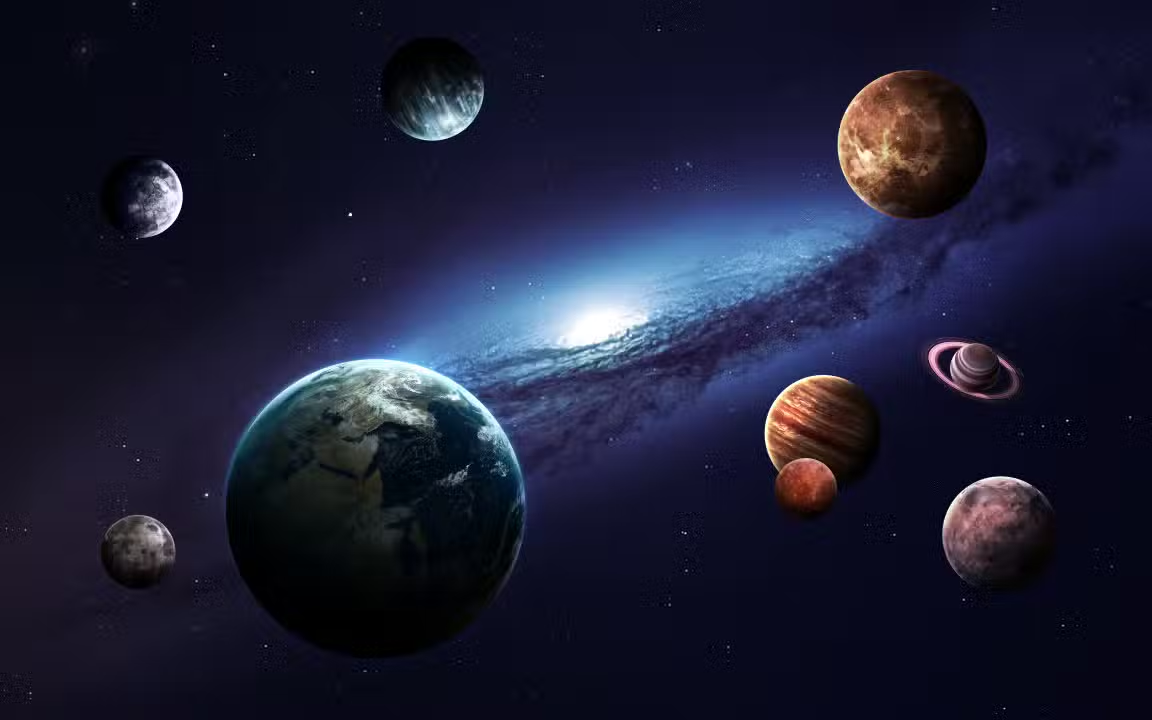
New research shows that exomoons orbiting free-floating planets, known as rogue planets, can sustain oceans of liquid water on the surface for periods reaching billions of years. Esses worlds have no nearby star to provide heat, but combine heating generated by tidal forces with dense atmospheres dominated by molecular hydrogen. Scientists have modeled scenarios where high atmospheric pressure allows hydrogen to retain internal heat through atomic collisions, creating stable conditions for the presence of liquid water.
This configuration differs from carbon dioxide-based atmospheres, which tend to condense at extreme temperatures in the interstellar medium and lose efficiency as a thermal insulator. The researchers considered moons with masses similar to Marte orbiting gas giants ejected from their original star systems. The ejection process can preserve exomoons, allowing them to remain in orbit around their host planet even in cold interstellar space.
- Tidal warming results from repeated gravitational deformation in the moon’s interior.
- This friction generates enough energy to maintain water evaporation and condensation cycles.
- The presence of molecular hydrogen acts as a stable greenhouse gas at low temperatures.
- Models indicate that high surface pressures extend the habitable period significantly.
Mechanisms supporting habitability in distant exomoons
Tidal warming arises from the gravitational interaction between the exomoon and the giant planet to which it is attached. Essa force deforms the moon’s rocky or metallic interior, releasing heat through internal friction over millions or billions of years. Diferentemente of moons such as Europa or Ganimedes on
The researchers integrated radiative transfer and equilibrium chemistry models to simulate hydrogen-dominated atmospheres. At surface pressures of around 100 bars, conditions for liquid water have been maintained for up to 4.3 billion years in some simulated cases. Esse interval corresponds approximately to the time required for the development of complex life at Terra. At lower pressures, such as 10 bars, the period drops to hundreds of millions of years, but still represents a relevant window for prebiotic chemical processes.
Even in thinner atmospheres, at 1 bar pressure, a fraction of the modeled orbits produced temporary conditions for liquid water. Hydrogen remains gaseous even at the very low temperatures of interstellar space, unlike carbon dioxide which solidifies or condenses easily. Essa property allows the gas to act as an effective thermal trap through collision-induced absorption, trapping internally generated heat.
Additional condensable species, such as methane, ammonia, and water vapor, can further contribute to stabilizing heat retention in the atmosphere. The wet-dry cycles caused by strong tides favor the polymerization of RNA and other initial steps for the emergence of life, according to the simulations.
Comparison with alternative atmospheres and observed limitations
Previous studies had explored the potential of carbon dioxide-rich atmospheres for exomoons, but the limit they found was about 1.6 billion years under similar conditions. The new work highlights that hydrogen offers superior stability in cold environments and without stellar radiation. Scientists from Ludwig-Maximilians-University Munich and Max Planck Institute for Extraterrestrial Physics emphasized that hydrogen does not collapse through condensation, maintaining its thermal insulation capacity for long periods.
The estimated abundance of free-floating planets in Via Láctea reinforces the interest in these configurations. Modelos indicate that these objects may outnumber stars in large proportions, with trillions of potential candidates. Muitos of them carry exomoons retained during the ejection process from the original star system.
Details of internal heating and geological cycles
The interior of exomoons experiences constant compression and expansion due to tidal forces. Essa dynamics release minerals and energy in hydrothermal vents at the bottom of the oceans, similar to what occurs on oceanic worlds in Sistema Solar. The release of chemical compounds can drive reactions that favor the formation of complex organic molecules.
The researchers noted that ejection from the host planet does not necessarily destroy the moons in orbit. Instead, the orbits may adjust so that tidal heating remains active. Essa persistence allows surface oceans to remain liquid even far from any star.
Implications for the search for life beyond Sistema Solar
The discovery expands the traditional concept of the habitable zone, which generally considers the distance to a star as the main factor. Exomoons around wandering planets represent environments where habitability depends primarily on internal processes and atmospheric composition. The models used incorporated a wide range of initial chemical compositions involving carbon, oxygen and nitrogen.
The results suggest that dark regions of interstellar space may harbor stable conditions for liquid water for long geological times. Essa perspective opens new avenues for future investigations with advanced telescopes capable of detecting atmospheric signatures in cold, isolated objects.
Conditions necessary for heat retention in hydrogen atmospheres
Surface pressure has a direct influence on the efficiency of thermal retention. Quanto the greater the pressure, the more intense the molecular collisions that allow the absorption of infrared radiation become. The simulations showed significant variations depending on the moon’s mass, orbit and the initial amount of hydrogen available.
Factors such as the exact composition of the atmosphere and the presence of other volatile gases modulate the thermal balance. The researchers highlighted that hydrogen-dominated atmospheres resist heat escape better compared to previously tested alternatives.
Tidal heating as a primary energy source
Continuous gravitational deformation acts like an internal battery that does not depend on sunlight. The Esse mechanism is already known on moons of Sistema Solar, but it gains special relevance on planets without a star. The combination with an insulating atmosphere creates a closed system capable of maintaining temperatures suitable for liquid water for extended periods of time.



Tidal cycles also promote mixing of materials between the ocean and the mantle, enriching the chemical environment. Essa dynamics can accelerate processes that lead to the formation of biological precursors.
Future detection prospects
Astronomers continue to identify candidate free-floating planets and their possible moons through gravitational microlensing observations and other methods. While direct detection of atmospheres in exomoons remains challenging, advances in instrumentation may enable spectroscopic analyzes in the future. The study provides a theoretical framework for prioritizing promising observational targets.
Characteristics of modeled exomoons
The simulations focused on moons with masses comparable to Marte or greater, orbiting ejected gas giants. Ilustrações conceptual maps show scenarios where some of these moons have surface oceans while others remain drier, depending on specific atmospheric conditions. Tidal heating varies depending on orbital distance and eccentricity, directly influencing the duration of habitable conditions.
Atmospheric stability in interstellar environments
Molecular hydrogen demonstrates high stability at extremely low temperatures. Essa property prevents atmospheric collapse that would affect other gases in similar conditions. Modeling included equilibrium chemistry and radiative transfer effects to ensure realism in predictions.
Contributions to the understanding of abiogenesis
Tide-induced wet-dry cycles, combined with the alkalinity provided by dissolved ammonia, create environments favorable to RNA polymerization. Essa chemical connection links the exomoon models to scenarios proposed for the early Terra, where hydrogen-rich impacts could have played a similar role.
The research reinforces that the origin of life does not necessarily depend on a nearby star, expanding the potential locations where pre-biotic processes can occur.
Summary of main simulation results
In atmospheres with 100 bars of pressure, the maximum period with conditions for liquid water reached 4.3 billion years. Reduções in pressure proportionally decreases this range, but even moderate values produce significant windows. The fraction of orbits that generate habitability varies depending on the initial parameters adopted in the model.
Differences from known oceanic worlds
While moons like Europa maintain global oceans beneath thick ice sheets, the exomoons studied may expose oceans directly to the atmosphere. Essa exposure facilitates chemical exchanges between the surface, atmosphere and interior, enhancing the complexity of environments.
Importance of hydrogen as an alternative greenhouse gas
Unlike carbon dioxide, hydrogen does not undergo rapid condensation in the interstellar cold. Collision-induced absorption allows it to efficiently retain heat under high pressure, offering a stable solution for thermal insulation in insulated exomoons.
Application of models to different compositions
Scientists tested several initial compositions involving elements such as carbon, oxygen and nitrogen. The results indicate that hydrogen-rich atmospheres remain robust even with variations in the proportion of these elements.
Conclusion of analyzes on habitable duration
The combination of persistent tidal warming and dense hydrogen atmospheres allows exomoons to maintain liquid oceans for times comparable to the current age of Terra. Essa discovery significantly expands the catalog of environments where conditions favorable to life can exist in the universe.
Veja Tambem em News (EN)

Research reveals that parents are unaware of how their children use artificial intelligence

Samsung releases new system update with new features for Galaxy Watch 4 users

Digital retail reduces the value of the Galaxy S25 5G smartphone with bank bonuses and device exchange

Amazon’s wireless CarPlay adapter has a 50% discount and high approval ratings from drivers

Zach Cregger’s new Resident Evil ignores games and focuses on an unprecedented story with new characters

Rumor suggests that Nintendo is preparing a special edition of the Switch 2 with a remake of Ocarina of Time

Apple accelerates production of the iPhone 17e and develops new Air model with dual camera system

Epic Games platform releases twelve high-budget games at no permanent cost for PC users

PlayStation 5 Pro price drop accelerates digital retail sales and eliminates global stocks

New Galaxy Watch 9 firmware appears on server and confirms progress in software development

Apple’s commemorative project tests cell phone with 1.1 millimeter edge and curved screen for 2027
