
Apple ends production of the Mac Pro and changes memory limits on professional line computers
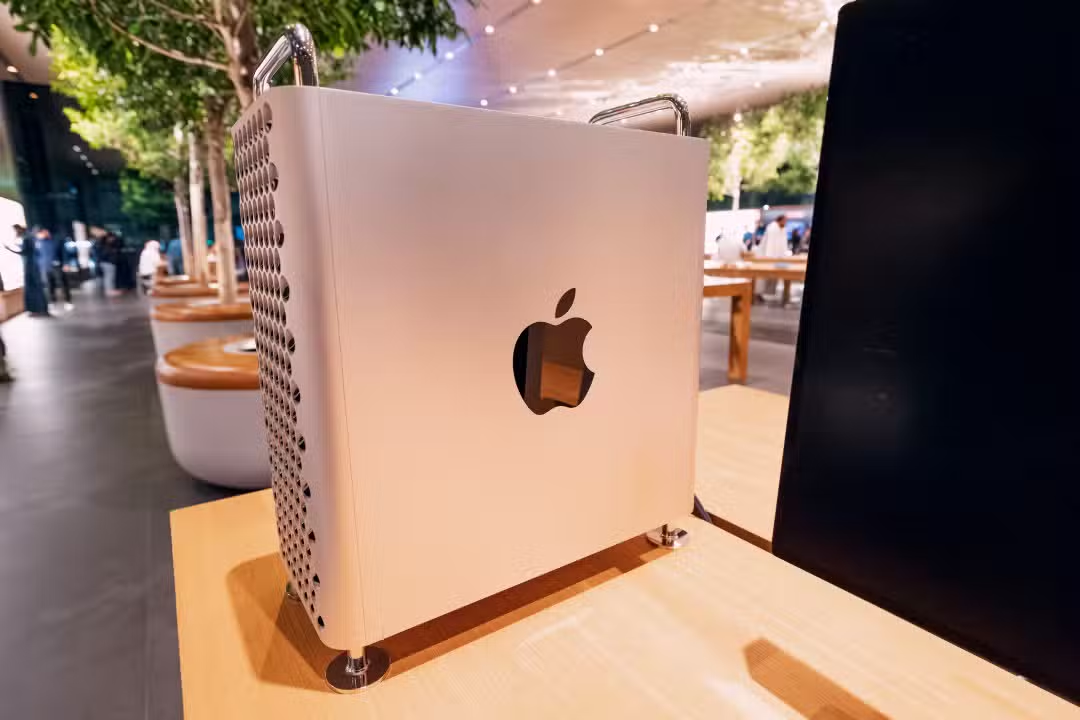
The technology company based in Cupertino has officially stopped manufacturing its most modular desktop computer after two decades of presence on the market. The decision to remove the equipment from the online catalog took place in the last week of March and signals a definitive change in the hardware strategy aimed at the corporate public and content creators. The measure accompanies a profound restructuring of the configuration options of other high-performance machines.
The compact computer aimed at creative studios also underwent direct changes to its sales architecture. The manufacturer removed the possibility of ordering the equipment with five hundred and twelve gigabytes of unified memory, establishing a new ceiling of two hundred and fifty-six gigabytes.

- End of line modular tower desktops with expansion slots.
- Reduced maximum random access memory limit on compact workstations.
- Increased standard storage capacity on high-end laptops.
These modifications require recording studios, film production companies and advertising agencies to reevaluate their information technology infrastructures for upcoming hardware upgrade cycles.
History of values and reactions of the technology sector
The portfolio restructuring changed the starting value table for laptops aimed at extreme productivity. The fourteen-inch model equipped with the fifth generation M series processor now has an entry value of one thousand six hundred and ninety-nine dollars on the international market. Esse readjustment occurs because the manufacturer eliminated the base version that had five hundred and twelve gigabytes of disk space, standardizing one terabyte of solid state storage for all machines in this category. The change improves transfer rates for heavy files, directly benefiting the handling of videos at very high resolutions.
Historically, the modular processing tower represented the pinnacle of customization within the brand’s ecosystem, allowing users to add third-party graphics cards, audio capture cards and additional memory sticks as project needs increased. The transition to the proprietary silicon architecture eliminated the technical feasibility of this modularity, since the new processors integrate the central unit, the graphics processor and the memory in a single component. Especialistas in hardware point out that this integration offers superior bandwidth and lower power consumption, but forces buyers to perfectly size the specifications at the time of purchase, as future physical upgrades are impossible for the end user to perform.
- Need for more rigorous financial planning in the initial purchase of equipment.
- Increasing dependence on high-speed external storage solutions.
- Migration from dedicated graphics-based workflows to unified processing.
Technical changes to memory architecture
The removal of the maximum memory capacity setting on the compact desktop reflects current bottlenecks in the global semiconductor supply chain. The production costs of high-density memory chips have seen significant increases in recent quarters, forcing the manufacturer to focus on configurations that are more viable for large-scale delivery.
Market analysts indicate that the race to develop artificial intelligence systems has generated unprecedented demand for processing and temporary storage components. Sem an official statement detailing the reasons for the restriction, the limitation to two hundred and fifty-six gigabytes remains the only option for buyers until the global supply of electronic components is stabilized.
Replacing High Visual Fidelity Monitors
The thirty-two-inch reference monitor with a resolution of six thousand pixels was withdrawn from circulation after seven years of commercial availability. Lançado originally in two thousand and nineteen, the equipment was aimed at colorists and directors of photography who needed absolute precision in tone reproduction and maximum brightness of one thousand and six hundred nits.
To fill this gap, the manufacturer introduced a new twenty-seven-inch screen equipped with mini light-emitting diode backlight technology. The new device offers a refresh rate of one hundred and twenty hertz, providing greater fluidity when playing fast-moving content and navigating the operating system interface.
The price positioning has also undergone a substantial change to attract a larger base of professionals. Enquanto the discontinued model cost almost five thousand dollars without the table support, the new version retails for three thousand two hundred and ninety-nine dollars, a price that already includes the factory articulated base.
Specifications of the new display equipment
The engineering behind the new display panel incorporates more than two thousand independent local dimming zones. Essa technical feature allows the monitor to completely turn off lighting in dark areas of the image, resulting in deep contrast that approaches organic diode technology, essential for film mastering.



Device connectivity has been upgraded to the Thunderbolt 5 standard, which offers twice the bandwidth compared to the previous generation. Essa communications port allows daisy-chaining of multiple ultra-high-speed storage peripherals without compromising the frame rate sent from the computer to the screen.
Unlike its strictly image-focused predecessor, the new model integrates a high-fidelity audio system and a high-resolution front camera. The inclusion of these components eliminates the need to purchase external microphones and webcams for video conferences and alignment meetings between remote teams.
Color fidelity meets rigorous audiovisual industry standards, fully covering the P3 and Adobe RGB color spaces. Factory calibration ensures that photographers and graphic designers view digital files exactly as they will be printed or displayed on digital cinema projectors.
Restructuring of the portable device portfolio
The update to the line of fourteen and sixteen inch portable computers consolidates the transition to the M5 series processors, in variants Pro and Max. By establishing one terabyte as the minimum storage space, the manufacturer meets a long-standing demand from software developers and content creators, who often exhausted the capacity of five hundred and twelve gigabyte units just by installing operating systems, editing applications and complex code libraries.
In parallel with the launches aimed at the professional sector, the company cleaned its catalog of entry-level and intermediate products. Versões of previous generations of Air tablets and ultra-thin laptops have been removed from virtual and physical shelves. Essa downsizing strategy aims to simplify consumer purchasing decisions and focus production and technical support efforts on the latest and most efficient processing architectures available in the technology market.
Adapting workflows for video editing
The consolidation of the compact desktop as the brand’s main fixed workstation requires post-production studios to restructure their data processing methods. Sem the possibility of installing rendering accelerator cards in internal expansion slots, video editors working with raw files in eight thousand pixel resolution depend entirely on the unified processing capacity of silicon chips. The shared memory architecture allows the graphics unit to access the same data as the central processor without the need to copy information between different buses on the motherboard. Essa Efficiency compensates for the lack of modularity in most intensive use scenarios, reducing export time for complex projects and allowing the playback of multiple video tracks in real time without losing frames during the audiovisual assembly process.
Implications for enterprise systems administration
The complete transition to proprietary processor architecture ends a historic cycle of dependence on external chip suppliers. Hardware engineering now operates in complete sync with software development, ensuring faster security updates and direct optimization at the core of the operating system.
Network administrators at large corporations need to review machine deployment manuals for new hires. The absence of expansion compartments requires hardware sizing to be definitive at the time of ordering, eliminating the practice of purchasing basic computers and gradually upgrading them over the years.
Directing corporate hardware production
The modifications to the product catalog highlight a design philosophy focused on absolute integration between the physical components and the operating system, prioritizing thermal stability and predictable performance over post-purchase customization by the end user.
Veja Tambem em News (EN)

Research reveals that parents are unaware of how their children use artificial intelligence

Samsung releases new system update with new features for Galaxy Watch 4 users

Digital retail reduces the value of the Galaxy S25 5G smartphone with bank bonuses and device exchange

Amazon’s wireless CarPlay adapter has a 50% discount and high approval ratings from drivers

Zach Cregger’s new Resident Evil ignores games and focuses on an unprecedented story with new characters

Rumor suggests that Nintendo is preparing a special edition of the Switch 2 with a remake of Ocarina of Time

Apple accelerates production of the iPhone 17e and develops new Air model with dual camera system

Epic Games platform releases twelve high-budget games at no permanent cost for PC users

PlayStation 5 Pro price drop accelerates digital retail sales and eliminates global stocks

New Galaxy Watch 9 firmware appears on server and confirms progress in software development

Apple’s commemorative project tests cell phone with 1.1 millimeter edge and curved screen for 2027
