
Astronomers detect hot, luminous newborn star in the constellation Sagittarius


Astronomers from Instituto, Astrofísica, Andaluzia led a study that identified a newborn star in the constellation Sagitário. The source, known as IRS7, presents characteristics that indicate a more advanced evolutionary phase than the main protostar in the IRAS 18162-2048 region. Essa discovery uses near-infrared observations, capable of penetrating the dense interstellar dust material that surrounds the area.
The region is home to the iconic protostellar jet HH 80-81, driven by a central protostar with a mass greater than 20 times that of Sol. Despite the prominence given to this main source over the years, recent analysis revealed another light source that had been detected in the 1990s, but remained little studied due to the dominant brightness of the central protostar.
- The star IRS7 was classified as type B2-B3.
- It is hot, luminous and relatively massive.
- The researchers detected excited molecular hydrogen nearby.
Characteristics of the star IRS7 in the star formation region
The newborn star exhibits properties consistent with a zero-age main sequence star. Essa classification suggests that it has already initiated photoionization processes in the surrounding environment, creating a region of compact ionized hydrogen. The data also indicate the presence of a rotating molecular disk associated with the main system, although IRS7 stands out for its differentiated evolution.
Experts observed that IRS7 is at a more advanced stage despite its lower mass than the central protostar. Essa evolutionary difference points to a multigenerational stellar population within the same molecular cloud. The detection of hydrogen recombination lines with a peculiar profile reinforces the evidence of photoionizing activity.
Infrared and radio observations confirm discovery
Near-infrared images made it possible to distinguish IRS7 from the main source, which remains obscured at several wavelengths. Análises in radio in the X and C bands revealed a compact source coincident with the position of IRS7, with consistent emission of optically thin free-free radio. Pela For the first time, the source was also detected at millimeter wavelengths.
These combined results indicate that IRS7 acts as a B2-B3 star that excites a surrounding photo-dissociation region. The molecular hydrogen emission pattern follows characteristics typical of ultraviolet radiation rather than shock excitation. Modelos of radiative transfer reproduce the ro-vibrational populations observed with gas temperatures around 600 K.
Implications for the study of massive star formation
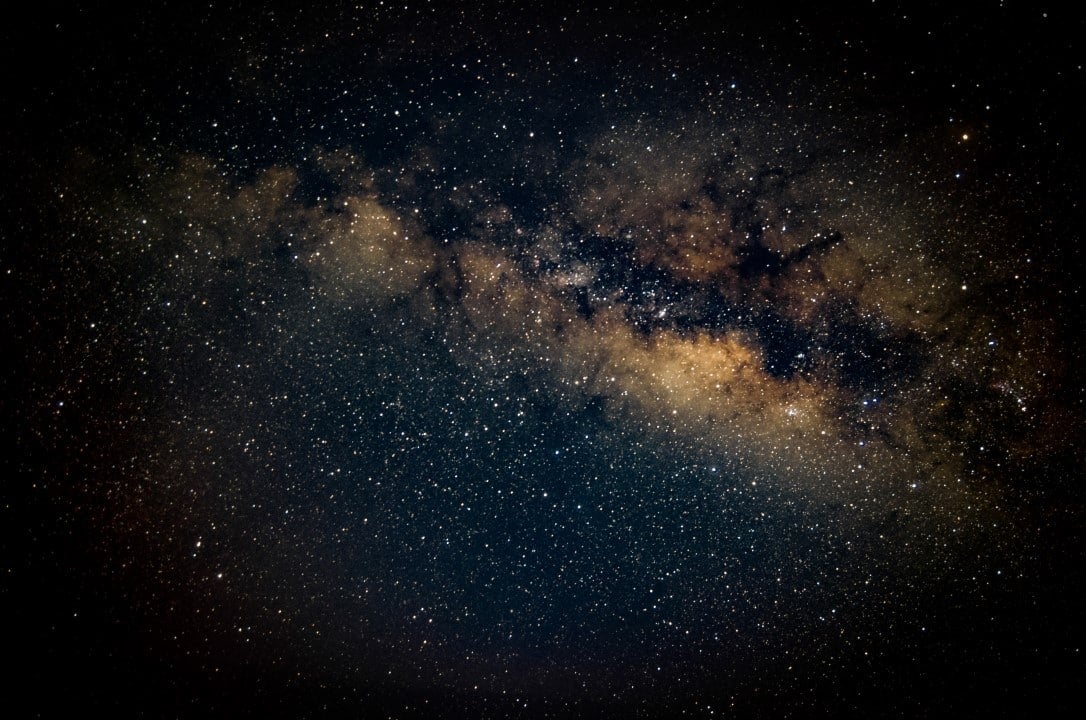
The IRAS 18162-2048 region, located toward the center of Via Láctea, offers a natural laboratory for investigating different stages of stellar evolution. The coexistence of a massive protostar in its initial phase with a star already in the main sequence demonstrates how the formation process can occur non-simultaneously in the same area.
Rubén Fedriani, first author of the work published in the journal Astronomy & Astrophysics, highlighted the relevance of IRS7 as a target for future observations. Telescópios like James Webb Space Telescope and ALMA can map the complex structure hidden by dust with higher resolution in multiple spectral bands.
Technical details of the study led by IAA-CSIC
The study analyzed the region with high-resolution data that separated the contributions from multiple infrared sources. Enquanto central protostar drives high-energy bipolar jet HH 80-81, IRS7 shows signs of ultraviolet feedback influencing surrounding gas. The continuous Lyman photon rate derived from radio observations matches that expected for a B2-B3 type star.
The researchers emphasized that new observations at different wavelengths will be essential to refine the understanding of the region’s internal dynamics. The presence of excited molecular hydrogen near IRS7 provides additional clues about the interactions between the star and the interstellar medium.
Observational perspectives with new generation instruments
Next-generation instruments will make it possible to study the cloud’s three-dimensional structure and accretion and ejection processes in unprecedented detail. The combination of infrared, submillimetre and radio data already reveals a greater complexity than initially imagined for this star formation region.
The identification of IRS7 as an independent source expands knowledge about how massive stars arise and interact in dense environments. Essa star offers unique opportunities to investigate the transition timing between the protostellar phase and the main sequence in high-mass objects.
The scientific community now considers the IRAS 18162-2048 region to be a valuable example of multigenerational star formation. Recent observations reaffirm the importance of revisiting known sources with more advanced techniques and instruments to reveal previously neglected components.



