
Milky Way’s central black hole may reactivate after merger with neighboring dwarf galaxy
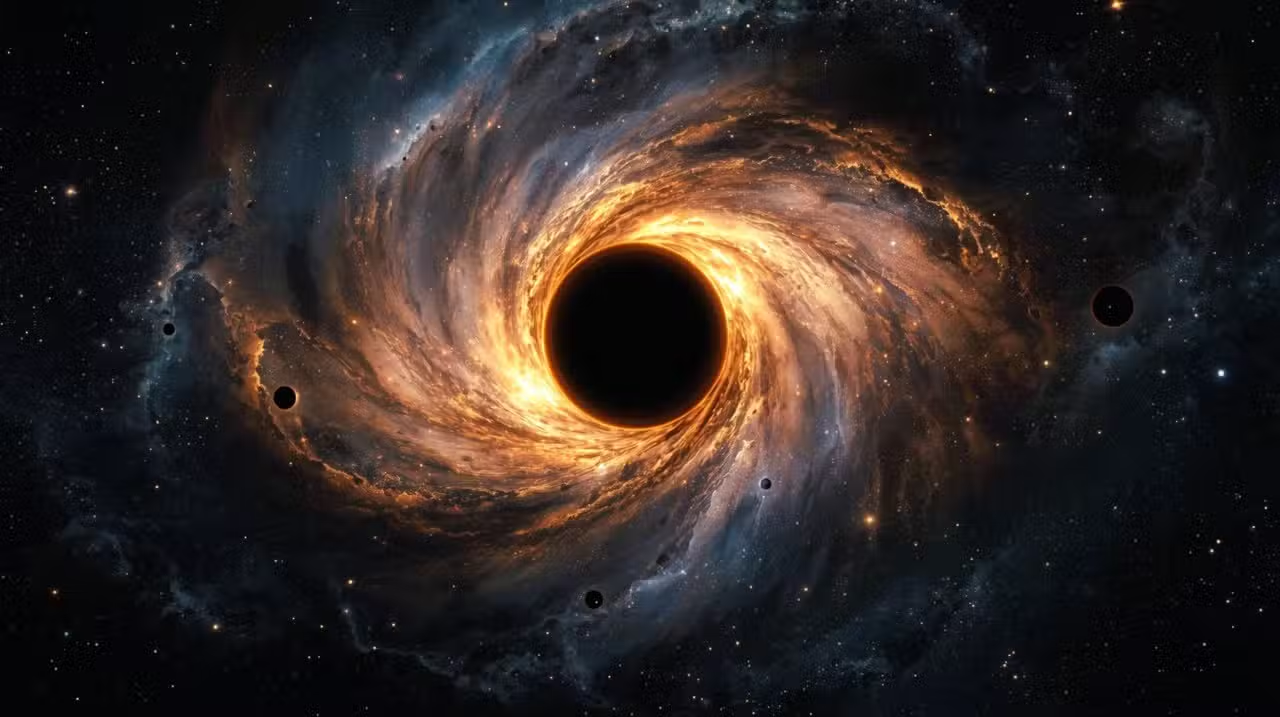
Astronomers identify that the supermassive black hole located at the center of Via Láctea has remained in a state of low activity for millions of years. Sagitário A* concentrates around four million solar masses in an extremely compact region. A new analysis indicates that this object may return to an active phase when Grande Nuvem of Magalhães, a dwarf galaxy that orbits Via Láctea, merges with it.
The current distance between Terra and Sagitário A* is approximately 26 thousand light years, in the direction of the constellation Sagitário. The black hole converts matter into energy with much lower efficiency than other similar objects. Observações confirm that it emits a weak glow most of the time.
- The closest known supermassive black hole to Terra is Sagitário A*.
- Its mass is equivalent to four million times that of Sol.
- Grande Nuvem of Magalhães is about 200 thousand light years away.
Sleeping giant in the galactic core
Instituto of Astrofísica of Andaluzia and other institutions highlight that Sagitário A* shows reduced activity compared to central black holes in other galaxies. In 2020, Prêmio Nobel of Física recognized contributions that proved the nature of this object as a supermassive black hole. Estudos with Telescópio Espacial James Webb analyze distant systems to better understand how these giants influence galactic evolution.
Astronomers note that Sagitário A* has already shown episodes of greater activity in the recent cosmic past. A smaller explosion occurred about 200 years ago, detected by instruments such as NASA’s Imaging X-ray Polarimetry Explorer. Esses Events help model future behavior of the galactic nucleus.
Sagittarius A*, the supermassive black fountain at the center of our galaxy, awakened 200 years ago to devour gas and other cosmic desires within its reach. Aprende more about the mission hall#IXPEof@NASAUniverse: https://t.co/ZgKT7CQL3j pic.twitter.com/VR1QN1MDC3
— NASA en español (@NASA_es)August 30, 2023
Future galactic collision could inject gas into black hole
Grande Nuvem of Magalhães gradually loses orbital energy and should spiral towards Via Láctea. Cálculos based on cosmological simulations, such as those of the 2019 EAGLE project, indicate that the merger will occur in approximately two billion years. Durante this process, large amounts of gas will be channeled into the center of the resulting galaxy.
This influx of material could form a hot accretion disk around Sagitário A*. Matter heated to millions of degrees would emit radiation in different bands of the electromagnetic spectrum. Pesquisas show that similar mergers in other galaxies lead to the growth of central black holes and the reshaping of the stellar halo.
The gravitational interaction will also affect the overall structure of Via Láctea. The globular cluster halo and the galactic disk will undergo significant changes throughout the event. Modelos indicate that the black hole can increase its current mass several times by absorbing available gas.
Reactivation would transform the nucleus into a glowing source
During the active phase, the infalling material would generate an active galactic nucleus capable of shining brightly. Observações of distant galaxies reveal that these nuclei emit energy at multiple wavelengths. Astrophysics Nathalie Degenaar, Universidade, Amsterdã, contributes analyzes of how matter radiates in these extreme environments.



Simulations suggest that the awakening of Sagitário A* would create a spectacle visible from afar, but limited in intensity. The event should not reach levels capable of drastically affecting distant regions of the galaxy. The distance of 26 thousand light years between the center and Sistema Solar acts as a natural protection factor.
Terra’s natural protections limit possible effects
Professor Carlos Frenk, Universidade, Durham, states that the active galactic nucleus resulting from the merger will not pose a serious threat to life on the planet. Joseph Michail, Centro, Astrofísica, Harvard and Smithsonian, reinforces that cosmic separation keeps Sistema Solar in relative safety. Camadas as Earth’s atmosphere, magnetic field, and Universidade0 gas disk itself would absorb much of the additional radiation.
Astronomers highlight that the galactic disk would act as a barrier against emissions from the center. Mesmo In scenarios of greater activity, the direct effects on Terra would remain minimal due to the scale of distances involved. Estudos Comparisons with other active galaxies corroborate this assessment.
Future observers will see more dynamic skies
The merger between Via Láctea and Grande Nuvem of Magalhães will reshape the galactic environment over billions of years. The central black hole will receive fresh fuel that will sustain its activity for prolonged periods. Esse process is part of the natural evolution of galaxies, which do not remain static.
Research using data from Telescópio Espacial James Webb and other instruments continues to map similar interactions in distant systems. Understanding Sagitário A* advances with observations in X-rays and other spectral bands. Esses data refines predictions about the future behavior of Via Láctea’s core.
Details of the dwarf galaxy’s current orbit
Grande Nuvem of Magalhães orbits Via Láctea as a satellite and shows movement that indicates gradual approach. Sua Mass and composition contribute to detectable gravitational perturbations. Astrônomos monitor these parameters to refine collision timelines.
Past interactions between dwarf and large galaxies provide useful analogies. The gas and stars from Nuvem to Magalhães will be redistributed during the merger. Esse rearrangement will fuel not only the black hole, but also new star formations in specific regions.
Veja Tambem em News (EN)

Research reveals that parents are unaware of how their children use artificial intelligence

Samsung releases new system update with new features for Galaxy Watch 4 users

Digital retail reduces the value of the Galaxy S25 5G smartphone with bank bonuses and device exchange

Amazon’s wireless CarPlay adapter has a 50% discount and high approval ratings from drivers

Zach Cregger’s new Resident Evil ignores games and focuses on an unprecedented story with new characters

Rumor suggests that Nintendo is preparing a special edition of the Switch 2 with a remake of Ocarina of Time

Apple accelerates production of the iPhone 17e and develops new Air model with dual camera system

Epic Games platform releases twelve high-budget games at no permanent cost for PC users

PlayStation 5 Pro price drop accelerates digital retail sales and eliminates global stocks

New Galaxy Watch 9 firmware appears on server and confirms progress in software development

Apple’s commemorative project tests cell phone with 1.1 millimeter edge and curved screen for 2027
