

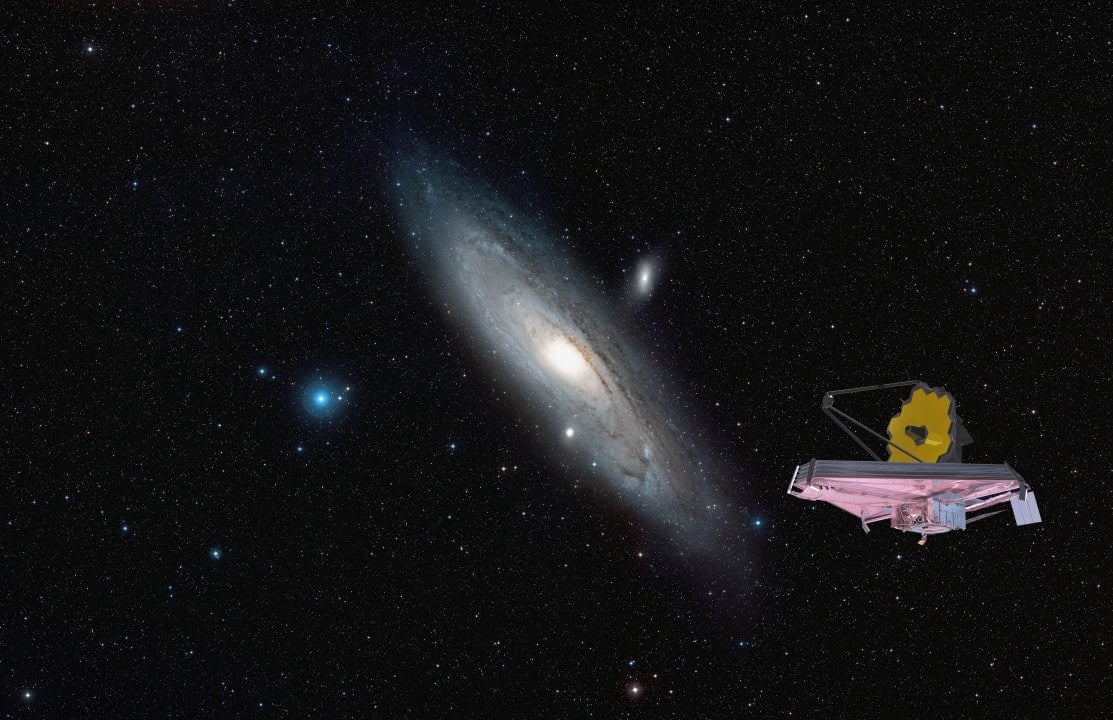
The North American space agency released recent data captured by the James Webb space telescope that points to the existence of carbon molecules and possible biogenic compounds on the exoplanet K2-18b. The celestial body is located approximately 124 light-years away from our solar system and orbits a red dwarf star in the constellation Leão. Preliminary analyzes of the planetary atmosphere revealed the abundant presence of methane and carbon dioxide, in addition to signs of dimethyl sulfide, a molecule that, in Terra, is produced exclusively by living organisms.
The identification of these elements reinforces the hypothesis that K2-18b belongs to a theoretical category known as Hycean planets. Esses worlds are characterized by having atmospheres rich in hydrogen and surfaces covered by oceans of liquid water. The combination of a dense atmosphere and the presence of liquid water creates an environment that astrophysicists consider promising for the development of life forms, even microscopic ones.
天文学者らは、太陽系の外で、地球から124光年離れた「K2-18 b.
彼らはまだ生命の発見を宣言していませんが、通常生成される「潜在的なバイオシグネチャー」を検出しました…pic.twitter.com/3cvmhATRy4
— アストロノミアウム (@astronomiaum)2025 年 4 月 17 日
The data collected by space equipment provides specific information about the composition of the exoplanet:
– The mass of K2-18b is about nine times greater than that of planet Terra.
– The celestial body orbits the habitable zone of its star, where temperatures allow the existence of liquid water.
– The absence of ammonia in the atmosphere suggests that the underlying ocean is highly deep and covers the entire surface.
– Detected dimethyl sulfide requires further validation due to overlapping spectral signatures.
The technological advancement provided by the instruments on board the space observatory allows for unprecedented readings of the atmospheres of exoplanets. The ability to separate starlight filtered by planetary gases gives researchers an accurate tool for mapping the chemistry of distant worlds and understanding the diversity of planetary formations in Via Láctea.
Atmospheric and oceanic characteristics of the celestial body
The concept of Hycean planets represents a significant change in the way scientists search for habitable environments outside the solar system. Tradicionalmente, the search focused on rocky planets with dimensions and compositions similar to those of Terra. However, worlds like K2-18b, which have intermediate sizes between Terra and Netuno, demonstrate that habitability can exist in completely different geological and atmospheric conditions. The presence of a thick layer of hydrogen acts as a thermal insulator, maintaining global ocean temperatures at levels suitable for complex organic chemistry.
The internal dynamics of these oceanic planets are still the subject of intense studies by the astronomical community. The pressure exerted by the massive atmosphere on the water surface can create physical states of water that do not occur naturally in Terra, such as hot ice or supercritical fluids at great depths. Despite these extreme conditions at the bottom of the ocean, the interface between water and the hydrogen-rich atmosphere offers a theoretically stable habitat where chemical reactions fundamental to biology could occur continuously over billions of years.
Planetary transit methodology in light capture
The detection of molecules in the atmosphere of K2-18b was possible thanks to the transit spectroscopy method. Essa technique consists of observing the light from the host star at the exact moment the planet passes in front of it. Durante In this event, a small fraction of the starlight passes through the exoplanet’s atmosphere before continuing its journey through space until it reaches the telescope’s mirrors.
Each chemical element present in the planetary atmosphere absorbs specific wavelengths of light, leaving a kind of dark barcode in the light spectrum captured by the instruments. The space observatory’s high-resolution spectrographs split this infrared light into its constituent colors, allowing scientists to identify exactly which gases are blocking stellar radiation.
The level of precision required for this measurement is extreme, considering the distance of 124 light years and the blinding brightness of the red dwarf star compared to the planet. The equipment’s ability to operate in the infrared spectrum is fundamental, as it is in this range of light that carbon-based molecules, such as methane and carbon dioxide, leave their clearest and most unmistakable signatures.
The role of dimethyl sulfide in biological research
The most intriguing finding in the spectrographic data is the possible presence of dimethyl sulfide, often abbreviated as DMS. In the terrestrial ecosystem, this organic molecule is generated almost exclusively by biological processes, with marine phytoplankton being the main responsible for its emission into the oceans. The detection of this gas on an alien world raises fundamental questions about the universality of biological processes.
The DMS molecule is composed of carbon, hydrogen and sulfur atoms, forming a structure that does not arise easily through known geological or volcanic processes. On rocky planets, volcanism tends to release sulfur dioxide or hydrogen sulfide, but the formation of complex dimethyl bonds requires specific chemical pathways that, to date, are strongly associated with the metabolism of living beings.
Researchers remain extremely cautious when interpreting this particular signal, as astrobiology requires robust evidence before confirming any biosignature. The amount of DMS suggested by the preliminary data is small and is at the limit of the current sensitivity of the instruments used in the initial observation.
Computational models of atmospheric chemistry are being run on supercomputers to verify whether there is any abiotic pathway, that is, without the involvement of life, capable of producing dimethyl sulfide in the specific conditions of a Hycean planet. Validating these simulations is a mandatory step to rule out false positives in the search for extraterrestrial life.
Challenges in confirming spectrographic data
The interpretation of planetary spectra faces technical obstacles related to overlapping molecular signatures. Diferentes gases can absorb light at very close wavelengths, creating a mixed signal that makes it difficult to identify less abundant compounds in isolation, as is the case with dimethyl sulfide in K2-18b. Methane, which is present in large quantities in this planet’s atmosphere, has absorption bands that can mask or partially mimic the DMS signal.
To resolve this ambiguity, astrophysics teams rely on accumulating data over multiple planetary transits. Cada new observation helps reduce background noise and increases signal-to-noise ratio, making absorption peaks more defined. Constant calibration of the telescope’s detectors is also essential to ensure that instrumental variations are not mistaken for real scientific discoveries.
Next Steps in Deep Space Exploration
The space observatory’s operations schedule already foresees new observation windows dedicated exclusively to the K2-18b system, using instruments that operate in the mid-infrared. Essa range of the electromagnetic spectrum is particularly sensitive to the molecular vibrations of dimethyl sulfide and other potential biomarkers, offering an opportunity to confirm or refute initial evidence with a much greater degree of certainty. The international scientific community has formed research consortia to analyze the raw data as it is transmitted to Terra, ensuring that different image processing and atmospheric modeling methodologies are applied simultaneously. Esse collaborative effort aims to eliminate analytical biases and establish a rigorous consensus on the chemical composition of the exoplanet. Furthermore, the results obtained with K2-18b will serve as a methodological guide for the selection of future observation targets, optimizing valuable telescope time in the search for other oceanic worlds orbiting red dwarfs in the galactic neighborhood.
Importance of the discovery for modern astrophysics
The detection of carbon-based molecules on a habitable zone planet reinforces the technical feasibility of investigating atmospheres of worlds with sub-Neptunian masses. Até the entry into operation of the current generation of space telescopes, detailed analysis of exoplanets was limited to Júpiter-sized gas giants, which orbit very close to their stars and are inhospitable to life.
The ability to probe smaller, more temperate planets opens up a new field of study focused on the chemical diversity of the universe. K2-18b acts as a natural laboratory where scientists can test theories about planetary formation, the migration of celestial bodies and the evolution of secondary atmospheres rich in volatile elements.
Validation of theoretical models on habitable zones
Empirical observations from K2-18b provide the first concrete data to calibrate theoretical habitability models developed in recent decades. The confirmation that Hycean planets can maintain stable, carbon-rich atmospheres changes space agencies’ search parameters, expanding the number of stellar systems considered priority targets for astrobiology and long-term astronomical exploration.



