
Skywatchers prepare for pink moon and planetary parade in April 2026
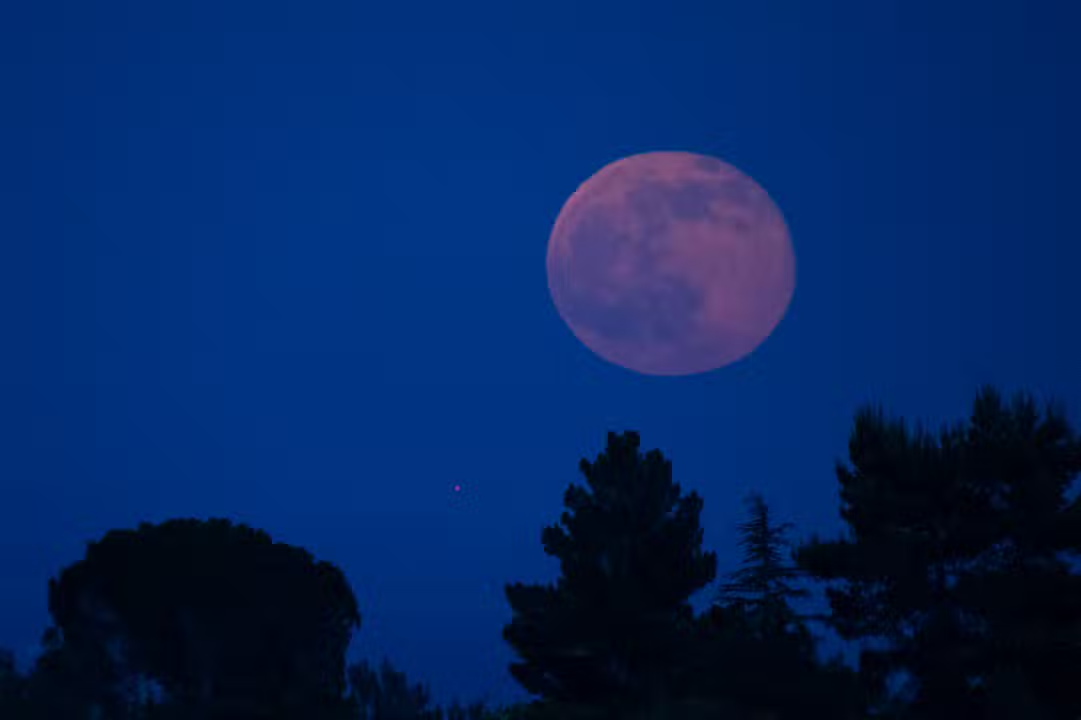
The night sky of April 2026 offers multiple opportunities for those who enjoy observing astronomical phenomena. The month begins with the full moon known as the pink moon and includes planetary alignments, possible comet visibility and the Lyrid meteor shower. Esses events occur on specific dates and require dark sky conditions for best enjoyment.
- The moon reaches its full phase at the beginning of the month.
- Mercury appears at its greatest western elongation.
- Comet C/2026 A1 (MAPS) passes through perihelion.
- A cluster of planets emerges before dawn.
- The rain of lirids reaches its peak in the second fortnight.
Enthusiasts in different hemispheres can plan trips to spots with low light pollution. The combination of events makes it possible to observe both bright objects with the naked eye and more subtle structures with binoculars or small telescopes.
Pink moon opens the observation calendar
The April full moon, traditionally called the pink moon, occurs on April 2nd. The name derives from the wildflowers that bloom at this time in some regions of the northern hemisphere, although the satellite does not have a pink hue.
It reaches its peak around the early hours of the 2nd, according to UTC time, and appears bright on the eastern horizon at sunset. Observadores notice the larger and brighter lunar disk when close to the horizon due to the illusory effect.
The full phase provides good initial illumination of the month, but it also interferes with observations of fainter objects until their brightness decreases in the following days.
Greater elongation of mercury makes sighting easier
Mercury reaches its greatest western elongation on April 3. The planet, which is normally close to the sun’s glare, moves far enough away to appear more clearly before dawn.
Astronomers recommend looking for it just above the eastern horizon, in an unobstructed location. Marte appears nearby shortly afterwards, forming a pair visible in the same morning window.
Clear sky conditions and the absence of low clouds increase the chances of successful observation of this rare event for those who follow the urban or rural sky.
Comet perihelion maps generates expectation
Comet C/2026 A1 (MAPS) reaches perihelion, the closest point to Sol, on April 4. Trata-se de um cometa rasante que passa a cerca de 160 mil quilômetros da superfície solar, distância que pode intensificar seu brilho ou levar à fragmentação.
If it survives the encounter, the object may become visible to the naked eye or with binoculars, especially in the southern hemisphere, where its position favors observations after perihelion. In the northern hemisphere, visibility tends to be shorter and closer to the horizon.
Astronomers monitor the comet’s behavior in real time, as the composition of ice, rock and dust determines the final spectacle.
Observers should avoid aiming directly at Sol during the period near perihelion and prioritize safe times after sunset in the following days.

Planetary parade takes place before dawn
Between April 16 and 23, Mercúrio, Marte and Saturno form a compact planetary parade on the eastern horizon before sunrise. The trio changes its configuration throughout the morning, approaching or extending in a diagonal line.
The 18th to 20th offer the most compact grouping, with the planets looking like a pyramid or close cluster.
Anyone looking for the phenomenon needs a clear view to the east, such as a lakeshore or open field. The event lasts about half an hour each morning, requiring local time planning.



Ideal conditions for seeing the milky way
The April 17th new moon creates one of the best nights of the month for stargazing. Sem significant lunar brightness, the core of Via Láctea is most accessible in the early morning hours.
Places with low light pollution, such as national parks or dark sky reserves, allow you to view the star-filled galactic center. Binóculos or telescopes reveal additional details of the spiral structure.
This window also favors the location of distant galaxies visible in the same region of the sky.
Conjunction brings together moon, Venus and Pleiades
On April 18th and 19th, after sunset, the crescent moon, Vênus and the Plêiades cluster align on the western horizon. The set remains visible for two to three hours.
Jupiter appears higher in the sky, close to the constellation Órion, completing the night panorama.
The conjunction offers the opportunity to photograph or simply admire the celestial alignment with simple equipment.
Lyrid meteor shower records peak
The Lyrid meteor shower occurs between April 14th and 30th, peaking in the early hours of April 21st to 22nd. Sob dark skies, expect between 10 and 18 meteors per hour, with the possibility of quick streaks and occasional fireballs.
The moon sets before midnight during peak, reducing light interference. The radiant in the constellation Lira reaches a favorable position before dawn.
Observers should choose areas away from cities and lie down to expand the field of view. The rain is one of the oldest recorded and can vary in intensity from year to year.
Whirlwind galaxy visible during the month
Astronomical spring in the northern hemisphere favors the observation of galaxies. Galáxia of Redemoinho (M51), near the cape of Ursa Maior, appears high around midnight for most of April.
Binoculars show the galaxy as a diffuse patch of light, while telescopes reveal its spiral structure and interaction with companion NGC 5195.
Trio of Leão, in the constellation of Leão, also offers a good target for equipped observers, with multiple spiral galaxies concentrated in the region.
These interstellar objects remain accessible throughout the month for those who dedicate time to nighttime contemplation.
The April set of phenomena encourages the preparation of equipment and the choice of suitable locations. Horários locations vary depending on geographic position, so consulting apps or astronomical guides help with precise planning.
Veja Tambem em News (EN)

Research reveals that parents are unaware of how their children use artificial intelligence

Samsung releases new system update with new features for Galaxy Watch 4 users

Digital retail reduces the value of the Galaxy S25 5G smartphone with bank bonuses and device exchange

Amazon’s wireless CarPlay adapter has a 50% discount and high approval ratings from drivers

Zach Cregger’s new Resident Evil ignores games and focuses on an unprecedented story with new characters

Rumor suggests that Nintendo is preparing a special edition of the Switch 2 with a remake of Ocarina of Time

Apple accelerates production of the iPhone 17e and develops new Air model with dual camera system

Epic Games platform releases twelve high-budget games at no permanent cost for PC users

PlayStation 5 Pro price drop accelerates digital retail sales and eliminates global stocks

New Galaxy Watch 9 firmware appears on server and confirms progress in software development

Apple’s commemorative project tests cell phone with 1.1 millimeter edge and curved screen for 2027
