
3I/ATLAS interstellar object reveals extreme abundance of deuterium in methane and water

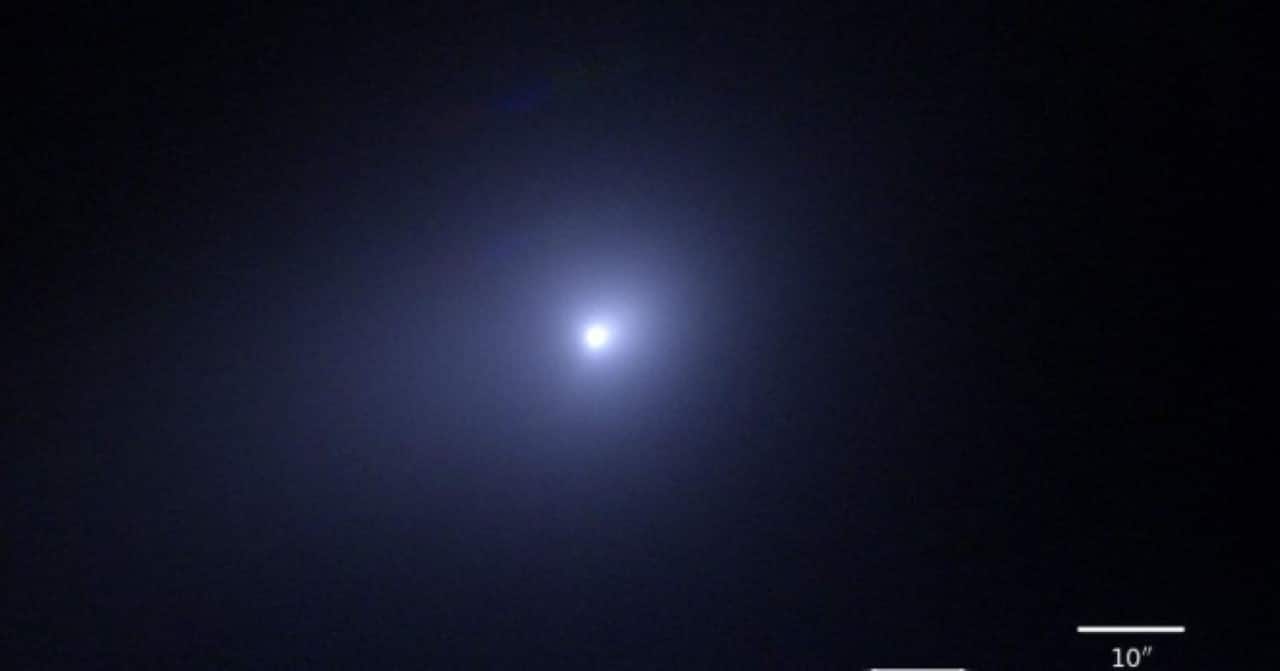
Astronomers have identified exceptionally high proportions of deuterium in molecules released by the interstellar object 3I/ATLAS. Measurements derived from observations of Telescópio Espacial James Webb indicate significant enrichment in both the water and methane expelled by the object. Esses data was released in two recent scientific articles, one on March 6, 2026 and the other on March 24, 2026.
The results show that the deuterium/hydrogen ratio (D/H) in water reaches (0.95 ± 0.06)%, a value more than an order of magnitude higher than that observed in known comets from Sistema Solar. In methane (CH4), the ratio reaches (3.31 ± 0.34)%, about three orders of magnitude higher than that found in giant planets and 14 times higher than that measured in the comet 67P/Churyumov-Gerasimenko by probe Rosetta. Tais levels far exceed typical abundances recorded on nearby celestial bodies.
- Water has a D/H of approximately one deuterium atom for every 105 hydrogen atoms.
- Methane registers D/H equivalent to one deuterium atom to about 30 hydrogen atoms.
- Carbon 12C/13C ratios are also high compared to nearby solar and interstellar values.
Spectroscopic measurements from telescope Webb
Spectra obtained by the NIRSpec instrument on Webb allowed detailed analysis of the gas plume around 3I/ATLAS. The researchers quantified the isotopic composition in different molecules released during the object’s activity. Essas observations occurred when 3I/ATLAS was at distances that favor the detection of weak emissions.
The data also reveals variations in carbon isotopic ratios in compounds such as CO2 and CO. Tais signatures differ from patterns observed in current interstellar clouds and nearby protoplanetary disks. The combination of deuterium enrichment with carbon anomalies suggests formation processes that occurred under specific low-temperature conditions.
Proposed explanations for isotopic enrichment
Scientists associate the high deuterium content with cold environments, below 30 Kelvin, where chemical reactions in the gas phase or on ice surfaces favor the preferential incorporation of the heavier isotope. Essa condition would be compatible with formation in an ancient protoplanetary disk, about 10 to 12 billion years ago. However, discussions point to limitations related to the temperature of the cosmic background radiation at the time.
Chemical models indicate that deuterium concentrates in molecules such as water and methane at extremely low temperatures. The simultaneous presence of high D/H ratios in two different molecules reinforces the hypothesis of a peculiar formation environment. Mesmo Thus, some researchers question whether ancient protoplanetary disks could reach temperatures low enough to explain the observed values.

Characteristics of the interstellar object 3I/ATLAS
3I/ATLAS represents the third confirmed interstellar object to visit Sistema Solar. Diferente of bodies originating here, it exhibits a hyperbolic trajectory and composition that does not match the known patterns of local comets or asteroids. Previous Observações had already recorded unusual activity, including jets and variations in the release of volatiles.
The detection of methane and water with extreme isotopic signatures adds another layer of complexity to studies into their origin. The object continues to be monitored by several telescopes as it follows its path out of Sistema Solar. Novas observations can provide additional data about other molecules and the evolution of their activity.
Deuterium as a fusion fuel and implications
Deuterium constitutes a key component in nuclear fusion reactions due to its ability to react at relatively low temperatures when combined with tritium. The fusion of deuterium and tritium produces helium-4 and releases high-energy neutrons, a process that releases significant amounts of energy. Na Terra, deuterium can be extracted from seawater in quantities that would support energy demands for long periods.
In the context of 3I/ATLAS, the overabundance observed in organic molecules and water arouses scientific interest in possible processes that led to such concentration. The authors of the studies highlight that the high proportions reflect extreme formation conditions. Pesquisas continue to determine whether known natural mechanisms can fully reproduce the measured values.
Comparison with abundances at Sistema Solar and beyond
In Sistema Solar, the D/H ratio in terrestrial seawater is about one in 6,500, while in Sol and Júpiter it approaches one in 40,000, a value close to the primordial one generated in the first few minutes after Big Bang. Cometas known exhibits moderate enrichments, but nothing comparable to the levels detected in 3I/ATLAS. Meteoritos and other bodies also give lower reasons.
Observations of interstellar clouds and protoplanetary disks in our galaxy generally show lower values than those reported for the interstellar object. The discrepancy motivates further analysis of possible formation routes or enrichment processes that operated differently in the 3I/ATLAS home environment. Estudos Futures with complementary data from other telescopes could help refine these models.
Open questions about the origin of the object
The association of 3I/ATLAS with populations of ancient metal-poor stars faces challenges, as such environments may not have enough heavy elements to explain certain observed features. Alternativas include reconsidering the inferred size or population density of similar objects in interstellar space. Isotopic data continues to be analyzed to test different formation scenarios.
Astronomers plan additional observations as the object moves away. Combining spectroscopic, photometric, and chemical composition data offers unique opportunities to better understand the diversity of interstellar materials. The case of 3I/ATLAS illustrates how visiting objects can reveal physical and chemical processes occurring in other stellar systems.



