
Astronomers discover rare triple-double radio galaxy 7.5 billion light-years away
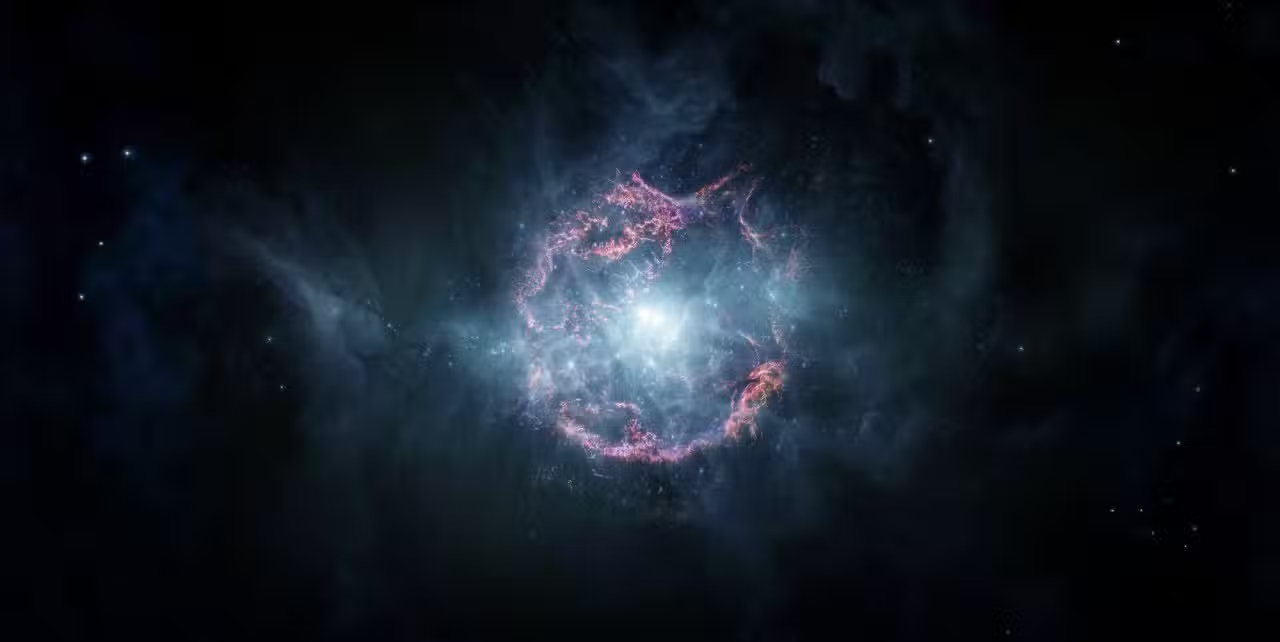
Astronomers have identified an extremely rare radio galaxy known as a triple-double located approximately 7.5 billion light-years from Terra. The object cataloged as J022248−060934 represents only the seventh known example of this class and offers unprecedented data on the intermittent behavior of supermassive black holes. The observations came from the MIGHTEE survey carried out with the MeerKAT telescope at África and Sul and revealed a complex structure of radio emissions that spans millions of light-years.
The galaxy displays three distinct pairs of radio lobes generated by successive phases of activity from the central black hole. Cada pair corresponds to a different episode of ejection of high-energy particles that interact with the surrounding gas and produce detectable emissions. Essa triple configuration allows studying the so-called activity cycle or duty cycle of the galactic nucleus more precisely than in common objects.
- The galaxy hosts a supermassive black hole responsible for launching jets in opposite directions.
- The outer lobes reach distances that classify the system as a giant radio galaxy.
- Spectral analysis confirms multiple core reactivations at relatively short intervals.
Unique configuration of radio lobes
The structure observed in J022248−060934 shows three pairs of lobes aligned symmetrically with respect to the nucleus. The outermost pair indicates the earliest phase of activity while the middle and inner pairs reflect subsequent episodes. The researchers mapped emissions at different frequencies and identified asymmetries between the east and west sides that suggest variations in the density of the interstellar medium.
These morphological differences appear especially in the eastern lobes, which have greater curvature. Polarimetry of the MeerKAT data revealed an inhomogeneous distribution of the environment around the galaxy consistent with the observed deformations. The spectral index maps show an inverted nucleus and ultra-marked aging in the most distant lobes, which reinforces the evidence of recurrent nuclear activity.
The outermost lobes formed at least 16 million years ago and the first active phase lasted about 10 million years. Após a quiescent interval of approximately 1 million years the second episode lasted around 7 million years. The third phase has been ongoing for around 8 million years and keeps the core active at the current time.
Spectral aging analysis
Applying the JP spectral aging model to the different components allowed estimating individual ages for each pair of wolves. The results indicate that the activity cycle does not involve long periods of inactivity as assumed in previous studies based only on kinematic ages. Instead the duty cycle of the first phase reached 90% which means that the black hole remained active for most of the available time.
This elevated rate of activity challenges previous models that predicted prolonged interruptions between episodes. The short interval of quiescence observed in J022248−060934 suggests that the gas supply to the black hole may be interrupted only briefly before resuming. The data reinforce the importance of observations at multiple frequencies to separate the contributions of each active phase.
The galaxy is at a spectroscopic redshift of approximately 0.94, which corresponds to a distance of 7.5 billion light years. Nessa At that time, the universe was about a third of its current age and galaxies were still undergoing intense processes of evolution. The detailed study of this source makes it possible to compare the growth of black holes at different cosmic stages.
Perspectives with new telescopes
The advancement of instruments like Square Kilometre Array Observatory should allow the systematic detection of more objects of this class. Next-generation Telescópios will offer greater sensitivity and angular resolution capable of identifying subtle structures in distant radio galaxies. The team responsible for the discovery highlights that automated searches in large volumes of data could reveal dozens of new candidates.
These future observations will help build more robust statistics on the frequency and properties of triple-double galaxies. Researchers hope to refine theoretical models that describe how supermassive black holes switch between active and quiescent states over time. Combining radio data with observations in other bands of the electromagnetic spectrum will also enrich the understanding of the impact of these objects on the interstellar medium of their host galaxies.



Morphology and polarimetry of wolves
Full intensity data shows a bright core accompanied by emission peaks at the edges of the lobes. The edge-brightened configuration indicates that the accelerated particles interact strongly with the external environment, generating more intense emissions at the edges. Additional polarimetry confirms local variations in density that influence the path of the jets.
These morphological details provide clues about the physical conditions surrounding the galaxy billions of years ago. The presence of multiple phases makes it possible to isolate the effect of each episode of activity and study how the black hole evolves over tens of millions of years. The results contribute to the broader field of the astrophysics of active galaxies and black hole feedback.
The discovery was detailed in an article published in Monthly Notices of the Royal Astronomical Society. The authors used the dataset from the first release of the MIGHTEE survey to perform the initial identification and subsequent analyses. Object J022248−060934 now joins a select group of just seven triple-double galaxies known to date.
Black hole activity cycles
The galaxy’s central black hole has alternated between phases of high activity and brief lulls throughout its observable history. Essa alternation creates successive layers of radio emissions that accumulate and overlap in space. The study of cases like this allows us to directly measure the characteristic time of nuclear reactivation in distant cosmic environments.
The researchers derived a lower limit for the total age of the system of around 16 million years from the individual spectral fit of each component. Essa Detailed chronology shows that interruptions between phases were short compared to the total duration of the activity. The findings suggest that black hole feeding mechanisms operate relatively continuously on astrophysical timescales.
The triple structure offers a unique opportunity to calibrate evolution models of giant radio galaxies. Observações additional data with higher resolution will be able to map the movement of particles and refine age estimates. Technological advances in radio astronomy promise to rapidly expand the catalog of these rare objects.
Importance for studies of galactic evolution
Radio galaxies like J022248−060934 illustrate the central role of black holes in the development of their hosts. The ejected jets transfer energy to the surrounding gas and can regulate large-scale star formation. Multi-phase detection allows you to track this feedback process over several generations of activity.
The MeerKAT data demonstrates the instrument’s ability to reveal complex structures even in distant sources. The MIGHTEE survey continues to produce relevant discoveries by covering large areas of the sky with high sensitivity. Futuras data releases should provide more examples that help contextualize the case of J022248−060934.
The astronomical community is following with interest the potential of new telescopes to map entire populations of similar objects. The combination of sensitivity and angular resolution will make it possible to investigate not only the morphology but also the physical properties of the plasma in the radio lobes. Esses Collective efforts expand knowledge about the mechanisms that govern the growth of large-scale structures in the universe.
Veja Tambem em News (EN)

Research reveals that parents are unaware of how their children use artificial intelligence

Samsung releases new system update with new features for Galaxy Watch 4 users

Digital retail reduces the value of the Galaxy S25 5G smartphone with bank bonuses and device exchange

Amazon’s wireless CarPlay adapter has a 50% discount and high approval ratings from drivers

Zach Cregger’s new Resident Evil ignores games and focuses on an unprecedented story with new characters

Rumor suggests that Nintendo is preparing a special edition of the Switch 2 with a remake of Ocarina of Time

Apple accelerates production of the iPhone 17e and develops new Air model with dual camera system

Epic Games platform releases twelve high-budget games at no permanent cost for PC users

PlayStation 5 Pro price drop accelerates digital retail sales and eliminates global stocks

New Galaxy Watch 9 firmware appears on server and confirms progress in software development

Apple’s commemorative project tests cell phone with 1.1 millimeter edge and curved screen for 2027
