
Chinese probe discovers radiation cavity on the Moon that reduces impact on astronauts in space
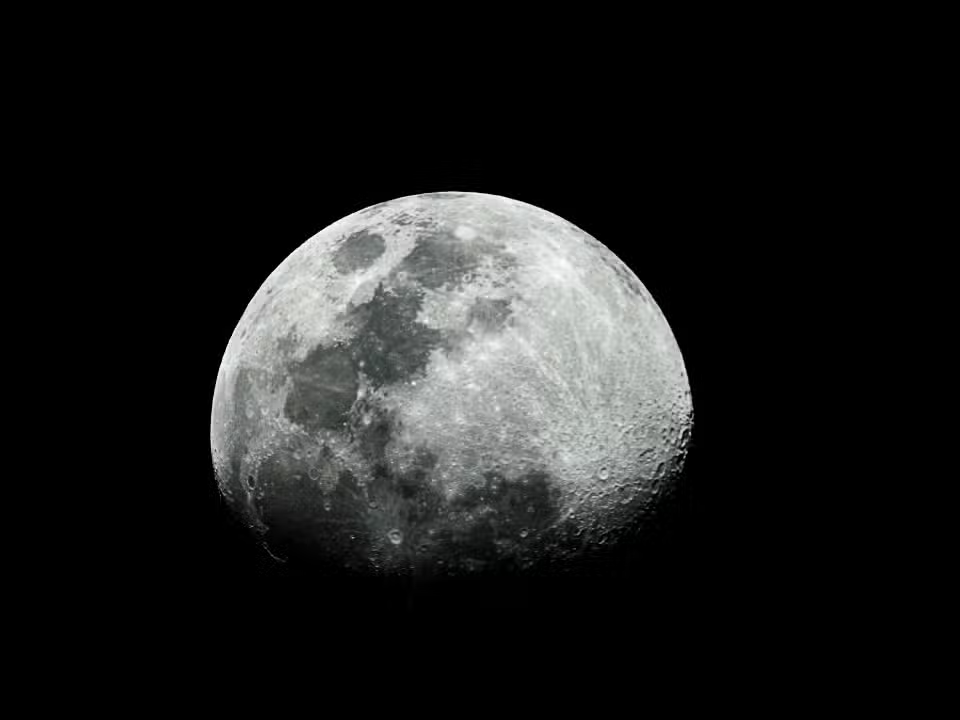
The Chinese space agency has identified a unique geological formation on the lunar surface that presents radiation levels significantly lower than the average for the natural satellite. The discovery occurred through advanced sensors attached to an exploration probe that monitors environmental conditions for future long-duration manned missions. The data collected indicates that the lunar environment is not uniform in terms of radioactive exposure, revealing safety windows that can be taken advantage of by space agencies.
This phenomenon occurs at specific times of the lunar day, when the tilt and structure of the detected cavity block part of the charged solar particles. The reduction in radioactive impact reaches 20% compared to open areas of the surface, which represents a substantial change in health planning for astronauts. Geólogos Space scientists believe that the lay of the land acts as a natural shield against galactic cosmic rays and the constant solar wind.
The site’s characteristics provide crucial information for the development of new security protocols and housing module engineering. Além Furthermore, statistical analysis of the mission reveals the following key points about the new discovery:
- Natural protection reduces the absorption of ionizing radiation by human tissues during planned extravehicular activities.
- Radiation levels undergo cyclical variations according to the position of the moon in relation to the sun, allowing the creation of safe work schedules.
- The density of the soil in the vicinity of the cavity suggests a mineralogical composition that helps in the dispersion of energy from subatomic particles.
- New measuring equipment will be sent on future missions to map larger areas of this region of scientific interest.
Direct implications for the biological safety of space missions
Prolonged exposure to space radiation is one of the biggest obstacles to establishing human colonies outside of Earth due to the risk of severe cellular damage. With the discovery of this cavity, scientists can design less cumbersome and more efficient protection systems for spacesuits and transport vehicles. Esta Low intensity zone allows the human body to withstand longer periods of exposure without reaching the critical limit of biological safety established by aerospace medicine.
The Chinese probe’s analysis focuses on the behavior of neutrons and gamma rays that reach the moon without the protection of a dense atmosphere or magnetic field. By finding a point where this incidence is mitigated, China gains a strategic advantage in the race to dominate lunar habitation technologies. The researchers are now working on correlating this data with local topography to identify whether there are other similar cavities at different lunar latitudes.
Potential for building permanent infrastructure on the surface
The identification of locations with natural radiological protection directly influences the choice of points where the first fixed laboratories will be installed. Construir bases in or near these cavities reduces the need to transport tons of armor materials from the ground, which drastically reduces the logistical cost of missions. Harnessing lunar geology for passive defense against space weather is considered the logical next step toward sustainable colonization.
Engineers assess that the structure of these formations can support the partial burial of habitable modules, further increasing thermal and radioactive insulation. Como the moon has extreme thermal variations, the cavities also provide a more stable environment for the preservation of sensitive electronic components and oxygen supplies. The economic viability of a lunar base depends entirely on the human ability to utilize the resources and characteristics of the satellite itself.

Constant monitoring of radiation during the lunar cycle
The orbiting probes continue to send real-time data about how radiation behaves as the moon orbits the Earth and receives different intensities of sunlight. Durante At lunar noon, the sensors recorded emission peaks, but the cavity maintained greater stability than the open plains of the lunar seas. Esse Detailed monitoring is essential to predict solar storms that could be fatal for unprepared astronauts in the open field.
Coordination between land bases and orbiting probes makes it possible to create a dynamic risk map for future explorers of the Chinese lunar program. Esta continuous surveillance strategy ensures that any anomalous changes in solar activity are detected before particles reach the lunar surface. The integration of artificial intelligence in the processing of this data makes it easier to identify space weather patterns that were previously considered unpredictable.
Advances in Chinese mission sensor technology
The technology used to detect this cavity represents a qualitative leap in remote sensing instruments applied to modern astronomy. The sensors are capable of differentiating between different types of radiation, allowing an accurate diagnosis of the quality of the environment for organic life. The success of this instrumentation validates Chinese investment in microelectronics resistant to extreme conditions and deep vacuum.
The development of these systems also benefits other areas of science, such as geophysics and high-energy particle physics. The accuracy of the data collected allows computer simulations on Earth to reproduce the lunar environment with unprecedented fidelity for materials testing. Cada New discovery cements space science’s position as an engine of technological innovation spilling over into global industry.
Prospects for international collaboration in scientific exploration
Although the discovery is an achievement by the Chinese agency, the data generated is of inestimable value for the entire international scientific community involved in space. Knowledge about radiation cavities could lead to new technical cooperation agreements for the standardization of space safety modules. Entender How radiation interacts with lunar soil is a common challenge for all nations seeking to send humans beyond Earth’s orbit.



Transparency in the disclosure of these physical parameters helps create global safety standards for space tourism and lunar mining. Espera International astronomy conferences are expected to debate these results to adjust current theoretical radiation models. Science, when operating at extreme frontiers, tends to require joint efforts to overcome the physical limitations imposed by the hostile environment of outer space.
Geological stability and durability of lunar cavities
The cavities identified are not ephemeral structures, but rather formations resulting from volcanic processes or impacts that occurred billions of years ago. Essa Geological stability ensures that low-radiation hotspots identified today will remain safe for thousands of years, making them valuable assets for the future. The absence of atmospheric erosion or intense tectonic activity preserves the geometry of these protection zones permanently.
Studying the origin of these cavities helps scientists understand the moon’s thermal history and the formation of its lava tubes. Muitos Researchers believe that these depressions are just the entrance to much larger and even more protected underground tunnel systems. If this hypothesis is confirmed, the potential for safe habitation on the moon will be multiplied, transforming the satellite into a true natural bunker for humanity.
Protection against high-energy solar particles
Solar flares launch protons and electrons at speeds close to that of light, creating an extremely dangerous environment on surfaces without an atmosphere. The uncovered cavity acts as a reflector and absorber of these particles, creating a shadow zone where the flow density is lower. Esse Geometric shielding effect is vital during periods of solar maximum, when our star’s activity becomes more frequent and violent.
The effectiveness of this protection was tested during moderate solar emission events, proving that the structure maintains its defensive integrity. Astronautas in a real mission they could use these areas as temporary emergency shelters in case of unforeseen solar alerts. The planning of exploration routes will necessarily consider the location of these natural refuges spread across the lunar soil.
Optimizing schedules for extravehicular activities on the moon
The discovery that radiation decreases by up to 20% at certain times allows for more intelligent management of astronauts’ working time. Instead of fixed shifts, teams will be able to carry out moonwalks at times of lower particle incidence, maximizing productivity without increasing risk. Essa Operational flexibility is a critical differentiator for the success of missions that require manual assembly of complex structures.
The programming of activities will be based on predictive models that cross the orbital position with cavity monitoring data. The rational use of safety windows reduces wear on life support systems and extends the life of spacesuits, which suffer from radiation degradation. The energy efficiency of missions also improves, as the cooling and electronic protection systems operate in less demanding regimes.
Long-term health impact of lunar colonists
Living on the moon requires constant concern about the cumulative effects of radiation on the crew’s immune system and DNA. Low-radiation cavities provide an environment where the body can recover from oxidative stress caused by exposure in open areas. Reduzir Daily dose of radiation by one-fifth could be the difference between a successful mission and the emergence of chronic diseases in the short term.
Space medicine uses this data to adjust the diets and antioxidant supplements provided to astronauts, creating an integrated health protocol. Além of physical harm, the safety provided by a protected environment also improves the psychological well-being of the crew, reducing anxiety related to the invisible dangers of space. The feeling of being in a safe place is essential for maintaining mental health in prolonged isolation.
Future of robotic and human exploration together
The Chinese strategy involves using autonomous robots to carry out detailed mapping of cavities before human disembarkation. Esses robots enter hard-to-reach areas and install communication beacons and fixed sensors to create a local data network. Quando When the astronauts arrive, they will find an environment already prepared and monitored, with exclusion zones and clearly defined safety routes.
This approach minimizes uncertainties and increases the success rate of operations on lunar soil, serving as a model for future trips to Mars. The integration between machines and humans in the space environment becomes increasingly deeper, with artificial intelligence managing environmental risks in real time. The moon is no longer a mystery but is becoming a territory mapped and understood by modern science.
Veja Tambem em News (EN)

Research reveals that parents are unaware of how their children use artificial intelligence

Samsung releases new system update with new features for Galaxy Watch 4 users

Digital retail reduces the value of the Galaxy S25 5G smartphone with bank bonuses and device exchange

Amazon’s wireless CarPlay adapter has a 50% discount and high approval ratings from drivers

Zach Cregger’s new Resident Evil ignores games and focuses on an unprecedented story with new characters

Rumor suggests that Nintendo is preparing a special edition of the Switch 2 with a remake of Ocarina of Time

Apple accelerates production of the iPhone 17e and develops new Air model with dual camera system

Epic Games platform releases twelve high-budget games at no permanent cost for PC users

PlayStation 5 Pro price drop accelerates digital retail sales and eliminates global stocks

New Galaxy Watch 9 firmware appears on server and confirms progress in software development

Apple’s commemorative project tests cell phone with 1.1 millimeter edge and curved screen for 2027
