
Countdown to Artemis 2 begins with NASA’s confidence in manned lunar flight
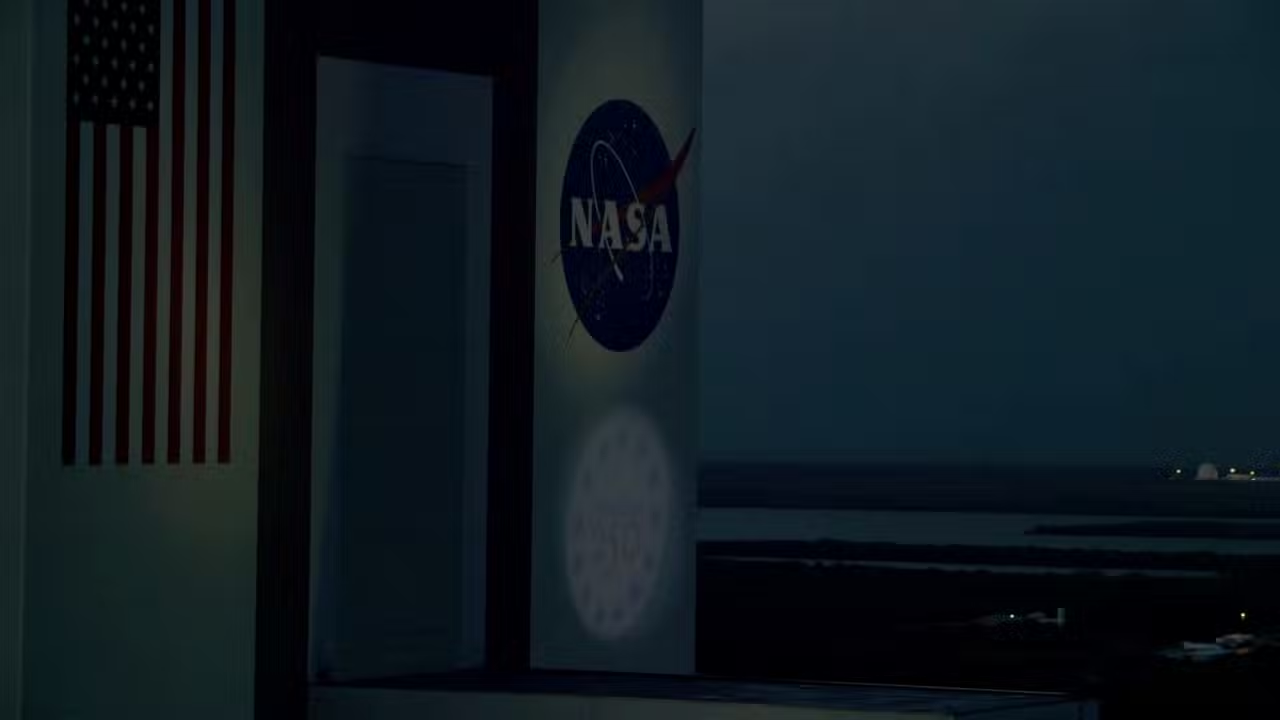
Nasa continued the final preparations for the launch of mission Artemis 2, scheduled to take place this Wednesday, April 1, 2026, at Centro Espacial Kennedy, at Flórida. Quatro astronauts will board the spacecraft Orion attached to rocket Space Launch System to perform the first manned flight beyond low Earth orbit in more than 50 years. The space agency expressed optimism during a recent press conference, highlighting that weather conditions present around an 80% favorable probability during the launch period. The crew will spend approximately 10 days traveling, performing a flyby of Lua before returning to Terra.
- Reid Wiseman serves as mission commander.
- Victor Glover serves as pilot.
- Christina Koch and Jeremy Hansen complete the international team.
This configuration marks the return of humans to the deep lunar environment since program Apollo, which concluded in 1972.
Details of the mission’s trajectory and technical objectives
Mission Artemis 2 will send astronauts on a free return trajectory that will take them to distances greater than 680,000 kilometers from Terra, allowing direct observations of the far side of Lua. Experts monitor the performance of the Orion spacecraft in deep space conditions, including life support systems for four crew members simultaneous. Equipes engineers have checked all critical components after recent adjustments to hydrogen and helium leaks identified in previous preparation phases.
Nasa emphasizes that the flight represents an essential test before subsequent missions aimed at landing on the lunar surface. Astronauts will conduct limited visual and scientific observations during the few hours in proximity to Lua, supplementing data collected by robotic orbiters like Lunar Reconnaissance Orbiter.
The launch team at@NASAKennedyare GO to begin filling the Artemis II rocket with fuel.
— NASA Artemis (@NASAArtemis)April 1, 2026
The official launch broadcast begins at 12:50pm ET (1650 UTC). Liftoff is scheduled for no earlier than 6:24 pm ET (2224 UTC). Tanking coverage can be found here:https://t.co/VVJqQrRz4a pic.twitter.com/tFoKsKxOvX
Preparations and statements by the scientific team
Dr. Noah Petro, head of the scientific division associated with the Artemis program, participated in recent updates and reinforced the focus on building sustainable capabilities for human exploration. Ele highlighted the planning of laboratories and research bases in Lua as an intermediate step towards broader goals in the solar system. Petro also mentioned the family influence on his career, noting that he follows in the footsteps of his father, who was part of the efforts of the Apollo program.
The second generation involved in lunar exploration brings a unique perspective to guide new professionals in the field. Petro expressed enthusiasm in contributing to the development of scientists, engineers and young people interested in complex space challenges. Nasa integrated lessons from previous missions to ensure safety and operational efficiency on Artemis 2.
International aspects and crew collaboration
The presence of Canadian astronaut Jeremy Hansen on the team reinforces the partnership between Nasa and Agência Espacial Canadense in the Artemis program. Essa collaboration expands the technical and scientific scope of the flight, incorporating contributions from different nations in navigation systems and experiments. The four crew members underwent extensive joint training to deal with the demands of the prolonged microgravity environment and real-time communication with the control center.



Multidisciplinary teams monitor the countdown’s progress in real time, adjusting protocols as necessary. The mission also serves as validation for technologies that will be used in Artemis 3, expected to include the first lunar landing with a diverse crew.
Chronology of recent advances in the program
Nasa completed final inspections on the SLS rocket and capsule Orion positioned on launch pad 39B. Técnicos resolved specific technical issues identified in supply tests, ensuring alignment with established schedules. Atualizações Meteorological reports indicate that clouds and winds require monitoring, but do not compromise the main launch window.
Flight Artemis 2 builds on decades of investment in renewed space infrastructure, from the development of the SLS to improvements to the Orion. Essa technical continuity enables gradual advances toward sustainable human presence outside Earth orbit.
Scientific observations during the lunar flyby
Astronauts will use their visual perceptions to record subtle variations in the color and texture of the lunar surface that complement satellite images. Dr. Noah Petro coordinated plans to maximize the scientific return on these brief observations, highlighting that human eyes detect details that automated instruments may not fully capture. The crew will document geological and environmental aspects while orbiting Lua.
These records will help refine models for future surface activities. Nasa plans to analyze all data collected to inform the development of lunar habitats and laboratories.
Expectations for return and next steps
After the flyby, spacecraft Orion will follow a controlled re-entry trajectory into the Earth’s atmosphere, with splashdown planned at Oceano Pacífico. Recovery Equipes will be positioned to assist the astronauts immediately after landing. The test results will influence system adjustments for subsequent missions of the Artemis program.
The agency remains focused on the safe execution of each phase, prioritizing crew integrity and operational success.
Veja Tambem em News (EN)

Research reveals that parents are unaware of how their children use artificial intelligence

Samsung releases new system update with new features for Galaxy Watch 4 users

Digital retail reduces the value of the Galaxy S25 5G smartphone with bank bonuses and device exchange

Amazon’s wireless CarPlay adapter has a 50% discount and high approval ratings from drivers

Zach Cregger’s new Resident Evil ignores games and focuses on an unprecedented story with new characters

Rumor suggests that Nintendo is preparing a special edition of the Switch 2 with a remake of Ocarina of Time

Apple accelerates production of the iPhone 17e and develops new Air model with dual camera system

Epic Games platform releases twelve high-budget games at no permanent cost for PC users

PlayStation 5 Pro price drop accelerates digital retail sales and eliminates global stocks

New Galaxy Watch 9 firmware appears on server and confirms progress in software development

Apple’s commemorative project tests cell phone with 1.1 millimeter edge and curved screen for 2027
