NASA prepares launch of Artemis II with four astronauts towards the Moon
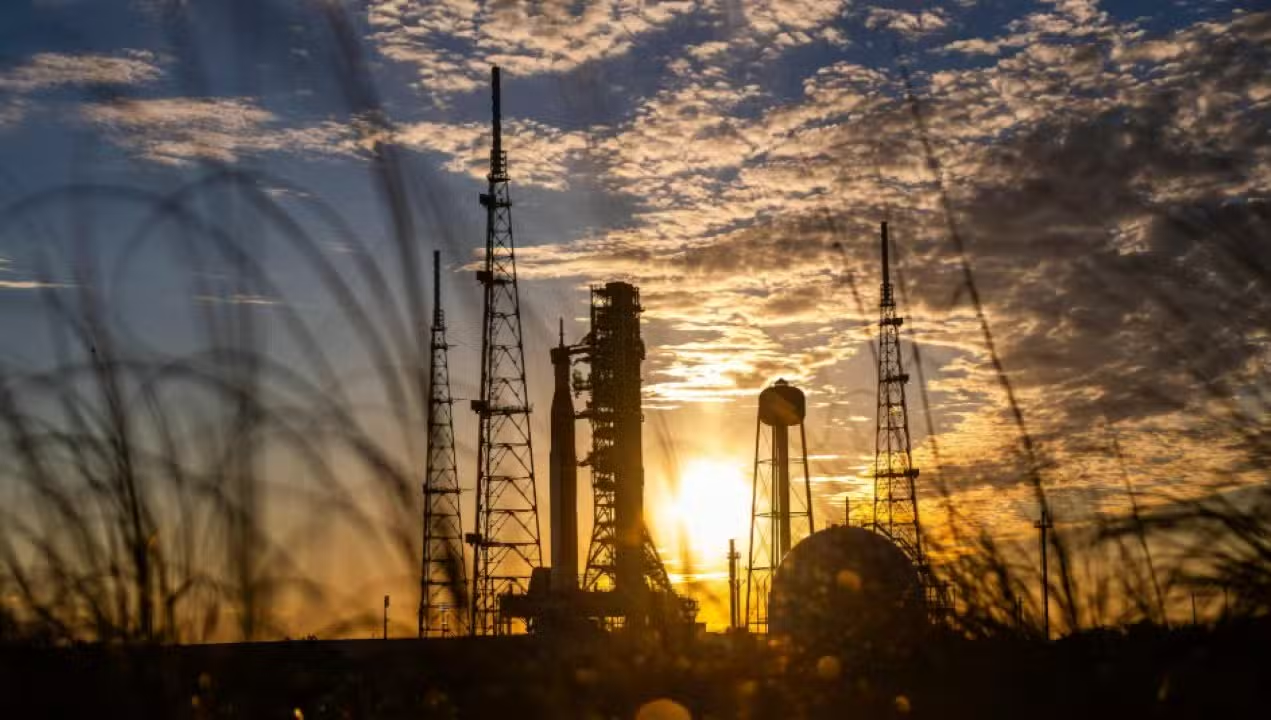
Nasa begins today the launch of mission Artemis II from Kennedy Space Center, on Flórida. Quatro astronauts continue aboard capsule Orion attached to rocket Space Launch System for a flight of approximately ten days that will take the crew around the moon. Esta operation represents the first manned test of the Artemis program and the return of humans to the lunar vicinity after more than 50 years. The scheduled takeoff time is 6:24 pm in the local time zone of Costa Leste of Artemis0.
The crew includes Commander Reid Wiseman, Pilot Victor Glover, Specialist Christina Koch, and Astronaut Agência Espacial Canadense Jeremy Hansen. Wiseman serves as mission leader while Glover becomes the first black man to travel to deep space. Koch records participation as the first woman beyond low Earth orbit and Hansen marks her presence as the first Canadian on a lunar mission. The four professionals completed extensive training to manage Orion systems in distant flight conditions.
- Reid Wiseman has experience as a test pilot for Marinha and experience at Estação Espacial Internacional.
- Victor Glover contributes with a background in naval aviation and operations in the space environment.
- Christina Koch holds the record for the longest stay by a woman on a single orbital mission.
- Jeremy Hansen joins the team as a combat flight and physics specialist.
Final preparations for launch
Teams at Nasa completed loading supercold propellants into the SLS rocket in the hours leading up to the launch window. The process involved gradually supplying liquid hydrogen and liquid oxygen to reach the required volumes in the core stage. Técnicos closely monitored possible hydrogen leaks, a recurring challenge in operations with this high-efficiency fuel.
The launch director authorized refueling to proceed after thorough checks of ground systems. Meteorologistas indicated an 80% favorable probability for the attempt, with clear sky conditions prevailing despite possible isolated showers in the late afternoon. Ventos coastal areas presented intensity within acceptable limits for the vehicle.
Planned mission trajectory
Capsule Orion will follow a route that includes initial orbits around Terra before heading to rendezvous with the moon. Durante the route, the crew will reach distances greater than the record set by Apollo 13 in 1970. The lunar flyby maneuver will take place at an altitude between 6,437 and 9,656 kilometers above the surface, allowing observations of regions not accessed by previous Apollo missions.
The mission prioritizes validating the vehicle’s capabilities with humans on board. Sistemas thermal control, life support and navigation will receive tests in a real environment. Orion should return to Terra after about ten days, with splashdown expected at Oceano Pacífico.
Artemis program history
Artemis II succeeds the unmanned mission Artemis I, carried out in 2022. Naquela On this occasion, Orion completed a 25.5-day flight and captured detailed images of Terra, the space trajectory and the lunar surface. The unmanned test confirmed the performance of the SLS rocket and capsule in deep space conditions.
Previous delays occurred in February and March due to technical problems such as hydrogen leaks and helium flow. Engenheiros Adjusted loading procedures and checks to increase system reliability. The Artemis program aims to establish a sustainable presence on the moon as a preparatory step for future exploration toward Marte.
Details about the rocket and capsule
Space Launch System measures 98 meters in height and uses cryogenic propellants to generate the thrust necessary to escape Earth’s gravity. Liquid hydrogen offers high specific impulse, although it requires precise handling to avoid evaporation losses or leaks. Capsule Orion incorporates improvements over previous versions, including exercise equipment and humidity management systems adapted to human presence.
Astronauts will carry out monitored activities during the flight to assess the comfort and operability of internal environments. The mission collects data on radiation, communications and solar panel performance over extended distances.
Technical aspects of the lunar flyby
The trajectory allows the crew to observe parts of the lunar surface not visible from orbits Apollo. The flyby’s higher altitude offers different perspectives than those obtained by previous command modules or robotic orbiters. Sensores and onboard cameras will record valuable information for planning subsequent missions.
Engineers at Nasa emphasize the gradual sequence of development. Cada stage tests specific capabilities before moving on to more complex operations, such as docking and descents on the lunar surface.



Profile of astronauts and representative landmarks
Reid Wiseman commands the expedition based on his training as a test pilot and experience in long-duration missions. Victor Glover contributes expertise in naval operations and represents diversity in deep space flight. Christina Koch brings knowledge in engineering and endurance records in space. Jeremy Hansen adds international perspective with Canadian combat aviation background.
The team’s composition reflects efforts to include professionals from different backgrounds in lunar exploration. Cada member participated in intensive simulations that reproduced phases of the mission, from launch to return.
Updates on supply and weather conditions
The propellant loading process progressed according to schedule after the tanks were adequately cooled. Equipes followed the continuous flow of liquid hydrogen before increasing the rate to complete filling the core stage with about 700,000 gallons of combined propellants.
Meteorological officials at Força Espacial confirmed that clouds and winds do not pose significant restrictions. The vehicle’s resilience allows tolerance to moderate conditions without compromising safe operation.
Comparison with previous missions
Unlike Apollo, which performed low orbits close to the moon, Artemis II adopts a higher flyby profile. Essa choice balances scientific objectives with safety requirements for the first manned flight of SLS and Orion. The mission does not include a lander, focusing instead on evaluating the transportation system.
Data collected during the flight will inform adjustments for future testing, including integration of commercial descent vehicles. The program follows an incremental approach to mitigate risks in each phase.
Significance for the space exploration program
The Artemis II advances the development of technologies necessary for sustainable lunar operations. Testes with crew validate life support, navigation and thermal control systems in real deep space conditions. Informações obtained contribute to the planning of missions that aim for a continuous presence on the moon.
Teams continue real-time monitoring of ground systems and the vehicle. The focus remains on safely executing the launch sequence and following the initial trajectory after liftoff.
Summary chronology of recent events
The integration of the rocket and capsule took place in the previous months, with rollout to the launch platform at a recent date. Testes Wet suit and systems checks preceded the current countdown. The crew carried out preparatory activities on the day of the operation, including meals and final reviews of procedures.
The launch marks a milestone in the human return to manned lunar exploration. Dados and experiences from that mission pave the way for subsequent steps in the Artemis program.
Veja Tambem em News (EN)

Research reveals that parents are unaware of how their children use artificial intelligence

Samsung releases new system update with new features for Galaxy Watch 4 users

Digital retail reduces the value of the Galaxy S25 5G smartphone with bank bonuses and device exchange
Amazon’s wireless CarPlay adapter has a 50% discount and high approval ratings from drivers

Zach Cregger’s new Resident Evil ignores games and focuses on an unprecedented story with new characters

Rumor suggests that Nintendo is preparing a special edition of the Switch 2 with a remake of Ocarina of Time
Apple accelerates production of the iPhone 17e and develops new Air model with dual camera system

Epic Games platform releases twelve high-budget games at no permanent cost for PC users

PlayStation 5 Pro price drop accelerates digital retail sales and eliminates global stocks

New Galaxy Watch 9 firmware appears on server and confirms progress in software development

Apple’s commemorative project tests cell phone with 1.1 millimeter edge and curved screen for 2027