
New adjustment by Petrobras increases aviation kerosene by 55% and affects commercial flight rates
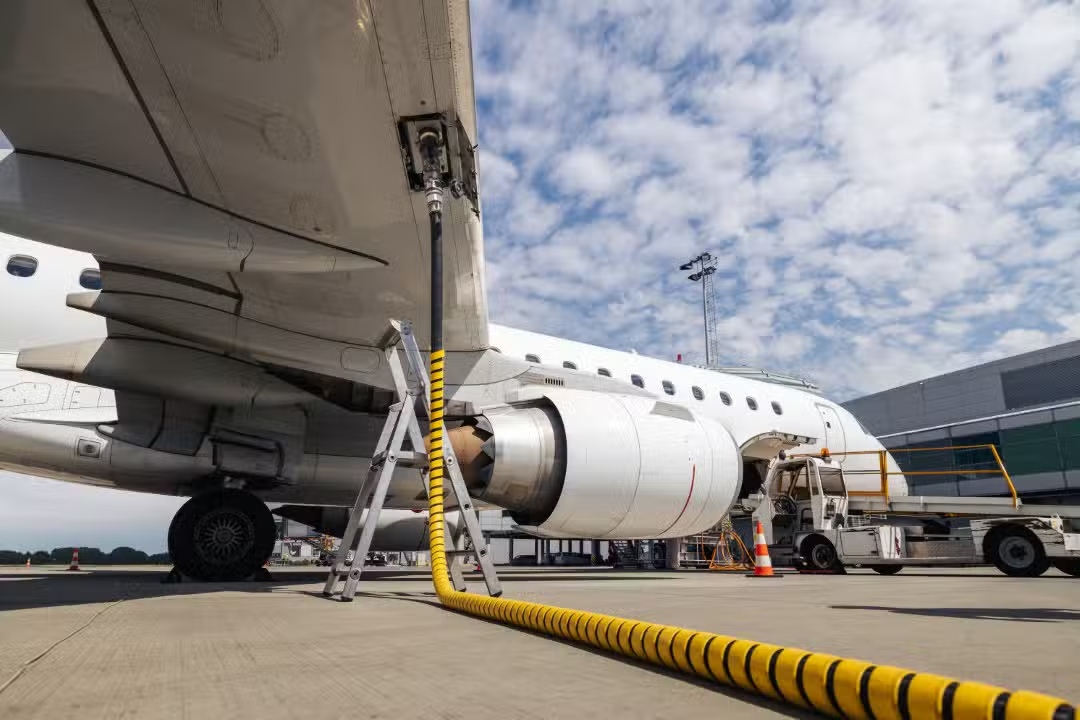
The Brazilian state-owned oil company confirmed a significant increase in the amounts charged for fuel used in commercial aircraft throughout the national territory. The 55% increase in refineries came into effect immediately, changing the cost dynamics of the main logistics and passenger transport operators. The measure changes the financial scenario of carriers, who depend on the input to maintain the regularity of their daily air routes.
This tariff movement reflects the international parity policy adopted by the company, which follows fluctuations in the foreign crude oil market and exchange rate variations. The decision surprised airline sector managers, who are now redoing their financial plans for the current quarter. Companies’ controlling teams look for ways to balance the books without removing the end consumer from the boarding terminals.

Energy input represents the largest share of carriers’ operating expenses, exceeding the mark of one third of all capital invested to keep fleets in the air. Diante of the new table established by the supplier, companies evaluate urgent commercial strategies to deal with pressure on cash flow and guarantee the continuity of services provided in all regions of the country.
Transfer dynamics for air tickets
The drastic change in the value of the cubic meter of the petroleum product generates a chain reaction in the formulation of fares charged to travelers. Especialistas in civil aviation point out that the full absorption of this cost by companies is unfeasible without compromising the profit margin and the maintenance of daily operations. The transfer to the consumer becomes an inevitable measure for the financial survival of companies.
Companies operating domestic routes have already started reviewing their cost matrices, which should result in more expensive tickets in the coming weeks. The strategy of offering promotional rates during low season periods is severely restricted given the current level of supply expenses. Corporate and leisure travel planning will need to be adjusted to the new price reality.
Cargo transportation and logistics operations linked to e-commerce are also on the rise. Contratos air freight usually have automatic readjustment triggers linked to fuel, transferring the burden of the increase to the end consumer who purchases products dependent on express delivery. Medicamentos, electronics and perishable goods tend to undergo adjustments on shelves.
Regional connectivity suffers direct risks with the increase in operational expenses, forcing companies to reevaluate the viability of flights to destinations with a lower passenger density. Frequências daily rates can be reduced to optimize aircraft use and concentrate demand at peak times. Cidades from the interior who depend on aviation for business may face a temporary reduction in seat supply.
Variables in the international energy market
The state-owned company’s pricing methodology considers the cost of importing the product, plus logistics costs to airport terminals and refining margins. Como national production does not meet all domestic demand, dependence on global prices makes the local market vulnerable to external shocks. Fatores Geopolitics and global supply constraints dictate the pace of airport bombs.
Fluctuations in the value of barrel type Brent and the strength of the US currency against the real determine the monthly updates. Esse model ensures that the oil company does not accumulate financial gaps, but transfers global volatility directly to the consumer end of the domestic market. Cost predictability for airlines is compromised, requiring rapid adaptations to each new fare announcement.
Mitigation strategies in commercial fleets
To try to curb the escalation of expenses, operators are accelerating their fleet modernization programs, replacing old planes with models that consume less kerosene per kilometer flown. Essa Technological transition requires billion-dollar investments and time for complete implementation on routes. Aeronaves of new generation can deliver superior energy efficiency, partially relieving the weight of fuel in the final balance.



Operational efficiency on the ground also undergoes rigorous reviews, with optimization of taxiing time and the use of alternative energy sources while aircraft are parked at the boarding gates. Cada Liter saved represents marginal relief in carriers’ financial spreadsheets. Procedimentos Continuous descent and more direct routes are negotiated with air traffic control.
Aircraft leasing and scheduled maintenance, both quoted in foreign currency, form an additional bottleneck when added to the cost of supply. Fleet management requires detailed accounting work to maintain safety and punctuality without exceeding budgets for the fiscal year. Renegotiating contracts with parts suppliers becomes a priority for financial departments.
Institutional dialogues on taxation
Entities representing civil aviation intensified conversations with government spheres in search of alternatives that alleviate the tax burden on the passenger transport sector. The main agenda involves the review of state and federal tax rates that apply to fuel, creating a cascade effect that makes the final product more expensive at airport pumps across the country. The associations’ proposal is to establish a ceiling or a temporary exemption that allows companies to go through the peak period without passing on the entire cost to passengers, preserving the volume of trips and the financial health of operators.
Maintaining the competitiveness of the Brazilian market compared to other hubs is a central argument in these negotiations with public authorities. Aeroportos Nationals that function as international connection hubs run the risk of missing flights from foreign companies if the cost of local supply becomes prohibitive compared to neighboring countries. The dialogue with Ministério, Minas and Energia seeks to create stability mechanisms, allowing operators to outline medium-term scenarios without the risk of tariff surprises that destabilize logistical planning and advance ticket sales.
Reactions in the tourism chain
The traveler’s sensitivity to the prices charged by airlines is a determining factor in the growth or contraction of the economy focused on national tourism. Quando the cost of tickets exceeds the limit of the family budget, there is an immediate migration to land transport modes or the cancellation of leisure trips. Redes hotels, reception agencies, car rental companies and local businesses in tourist destinations feel the direct impact of the decrease in the flow of visitors to airports. The significant increase in basic aviation inputs creates a financial barrier that threatens to interrupt the growth curve that the services sector has been recording in recent quarters. Gestores of tourist destinations are already monitoring booking rates for the coming months, anticipating joint promotional campaigns to try to maintain the attractiveness of internal travel even in the face of high air fares. Air connectivity is the driver of tourist hubs far from large urban centers, and any increase in logistics affects the generation of direct and indirect jobs in these regions that depend on the constant flow of visitors.
National supply guarantee
Maintaining continuous supply at airport terminals is defended by the oil company as the main benefit of its policy of aligning with global prices. Sem import parity, private agents would stop bringing the product from abroad, creating a real risk of shortages that would paralyze the country’s air network in a few days, affecting the transport of people and essential cargo.
Financial market behavior
The announcement of the adjustment generated immediate movements on the stock exchanges, with investors reevaluating their positions in shares of companies linked to commercial air transport. The prospect of compressed profit margins drives away speculative capital and requires companies to demonstrate resilience in their quarterly balance sheets. Analistas market adjust their buy and sell recommendations based on each company’s ability to pass on costs.
The state-owned supplier reinforces the market’s confidence in its governance by protecting its revenues against artificial lags. The profitability of refining operations remains protected, guaranteeing the necessary resources to continue investments in energy infrastructure in the national territory. The balance between the financial health of the supplier and the viability of the airlines remains the main point of attention in the transport economy.
Veja Tambem em News (EN)

Research reveals that parents are unaware of how their children use artificial intelligence

Samsung releases new system update with new features for Galaxy Watch 4 users

Digital retail reduces the value of the Galaxy S25 5G smartphone with bank bonuses and device exchange

Amazon’s wireless CarPlay adapter has a 50% discount and high approval ratings from drivers

Zach Cregger’s new Resident Evil ignores games and focuses on an unprecedented story with new characters

Rumor suggests that Nintendo is preparing a special edition of the Switch 2 with a remake of Ocarina of Time

Apple accelerates production of the iPhone 17e and develops new Air model with dual camera system

Epic Games platform releases twelve high-budget games at no permanent cost for PC users

PlayStation 5 Pro price drop accelerates digital retail sales and eliminates global stocks

New Galaxy Watch 9 firmware appears on server and confirms progress in software development

Apple’s commemorative project tests cell phone with 1.1 millimeter edge and curved screen for 2027
