
New study indicates Enaiposha as an exoplanet with no equivalent in the solar system
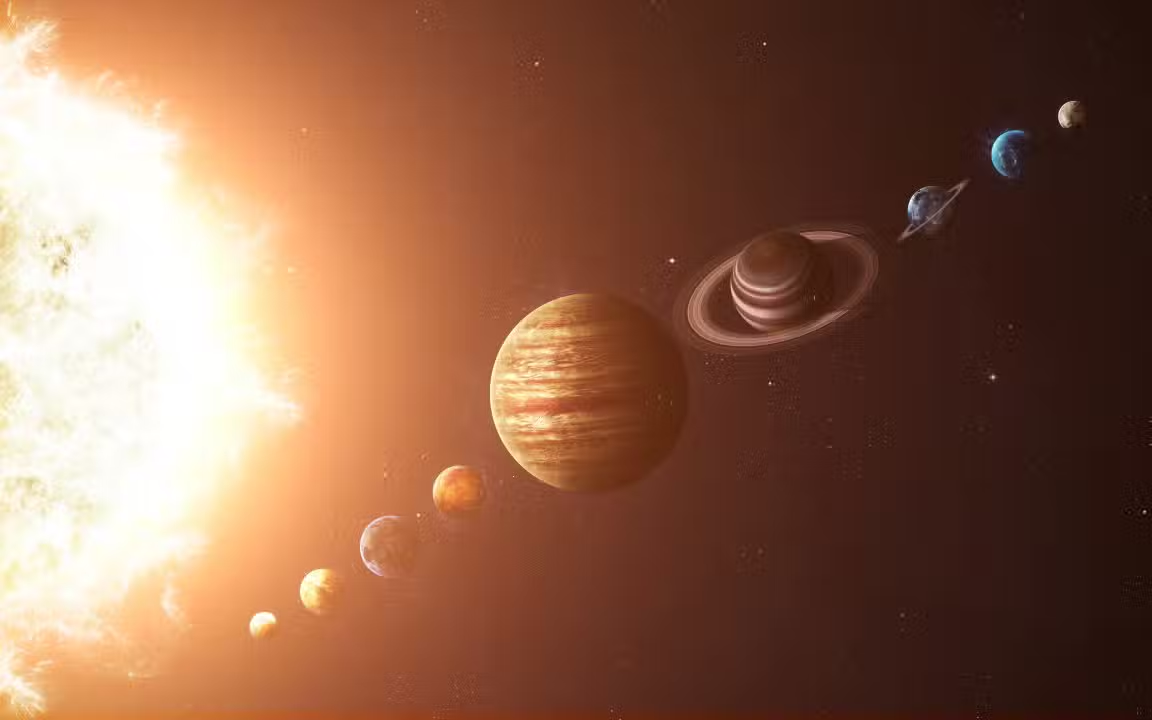
Astronomers have identified new features in the atmosphere of exoplanet Enaiposha, also known as GJ 1214 b. The world orbits a red dwarf star approximately 48 light-years from Terra, in the constellation Ophiuchus. Observações with the James Webb space telescope made it possible to analyze with greater precision the composition of the planet, which has a mass equivalent to just over eight times that of Terra and an intermediate radius between Terra and Netuno.
The planet completes an orbit around its star in about 1.6 Earth days. Essa Proximity results in extreme temperature and radiation conditions. Dados obtained using transit spectroscopy indicate that the atmosphere is thick and hazy, with signs of carbon dioxide above a dense layer of aerosols. Essa configuration weakens previous hypotheses that pointed to an oceanic world or a classic mini-Neptune.
- The atmosphere contains metallic elements in high proportions.
- Dense aerosols cover much of the atmospheric structure.
- Hints of carbon dioxide emerge in analyzes of specific wavelengths.
- The observed profile differs from known rocky planets or gas giants.
Unique characteristics of the atmosphere of Enaiposha
Recent measurements highlight that the atmosphere of Enaiposha is dominated by metals and has high reflectivity. Essa property helps explain recorded day and night temperatures, with the aerosol layer acting as a shield that reflects a significant part of the starlight. Cientistas use three-dimensional models to interpret thermal emission data collected by James Webb.
The spectroscopic curved phase technique made it possible to map temperature variations between the day and night sides of the planet. The results show an atmosphere enriched with heavy molecules, which suggests formation processes distinct from those observed on planets in the solar system. The presence of thick aerosols continues to defy direct analysis at certain wavelengths.
Rendering of Enaiposha (center). also known as GJ 1214 b. It is an exoplanet that is unlike anything seen before, with a thick atmosphere potentially composed of hydrogen, helium, water, methane, and carbon dioxide, leading to it’s given title of ‘Super Venus’pic.twitter.com/LaBpKVMdlU
— Black Hole (@konstructivizm)March 30, 2025
Interpretation as potential super-Venus
Researchers now consider that Enaiposha may represent a class of planet similar to a scaled-up version of Vênus. The planet does not fit neatly into the traditional categories of super-Earth, mini-Neptune or oceanic world. The combination of a dense atmosphere, rich in metals and carbon dioxide in aerosols brings its profile closer to the extreme conditions seen in Vênus, but on a larger scale.
This reclassification comes after years of observations that failed to completely penetrate the atmospheric haze. James Webb provided mid-infrared data that revealed previously hidden features. The host star, a red dwarf, directly influences the planet’s environment due to its orbital proximity.
Challenges in exoplanet spectral analysis
Astronomers apply transit spectroscopy to study the star’s light passing through Enaiposha’s atmosphere during frequent transits. Essa approach allows detecting absorptions at specific wavelengths associated with different molecules. Mesmo with the thick aerosol layer, signals compatible with carbon dioxide and possible methane were identified in analyzes from 2024 and 2025.
Atmospheric models indicate that high metallicity can explain part of the observations. The high reflectivity of the atmosphere suggests that the planet does not absorb all the incident stellar energy, maintaining temperatures a little more moderate than would initially be expected. Estudos Complementary curved phase data reinforce the idea of a complex structure beneath the haze layer.
Importance to planetary science
Enaiposha expands understanding of the diversity of intermediate-sized exoplanets. Sub-Neptunes like this are common in Via Láctea, but absent in the solar system. Detailed analysis of their atmosphere provides clues about how planets form and evolve in systems with red dwarf stars.
Data from James Webb continues to refine theoretical models about dense, chemically complex atmospheres. Observações may further confirm or adjust current detections of specific molecules. The planet serves as a natural laboratory to test hypotheses about planetary compositions that deviate from local references.



Origin of the name and context of the discovery
The name Enaiposha was officially assigned in 2023 by União Astronômica Internacional, following a proposal from a Kenyan team. Ele derives from the Maa language and means large body of water, although current characteristics point to a very different environment. The planet’s initial discovery occurred in 2009, with recent reinterpretation driven by new observational capabilities.
The host star was named Orkaria, also of maa origin, related to the reddish color typical of red dwarfs. Esses names highlight international collaboration in exoplanet naming. The system is approximately 47 to 48 light years away, a distance that allows detailed observations with current instruments.
Technical details of recent observations
Scientists have combined transmission spectra in different infrared bands to map the atmosphere. Resultados indicate that the aerosol layer is highly reflective and rich in particles. Abaixo of it, models suggest a composition dominated by heavy elements, with a possible influence of water vapor in previous analyses.
The short orbital period facilitates the accumulation of multiple observations at short intervals. Essa Frequency helps reduce uncertainty in statistical models applied to data. Pesquisas published in specialized journals detail the methodologies used to separate atmospheric signals from instrumental noises.
Comparison with existing planetary classifications
Enaiposha does not correspond exactly to any planet in the solar system. Sua mass and radius place it in the sub-Neptune range, but the thick, metallic atmosphere sets it apart from known gaseous or rocky examples. The similarity with Vênus arises mainly due to the atmospheric density and presence of carbon dioxide, although in different proportions and conditions.
This discovery reinforces the idea that planetary architecture in the universe includes varieties not represented locally. Estudos Futures with James Webb and other telescopes can better map the planet’s internal structure and thermal evolution. The analysis contributes to more accurate catalogs of intermediate-mass exoplanets.
Methodological advances in the characterization of atmospheres
The use of spectroscopic phase curves made it possible to measure direct thermal emissions from the planet. Temperaturas Averages recorded on the day and night side provide data on global atmospheric circulation. Modelos three-dimensional models incorporate these values to simulate possible chemical compositions consistent with observations.
The high measured reflectivity implies high albedo, which affects the planet’s energy balance. Equipes international teams collaborate to cross-reference data from different instruments and analysis pipelines, ensuring robust results. Esses methods represent advances in the ability to study distant worlds shrouded in fog.
Perspectives for future research on Enaiposha
New planned observations aim to confirm detections of molecules such as carbon dioxide and investigate other possible chemical species. Orbital proximity allows for continuous monitoring that accumulates evidence over time. Cientistas also explore implications for planet formation in metal-rich protoplanetary disks.
The case of Enaiposha illustrates how instruments like James Webb transform knowledge about exoplanets. The reevaluation of old classifications makes room for new categories that better describe the observed diversity. The planet remains a priority target for studies of dense atmospheres in nearby systems.
Veja Tambem em News (EN)

Research reveals that parents are unaware of how their children use artificial intelligence

Samsung releases new system update with new features for Galaxy Watch 4 users

Digital retail reduces the value of the Galaxy S25 5G smartphone with bank bonuses and device exchange

Amazon’s wireless CarPlay adapter has a 50% discount and high approval ratings from drivers

Zach Cregger’s new Resident Evil ignores games and focuses on an unprecedented story with new characters

Rumor suggests that Nintendo is preparing a special edition of the Switch 2 with a remake of Ocarina of Time

Apple accelerates production of the iPhone 17e and develops new Air model with dual camera system

Epic Games platform releases twelve high-budget games at no permanent cost for PC users

PlayStation 5 Pro price drop accelerates digital retail sales and eliminates global stocks

New Galaxy Watch 9 firmware appears on server and confirms progress in software development

Apple’s commemorative project tests cell phone with 1.1 millimeter edge and curved screen for 2027
