Researchers identify merger of three massive galaxies 7.5 billion light years from Earth
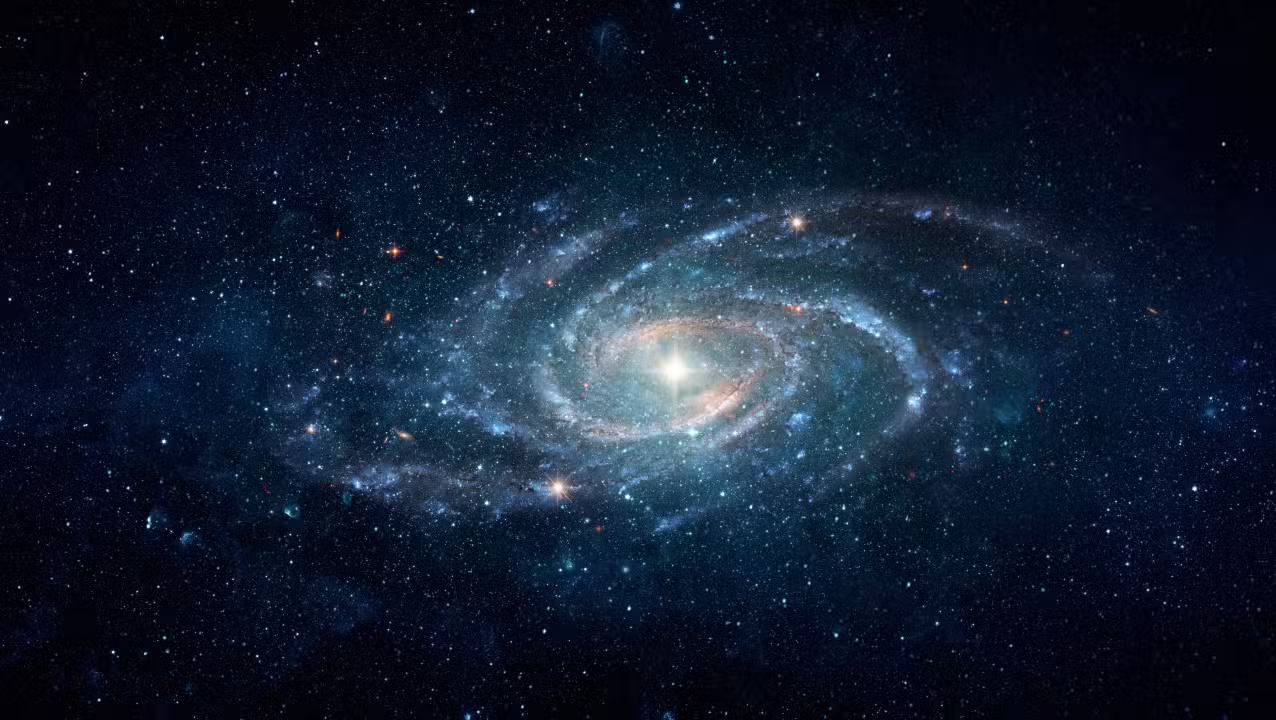
Deep space monitoring teams have recorded the existence of a galactic complex formed by three massive structures in the process of merging. The astronomical phenomenon is positioned at a distance of 7.5 billion light years from our planet, functioning as a visual record of when the universe was approximately half its current age. Detailed observation of this cluster provides unprecedented data on the consolidation of large celestial formations in the early cosmos.
Detection occurred using highly sensitive equipment calibrated to capture multiple wavelengths of electromagnetic radiation. The data reveals that the three galaxies share a vast halo composed of superheated gas and stardust, indicating an advanced stage of gravitational interaction. The total mass of the ensemble exceeds conventional estimates for systems from that time.
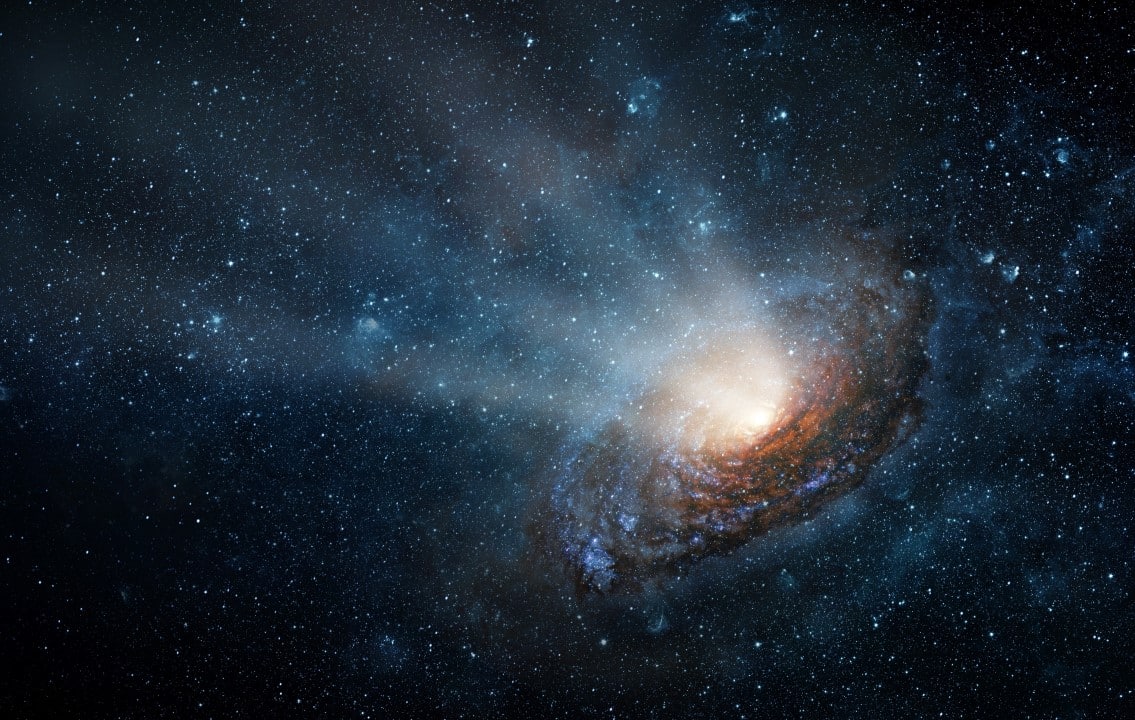
The initial mapping of the triple system highlighted specific characteristics that differentiate this formation from other clusters already cataloged by space agencies and terrestrial observatories:
- The exact position in space was validated through high-precision measurements of the redshift of the emitted light.
- The rate of new star birth within the shared halo exceeds patterns observed in isolated galaxies.
- Tidal forces generated by the proximity of the nuclei are altering the original spiral morphology of each component.
- The high luminosity of the array allows the identification of complex chemical signatures in the distant interstellar medium.
Gravitational dynamics and the formation of stellar nurseries
The architecture of the triple system features an unusual concentration of baryonic and dark matter, drawing the attention of the scientific community to the speed of mass clustering in the young universe. Cada member of the trio has an active core powered by supermassive black holes, whose gravitational forces dictate the rhythm of the internal movement of the entire complex. Essa mutual attraction drags gigantic clouds of molecular hydrogen through intergalactic space, compressing the gas to the point of nuclear ignition.
The continuous displacement of these gaseous masses results in the creation of extensive stellar nurseries that cover distances of thousands of light years between the centers of galaxies. Nesses In extremely dense environments, the gravitational collapse of interstellar material occurs at an accelerated rate, generating populations of young and massive stars. The ultraviolet radiation emitted by these new stars ionizes the surrounding gas, creating bubbles of plasma that shine brightly and make it easier for telescopes to track the structure.
Thermal characteristics of intergalactic gas
Thermodynamic analyzes of the fusion region demonstrated that the intergalactic medium is subjected to extreme temperatures, a direct consequence of high-speed collisions and shock waves generated by the approach of the three celestial bodies. The kinetic energy dissipated during the meeting of the vast clouds of dust and gas is converted into heat, raising the temperature of the shared halo to millions of degrees Celsius. Esse superheating creates a paradoxical environment, as, in certain areas of the cluster, the thermal agitation of the particles prevents the gas from cooling and condensing to form new stars, temporarily interrupting the cycle of stellar renewal. X-ray mapping of this thermal emission provides astrophysicists with a detailed map of the mass distribution in the system, revealing how the mechanical energy of fusion is distributed throughout the structure and influences the ensemble’s overall star formation rate.
Dark matter behavior in the distant cluster
Calculations of the orbital mechanics of the three galaxies indicate that the visible mass represents only a fraction of the system’s total weight. Most of the gravitational pull holding the trio together comes from a vast halo of invisible dark matter.
The presence of this hidden component is inferred through the effect of gravitational lensing, where light from even more distant objects is bent as it passes through the cluster’s vicinity. The observed optical distortion confirms the existence of a deep gravity well.
Studying the distribution of this invisible matter helps validate current cosmological models about the formation of large-scale structures. The concentration of mass acts like an anchor, continually attracting more gas and smaller galaxies from the cosmic neighborhood.
Activity of active nuclei and radiation emission
Activity at the centers of the three galaxies is driven by the constant fall of matter toward supermassive black holes. Esse The accretion process generates disks of superheated material that emit radiation across virtually the entire electromagnetic spectrum.
Some of the matter that spirals towards the event horizon is ejected in the form of relativistic jets. Esses Beams of particles travel at speeds close to that of light, piercing the intergalactic medium and creating vast lobes of radio emission.



The interaction of these jets with the surrounding gas generates additional turbulence, contributing to the heating of the common halo. Continuous measurement of these radio emissions makes it possible to map the intensity and orientation of the magnetic fields present in the system.
The variations in brightness recorded over the months of observation indicate that the feeding of black holes occurs in irregular pulses. Essa Intermittency reflects the chaotic nature of the gas streams that flow into the center of the cluster during the fusion process.
Advanced interferometry observation methods
Capturing images with sufficient resolution to distinguish the three nuclei at 7.5 billion light years required the use of interferometry techniques. Esse method synchronizes the signal received by multiple antennas and mirrors spread across the globe, creating a virtual telescope of planetary proportions.
Digital processing of the raw data eliminates distortions caused by the Earth’s atmosphere and isolates the signal coming from deep space. The mathematical precision achieved by this network of observatories was essential for mapping the thin bridges of matter that connect galaxies.
Chemical evolution and the presence of heavy elements
Spectroscopy of the light emitted by the system revealed the presence of heavy chemical elements, such as carbon, oxygen and iron, spread throughout the intergalactic medium. The detection of these metals proves that previous generations of massive stars were born, evolved and exploded as supernovae, enriching the primordial gas long before the current triple fusion began.
Reconfiguration of orbits and stellar currents
The gravitational dance between the three main masses causes the original structures of the galaxies to rupture. Estrelas located at the edges of the spiral disks are torn from their normal orbits by tidal forces, being thrown into the empty space between the nuclei.
This ejected material forms long stellar chains that intertwine, erasing the visual boundaries between the system’s components. Astrophysical fluid dynamics simulations indicate that the three entities will eventually collapse into a single center of mass, forming a giant elliptical galaxy.
Expansion of the universe and large-scale gravity
The detection of such a massive cluster at a time when the universe was significantly denser and younger provides concrete parameters for studying cosmic expansion. Gravity’s ability to gather such a large amount of matter in a relatively short period of time tests the limits of theories about the initial growth rate of density fluctuations after Big Bang. The system acts as an isolated laboratory where the laws of physics operate under extreme conditions of mass and energy.
Continuous monitoring of this region of deep space aims to identify other satellite galaxies that may be attracted to the center of the gravitational well. Cataloging these multiple merger events allows astrophysicists to build a statistical database on how often giant galaxies form through violent collisions. Close analysis of the ancient light arriving at Terra continues to reveal the fundamental mechanics that organized matter into the vast cosmic web seen today through the lenses of large telescopes.
Veja Tambem em News (EN)

Research reveals that parents are unaware of how their children use artificial intelligence

Samsung releases new system update with new features for Galaxy Watch 4 users

Digital retail reduces the value of the Galaxy S25 5G smartphone with bank bonuses and device exchange

Amazon’s wireless CarPlay adapter has a 50% discount and high approval ratings from drivers

Zach Cregger’s new Resident Evil ignores games and focuses on an unprecedented story with new characters

Rumor suggests that Nintendo is preparing a special edition of the Switch 2 with a remake of Ocarina of Time

Apple accelerates production of the iPhone 17e and develops new Air model with dual camera system

Epic Games platform releases twelve high-budget games at no permanent cost for PC users

PlayStation 5 Pro price drop accelerates digital retail sales and eliminates global stocks

New Galaxy Watch 9 firmware appears on server and confirms progress in software development

Apple’s commemorative project tests cell phone with 1.1 millimeter edge and curved screen for 2027