

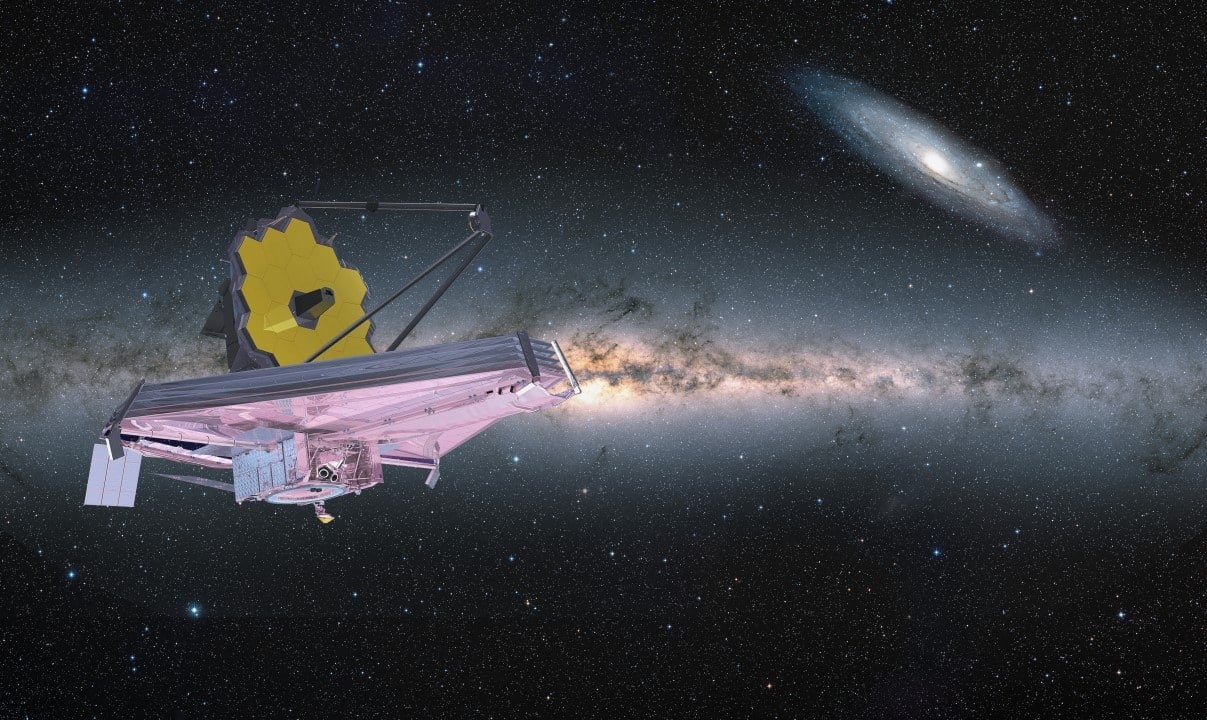
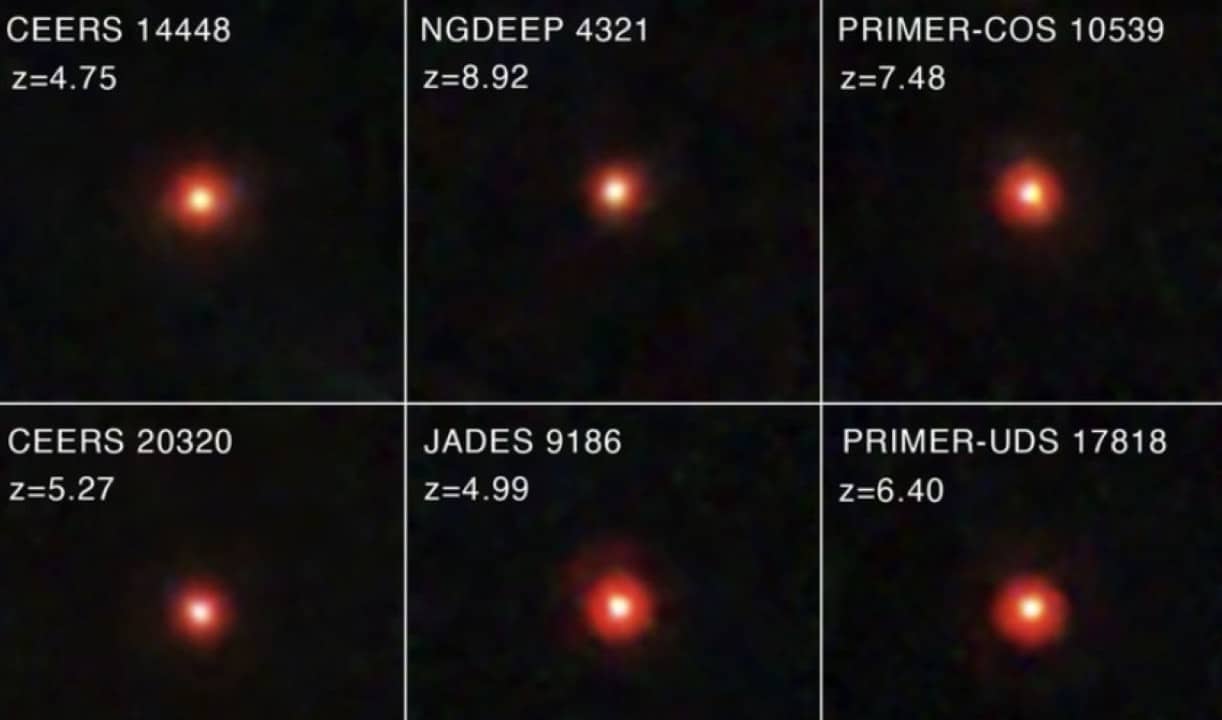
Telescópio Espacial James Webb continues to record small, bright red dots in virtually all of its deep space observations since it began scientific operations about four years ago. Esses Compact objects, known as LRDs, appear frequently in infrared images and still do not have a definitive identification among researchers. Centenas of them have already been catalogued, which has led to the launch of multiple projects dedicated to understanding their exact nature.
Initial observations generated several hypotheses about the composition of these points. Algumas suggested that these were massive galaxies formed soon after Big Bang, while others pointed to black holes shrouded in cosmic dust. However, subsequent analyzes refuted several of these initial ideas and opened up space for new interpretations based on more precise data obtained by the equipment.
- LRDs stand out for their intense red color even in their original frame of reference.
- They focus mainly on the distant universe, corresponding to the first billion cosmic years.
- Detection occurs thanks to the Webb’s sensitivity to infrared light, higher than that of previous telescopes such as the Hubble.
Features observed in red objects
Red dots appear recurrently whenever the telescope directs its gaze to specific regions of the cosmos for long periods. Professor Jenny Greene, Universidade, Princeton, highlighted that there is no consensus on the exact reason for this distinct appearance. Ela studies supermassive black holes and the evolution of galaxies, and considers that light can come from a black hole in the process of accelerated growth.
Other possibilities include an extremely massive star at the end of its lifespan. Observations show that previous hypotheses were discarded as new data emerged. Isso indicates that the current understanding may still change with future information collection.
LRDs are abundant in the early universe, especially in the first billion years after the birth of the cosmos 13.8 billion years ago. In contrast, they become very rare in closer, more recent regions of the universe. Essa temporal distribution offers clues about the processes that occurred when space was still young.
Current hypotheses about light emission
Researchers propose that the observed redness may result from the presence of hydrogen gas around growing black holes, rather than dust as initially thought. Essa review came after spectral analyzes that did not detect clear signs of dust in expected quantities. The phenomenon of redshift explains part of the appearance, as the expansion of the universe lengthens the wavelengths of light emitted by distant objects.
Experts such as Jorito Matty, Instituto Austríaco, Ciência, and Tecnologia have coined the informal term “little red dot” for ease of reference. The technical name involves broad alpha hydrogen emission, but the simplified version has gained popularity among the scientific community. Matty leads teams that analyze these objects and reinforces that many of them are located at extreme distances, which makes detailed studies difficult.
Three cases of LRDs closest to Terra have recently been identified, although they are about 100,000 times rarer than those in the early universe. Relative proximity facilitates future observations and can help clarify outstanding doubts about its formation.
Importance for the study of black holes
These compact objects could represent an early phase or “infancy” of supermassive black holes, similar to what exists at the center of Via Láctea. Entender their origin would fill in gaps in the history of the formation of these celestial bodies, which still intrigue astronomers. The Telescópio Webb, with its 6.5-meter mirror, allows it to capture weak infrared light that previous instruments escaped.
New observations continue to be made and may overturn or confirm current hypotheses. Cada dataset adds details about the density, rotational speed of the gas, and emissions at different wavelengths. The researchers emphasize that the scientific process involves constant testing of ideas, with frequent adjustments as evidence evolves.
The systematic detection of these points in multiple observation campaigns reinforces their relevance for models of cosmic evolution. Eles appear as significant components of galaxies in the young universe, representing a notable fraction of the objects identified in the first billion years.
Next steps in research
International teams plan additional observations to better map the properties of these LRDs. The focus is on separating contributions from stars, ionized gas and possible active galaxy nuclei. Avanços in understanding may alter views about how supermassive black holes formed so quickly in the early cosmos.
The mystery remains open, with the potential to reveal mechanisms still unknown in astrophysics. Cada new image of James Webb adds pieces to the puzzle, expanding knowledge about the distant universe.



