Comet MAPS discovered in January could shine in the April sky if it resists solar heat
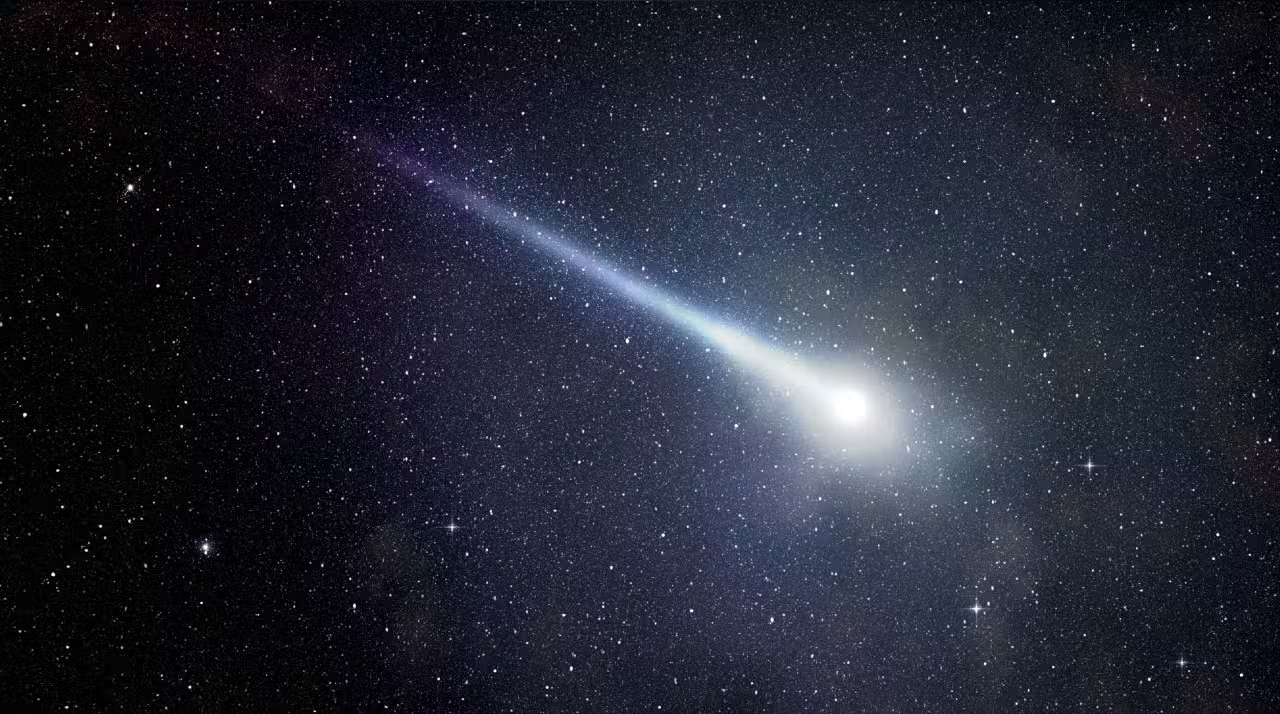
Comet C/2026 A1 (MAPS) makes its closest approach to Sol this week. The perihelion is scheduled for April 4, 2026 and the object will pass approximately 161 thousand kilometers from the solar surface. Astrônomos follow the event closely because the comet could disintegrate due to gravitational and thermal forces or survive and produce a bright trail visible from Terra in the following days.
Discovered on January 13, 2026 by four French amateur astronomers, the comet was named MAPS in reference to the discoverers’ initials: Alain Maury, Georges Attard, Daniel Parrott and Florian Signoret. Detection occurred with a remotely operated 11-inch telescope at the AMACS1 observatory, located in desert of Atacama, no Chile. Classification as sungrazer Kreutz places the object in the same group of comets that plunge dramatically close to Sol.
- The core is estimated to be around 0.4 kilometers in diameter.
- The current magnitude is around 6 to 8, with variations observed in recent weeks.
- The orbit has a period of approximately 1,900 years.
Recent discovery attracts global interest
The identification of comet MAPS occurred just three months ago. The team used CCD images to record the object still more than 2 astronomical units away from Sol. Esse detail differentiates MAPS from other sungrazers, which are usually detected closer to perihelion.
The comet already showed an increase in brightness between March and the beginning of April. Observadores noticed expansion of the coma and formation of a faint tail in some records. Apesar Furthermore, activity remains volatile and directly depends on the integrity of the core during solar passage.
Features of sungrazers Kreutz
Comets in this family are fragments of a larger body that disintegrated in ancient passages. Eles follow highly eccentric and inclined orbits, which takes them to extreme speeds close to Sol, exceeding 500 kilometers per second. MAPS is no exception to this standard.
Interaction with the solar corona exposes the comet’s ice and gases to temperatures of millions of degrees. Esse process releases material that forms the coma and tail, but can also fragment the nucleus if it is too small or fragile. Estudos Preliminaries indicate that the small size increases the risks for MAPS.
🌠☄️ ‘Comet from Páscoa’ may be visible from Terra in the coming weeks
— Sputnik Brasil (@sputnik_brasil)March 12, 2026
📍 Astrônomos follows the approach of comet C/2026 A1 (MAPS), discovered in January in the desert of Atacama, Chile. The object has been rapidly increasing in brightness as it approaches Sol.
💥 The…pic.twitter.com/bZ8P7MoBqy
Risks during perihelion
The comet will face intense tidal forces and extreme heating on April 4th. One possibility is total disintegration before or during the closest point, similar to what occurred with comet ISON in 2013. Nesse case, no visible traces of Terra would remain.
Another alternative involves survival to perihelion followed by subsequent fragmentation. Nessa situation, an elongated tail without a well-defined head could emerge, as recorded in Grande Cometa of Sul of 1887. The third scenario, less likely but possible, foresees the maintenance of the structure intact.
Safe instrument observation
The extreme proximity to Sol prevents direct observation with the naked eye or with telescopes during perihelion. Qualquer attempt poses a risk of permanent damage to vision due to intense infrared radiation. Especialistas recommend the exclusive use of images from space coronagraphs.



The LASCO C3 instrument on board the SOHO probe will capture the comet between April 2nd and 6th. The images in near real time will make it possible to follow the hairpin-shaped path around Sol without direct exposure to the solar disk. Additional Dados will come from other orbital observatories.
Possible visuals after passing
If the comet survives the encounter, it could appear in the western sky at dusk in the second week of April. Dispersion of light by forward scattering can temporarily increase brightness. Astrônomos estimate that, under favorable conditions, the object could reach negative magnitude and become visible even at twilight.
The tail would lengthen to the east or southeast in the first few days after perihelion. Visibility will depend on the amount of dust and gas released, in addition to the relative position in relation to the horizon. Binóculos or small telescopes would make detection easier for observers at mid-latitudes.
Continuous monitoring by scientists
International teams have been following the comet with ground and space telescopes since its discovery. Medições recent data indicate that the core shows moderate condensation and variable activity. The absence of large amounts of dust in some records suggests atypical behavior for sungrazers.
Researchers use coma magnitude and size data to refine predictions. The James Webb Space Telescope and other instruments have contributed to more accurate estimates of nuclear diameter. Essas Information helps assess the likelihood of survival.
Comparison with historical events
The last sungrazer of note was comet ISON, which did not survive its approach in 2013. Antes of it, comet Ikeya-Seki in 1965 produced a remarkable spectacle by surviving with a larger nucleus. MAPS bears similarities to these cases, but its small size makes it more vulnerable.
Records from centuries past show that sungrazers Kreutz spawned some of the brightest comets in history when intact. The final result of MAPS is still uncertain and depends on physical factors that will only be known during or after perihelion.
Updates expected in the next few days
Observers should consult SOHO’s live feeds to track progress between April 2 and 6. Qualquer Fragmentation or survival will generate valuable data on the composition and strength of these celestial bodies. The event contributes to the general understanding of sungrazer comets.
Comet MAPS offers a rare opportunity for real-time study. Independentemente of the outcome, the observations will enrich knowledge about these cosmic visitors who come dangerously close to Sol.
Veja Tambem em News (EN)

Research reveals that parents are unaware of how their children use artificial intelligence

Samsung releases new system update with new features for Galaxy Watch 4 users

Digital retail reduces the value of the Galaxy S25 5G smartphone with bank bonuses and device exchange
Amazon’s wireless CarPlay adapter has a 50% discount and high approval ratings from drivers

Zach Cregger’s new Resident Evil ignores games and focuses on an unprecedented story with new characters

Rumor suggests that Nintendo is preparing a special edition of the Switch 2 with a remake of Ocarina of Time
Apple accelerates production of the iPhone 17e and develops new Air model with dual camera system

Epic Games platform releases twelve high-budget games at no permanent cost for PC users

PlayStation 5 Pro price drop accelerates digital retail sales and eliminates global stocks

New Galaxy Watch 9 firmware appears on server and confirms progress in software development

Apple’s commemorative project tests cell phone with 1.1 millimeter edge and curved screen for 2027