Gemma 4 on Arm accelerates on-device AI on Android devices efficiently and privately
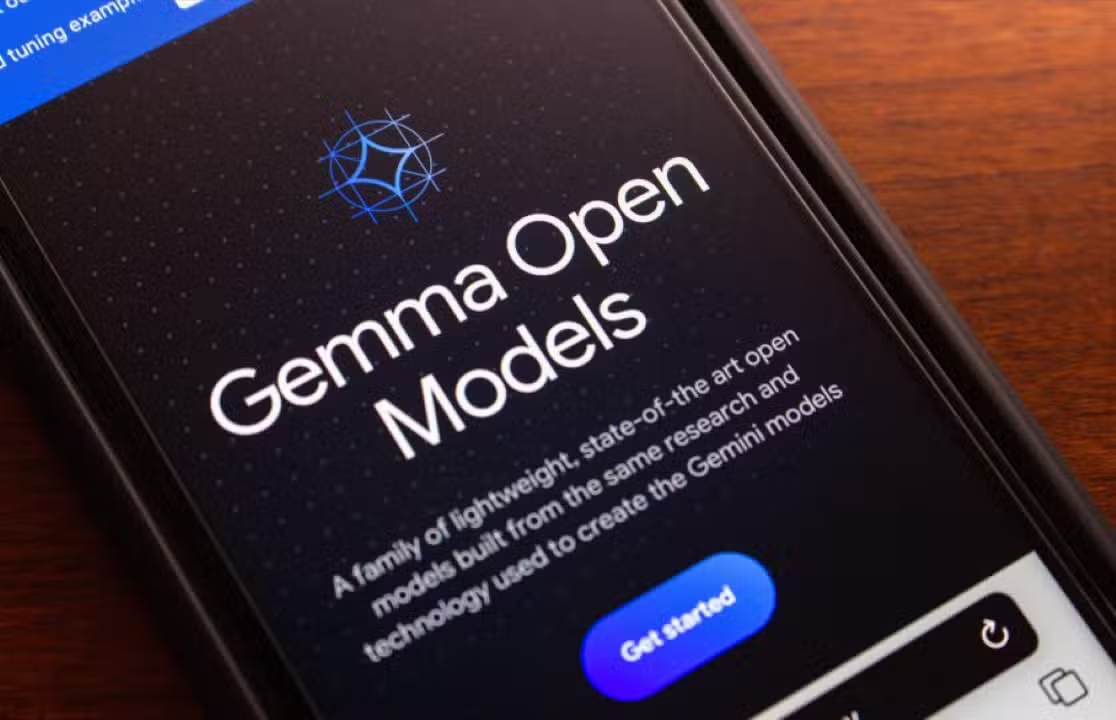
Google released Gemma 4, which brings significant advancements to running artificial intelligence directly on Arm architecture-based Android devices. Essa release improves performance and power efficiency, enabling developers to create richer, real-time experiences without relying on cloud connections. Usuários gain access to instant assistance, fluid communication, and advanced customization, all kept within the power envelope of modern smartphones. Integration with the Arm ecosystem facilitates adoption on a global scale.
Initial engineering tests carried out by Arm demonstrated significant gains in the processing of the Gemma 4 E2B model. Pre-populating user input saw an average speedup of 5.5x, while response generation was up to 1.6x faster with Armv9 innovations. Essas improvements involve updates to Google’s XNNPACK and Arm’s KleidiAI layer, optimizing AI workloads directly on CPUs.
- Expanded support for multimodal experiences that combine text, audio, and image.
- Maintenance of the memory footprint without significant increase.
- Expanded language support for more inclusive interactions.
- Solid foundation for agentic workflows and real-time reasoning.
These features position Gemma 4 as a solution that meets users’ growing expectations for immediate, contextual responses in everyday applications.
Technical advances of Gemma 4 in Arm processors
The Armv9 architecture represents the most advanced and secure foundation for running AI at sliding scale. The Scalable Matrix Extension 2 (SME2) accelerates heavy matrix operations typical of AI models, all within the power limits of today’s smartphones. Processadores Arm C1 already incorporate this technology, which results in higher sustained performance and better energy efficiency during prolonged use.
The Arm KleidiAI acceleration layer natively integrates with libraries such as XNNPACK, LiteRT, and MediaPipe from Google. Desenvolvedores access these optimizations without requiring changes to existing code, templates, or deployment pipelines. The practical result includes faster responses, continuous interactions and thermal stability even with more complex models.
This combination allows applications to deliver consistent experiences regardless of connectivity conditions. Local inference reduces latency, strengthens privacy by keeping data on the device, and lowers infrastructure costs for app creators.
Practical application in accessibility with the app Envision
Envision, an application focused on blind and low vision users, evaluated a prototype that runs Gemma 4 locally on Arm CPUs with SME2 support. Anteriormente, interpretation of scenes depended on connection to the cloud. Agora, the user captures a photo and receives detailed descriptions of the scene directly on the device, without sending sensitive data over the network.
This offline approach ensures operation anywhere, even without internet, and preserves privacy by processing everything on the device. The CEO of Envision highlighted the importance of this capability for the community, as it offers scene descriptions and visual responses with low latency and high reliability.
The case serves as an initial demonstration of the potential when Gemma 4 meets the Arm computing platform on a sliding scale. Outros Developers can follow the same path to integrate similar functionality into different app categories.
Collaboration between Arm and Google for the Android ecosystem
The partnership between Arm and Google seeks to simplify the work of developers who want to incorporate Gemma 4 into Android applications. Performance optimizations are automatically available when targeting Arm-based devices with SME2. Essa collaboration combines the Armv9 architecture with native Android operating system accelerations.
Company representatives reinforced their joint commitment to advancing on-device AI. The focus is on delivering fast, responsive and privacy-preserving experiences without requiring deep modifications to existing applications. Usuários Ends benefit from more fluid interactions and greater device autonomy.
The transition to local inference represents a structural change in mobile application architecture. Ela opens space for new categories of tools that operate in real time, regardless of the quality of the data connection.
General benefits of running AI locally with Gemma 4
Applications that adopt Gemma 4 optimized for Arm deliver faster responses and smoother interactions. Battery life maintenance and thermal control remain stable even during AI-intensive tasks. Essa Efficiency makes it feasible to use increasingly capable models directly on devices.
The Android ecosystem, which reaches billions of users, benefits from this evolution. The ubiquitous presence of the Arm architecture allows improvements to arrive broadly and uniformly. Desenvolvedores can explore use cases that previously required heavy cloud infrastructure.
The combination of performance, privacy and accessibility positions the solution as an emerging standard for smart mobile applications. Experiências Contextual and assistive processes become routine without compromising the security of personal data.
Integration of multimodal capabilities and expanded support


Gemma 4 expands capabilities beyond traditional text. Ela integrates audio and image processing, allowing for more natural and complete interactions. Usuários can switch between different modalities without noticeable interruptions in the application flow.
Support for more languages makes adoption easier in diverse markets around the world. Desenvolvedores create applications that understand visual, auditory and textual context simultaneously. Essa Multimodality enriches productivity, education and entertainment tools available on smartphones.
Tests demonstrate that optimizations keep resource consumption under control. The model processes complex inputs and generates relevant outputs with reduced latency. Essa This feature is essential for applications that demand instant responses.
Developer adoption prospects
Developers who are already exploring the Android ecosystem find an easier way to incorporate Gemma 4. The updated libraries and frameworks deliver performance gains without requiring code rewriting. Essa Simplicity speeds up the development and testing cycle.
Accessibility, healthcare, translation and personal assistance applications benefit especially from running locally. Network independence extends reach to regions with limited connectivity. Usuários receive reliable functionality regardless of location.
Ongoing collaboration between the technical teams at Arm and Google aims to provide clear guidance and up-to-date tools. The goal is to make on-device AI the default architecture for most mobile experiences.
Impact on end user experience
Smartphones equipped with SME2-compatible Arm processors offer smarter, more responsive interactions. Usuários realize almost immediate responses in assistants, image editors and communication tools. Enhanced privacy conveys greater confidence in daily use.
Reducing cloud dependence also contributes to greater device autonomy. Aplicativos Work consistently even when traveling or in areas with no signal. Essa reliability increases overall satisfaction with AI features.
The advancement represents another step towards personalized experiences that respect the limits of mobile hardware. Bilhões of Android users can access similar benefits as more applications adopt the technology.
Technical challenges overcome in optimization
Engineering teams worked to efficiently align hardware and software. SME2 extensions have been integrated into existing runtimes, ensuring broad compatibility. Testes focused on real usage scenarios to validate gains in speed and efficiency.
The result is a balance between computing capacity and energy consumption that meets the demands of today’s smartphones. Modelos larger ones can run with maintained quality without draining resources excessively. Essa Optimization opens doors for future innovations in the mobile segment.
Expansion for different use cases
In addition to accessibility, sectors such as education, finance and healthcare are exploring similar applications. Ferramentas document summarization, visual analysis and conversational assistance gain accuracy when performed locally. Privacy becomes a competitive differentiator in these segments.
Independent developers and large companies find equivalent opportunities thanks to the solution’s accessibility. Available documentation and examples make initial integration easy. Comunidades techniques already share prototypes that demonstrate practical potential.
Gemma 4 no Arm consolidates the trend of bringing advanced intelligence to edge computing on mobile devices. The combination of specialized hardware and software optimizations creates an enabling environment for the continued growth of this technology.
Veja Tambem em News (EN)

Research reveals that parents are unaware of how their children use artificial intelligence

Samsung releases new system update with new features for Galaxy Watch 4 users
Digital retail reduces the value of the Galaxy S25 5G smartphone with bank bonuses and device exchange
Amazon’s wireless CarPlay adapter has a 50% discount and high approval ratings from drivers

Zach Cregger’s new Resident Evil ignores games and focuses on an unprecedented story with new characters

Rumor suggests that Nintendo is preparing a special edition of the Switch 2 with a remake of Ocarina of Time

Apple accelerates production of the iPhone 17e and develops new Air model with dual camera system

Epic Games platform releases twelve high-budget games at no permanent cost for PC users

PlayStation 5 Pro price drop accelerates digital retail sales and eliminates global stocks

New Galaxy Watch 9 firmware appears on server and confirms progress in software development

Apple’s commemorative project tests cell phone with 1.1 millimeter edge and curved screen for 2027