
Heat from the sun breaks the surface of comet 3I/ATLAS and reveals unprecedented organic molecules in space
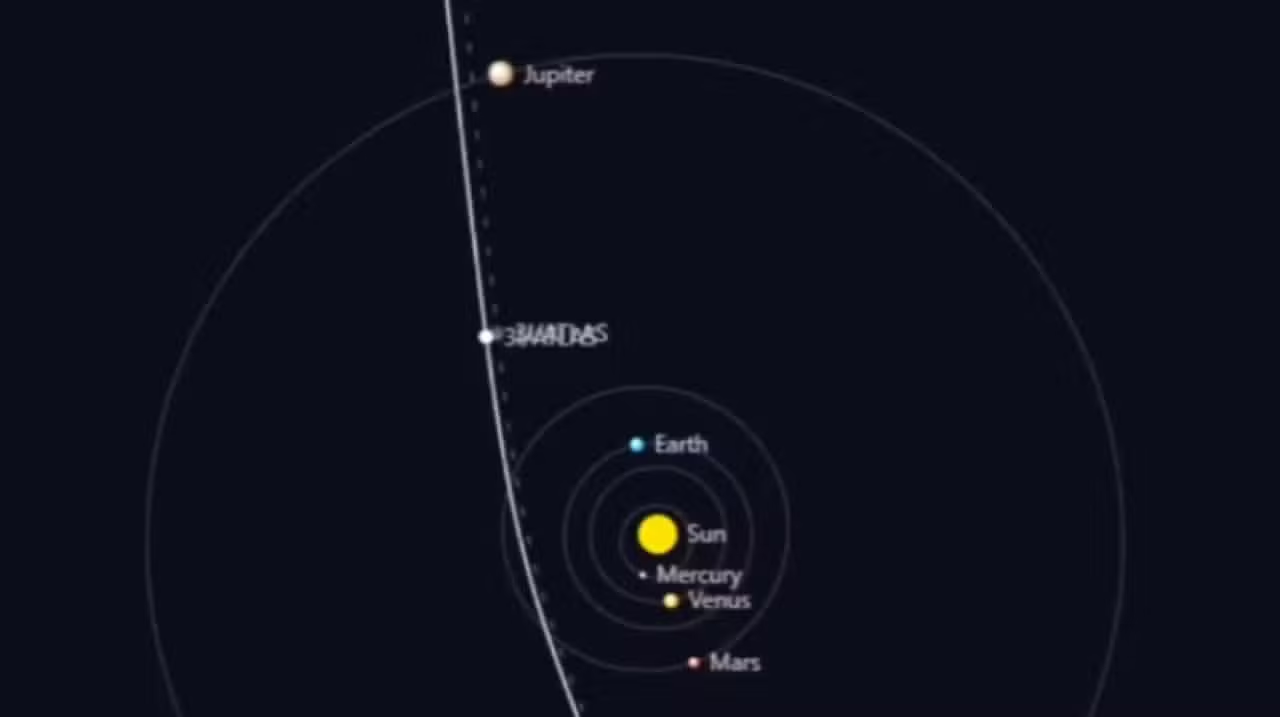
The passage of the interstellar object 3I/ATLAS through the interior of the solar system has caused an astronomical phenomenon of great magnitude in recent weeks. Durante the maximum approach to the central star, the intense thermal radiation caused the rupture of the outer layer of the physical body. The event triggered a series of chemical and physical reactions that exposed materials frozen in the deep vacuum for hundreds of millions of years.
Continuous monitoring revealed that the visitor’s internal structure housed substances intact from its original formation in a distant planetary system. The prolonged absence of heat during the journey through outer space transformed the object into a true time capsule structured in ice and cosmic dust. Upon entering the zone of thermal influence, the material underwent a drastic change that ejected jets of matter at very high speeds.
🚨サークリ・ウザイリ・クイルクルユズル ☄️
Yıldızlararası kuyruklu yıldız 3I/ATLAS’ı araştıran bilim insanları onun “alkolle dolu” olduğunu soylüyor。
⚠️アタカマ アクトゥジヌ テストピット エト…pic.twitter.com/CcXfXA8URS
— 3I/ATLAS ギュンセレメレリ (@Defence12543)2026年3月13日
Preliminary data from space agencies confirm that the origin of the celestial body is external to our cosmic neighborhood. The action of heat acted as an immediate catalyst, activating sublimation processes that exposed the dark, icy core to direct light. Essa exposure enabled primary spectrometric analysis by terrestrial and orbital research centers around the world.
Hyperbolic trajectory and the origin in distant molecular clouds
Orbital calculations and light curve analyzes indicate that the object’s formation occurred over a period estimated between one billion and one billion two hundred million years ago. The time lag suggests that the celestial body was born from the molecular cloud of a high-density star system. Posteriormente, the object ended up ejected due to complex gravitational interactions with giant planets in that region. The initial structure preserved during the solitary journey kept the primordial elements protected under a thick crust of ice and hardened dust. The absence of solar winds and direct radiation into the interstellar medium ensured that the chemical composition remained unchanged. Dessa way, the material offers a faithful portrait of the thermodynamic conditions of its birthplace in the galaxy.
Entry into the solar system occurred stealthily, with the object crossing the boundary of the Oort cloud. The approach took place at a steep angle in relation to the orbital plane of the known planets. The continuous speed and direction of movement confirmed the hyperbolic trajectory of the celestial body. Essa is a fundamental characteristic of bodies that are not tied to local gravity and only make a temporary passage. Durante the approach, the interaction with the gravitational field of the gas giants subtly altered the rotation of the nucleus. The movement exposed different faces to increasing radiation and set the stage for structural fragmentation events.
Surface collapse and mass loss during perihelion
The moment of greatest thermal proximity resulted in the destruction of approximately twenty meters of the object’s hardened surface layer. Continuous sublimation turned the ice directly into gas at an accelerated rate. Esse process generated unsustainable internal pressure in the core of the celestial body. The accumulated force culminated in the structural collapse of the outer crust in a matter of days. Imediatamente, a dense cloud of debris formed around the rotating main core. The rapid temperature transition generated deep fissures in the newly exposed surface. Essas openings allowed ultraviolet radiation to penetrate the inner layers of plasma and dust. The subsequent ionization process formed an extensive, bright tail in the vacuum. The particles were swept by the stellar wind continuously and aggressively. Consequentemente, transit through perihelion significantly reduced the total mass of the physical body.
Identification of organic molecules and essential building blocks
The breakup of the surface revealed a level of organic molecules four times higher than the average observed in local comets. The abundant presence of methanol and other carbon-based chains surprised the researchers. The finding suggests that the essential building blocks for complex chemical reactions exist in large quantities in Via Láctea’s dark molecular clouds.
The instruments also recorded the simultaneous emission of water vapor, carbon monoxide and traces of noble gases. Essa combination of elements formed a temporary atmosphere around the core exposed to radiation. The exact ratio between the substances provides vital clues about how far the object formed from its original star.



The continuous release of the material in its pure state allowed complete mapping of the isotope distribution. The process clearly differentiated the chemical signature of the visitor from the rocks and ice floes native to our system. The data indicate an origin far beyond the so-called stellar snow line.
The proportion of heavy water in relation to common water showed different values during the measurements. The record reinforces the thesis that organic chemistry is distributed heterogeneously throughout the observable universe. The information collected will serve as a basis for future studies on panspermia and the formation of planetary systems.
Coordinated Operation of Next-Generation Space Telescopes
Detailed observation of the phenomenon required the coordination of a global network of advanced astronomical equipment. Telescópio Espacial James Webb aimed its infrared spectrometers to map heat emission and dust distribution. The action revealed the exact size of the ejected grains and the cooling rate of the material exposed to the vacuum.
The ability to peer through dense clouds of debris ensured accurate identification of carbon molecules. The recording occurred before the compounds were dissipated by the strong pressure of the surrounding radiation. The work eliminated margins of error in identifying complex organic elements released into space.
Millimeter analysis of cold gases by ground-based observatories
Simultaneously, the ALMA ground observatory calibrated its radio antennas in the desert of Atacama. The objective was to capture the frequencies emitted by the cold gases that circulated the disintegrating nucleus. Millimeter analysis detected the expansion rate of carbon monoxide in real time.
The equipment also measured the density of the temporary atmosphere created around the comet. The data provided the metrics needed to calculate mass loss per second. The integration of this information with spatial data formed a complete picture of the astronomical event.
Interception of ion contrails by active interplanetary missions
To complement long-distance observations, the JUICE interplanetary probe has emergencyly recalibrated its particle sensors. The spacecraft was on a cruise route through the solar system when it intercepted the tracks left by the object. The unscheduled maneuver demonstrated the versatility of the equipment in operation.
The action allowed the direct capture of electrons and heavy ions that had detached from the comet’s tail. The procedure offered an indirect physical sample of the high-speed ejecta. Telemetry data sent by the probe confirmed readings from ground-based and orbital telescopes.
The precision of the instruments aboard the spacecraft added a new layer of information about the magnetic interaction. The study focused on the clash between the stellar wind and the ionized gases of the cosmic visitor. The strategy maximized the scientific return from deep space operations with in-situ measurements of the plasma cloud.
Definitive distancing and freezing of the new outer crust
After reaching a maximum speed of sixty-eight kilometers per second at perihelion, the celestial body began its journey towards the edge of the solar system. Sublimation activity gradually ceased as the ambient temperature dropped, refreezing the exposed surface. The object now follows a straight trajectory into the interstellar darkness, carrying a newly formed crust and leaving behind a vast array of cataloged data.
Veja Tambem em News (EN)

Research reveals that parents are unaware of how their children use artificial intelligence

Samsung releases new system update with new features for Galaxy Watch 4 users

Digital retail reduces the value of the Galaxy S25 5G smartphone with bank bonuses and device exchange

Amazon’s wireless CarPlay adapter has a 50% discount and high approval ratings from drivers

Zach Cregger’s new Resident Evil ignores games and focuses on an unprecedented story with new characters

Rumor suggests that Nintendo is preparing a special edition of the Switch 2 with a remake of Ocarina of Time

Apple accelerates production of the iPhone 17e and develops new Air model with dual camera system

Epic Games platform releases twelve high-budget games at no permanent cost for PC users

PlayStation 5 Pro price drop accelerates digital retail sales and eliminates global stocks

New Galaxy Watch 9 firmware appears on server and confirms progress in software development

Apple’s commemorative project tests cell phone with 1.1 millimeter edge and curved screen for 2027
