
Interstellar comet 3I/ATLAS hits Jupiter’s sphere and releases chemical compounds that are precursors of life


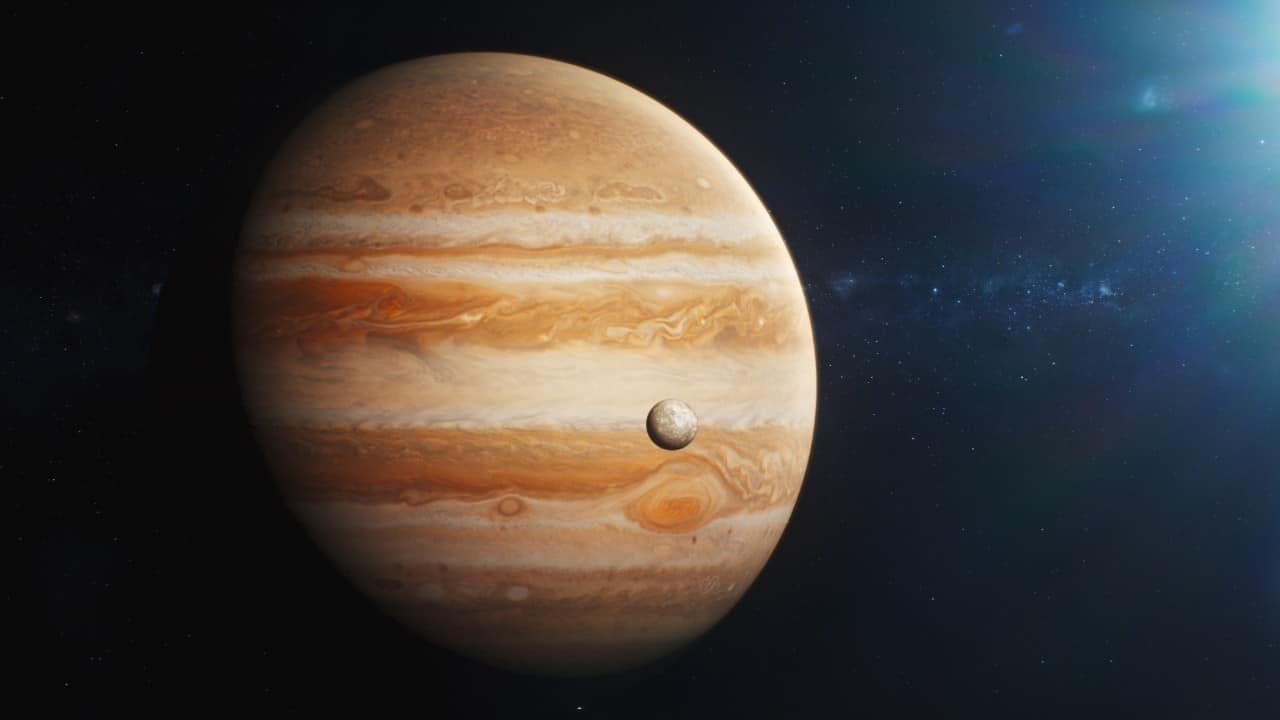
The interstellar comet 3I/ATLAS, also officially cataloged as C/2025 N1, reached its closest approach with Júpiter this week, crossing a critical gravitational boundary. The celestial body passed at a distance of approximately 0.358 astronomical units from the giant planet, entering directly into the so-called sphere of Hill, a region of space where Jovian gravity overcomes the direct influence of Sol. Esta specific orbital maneuver provided a rare opportunity for ground-based observatories and space telescopes to capture detailed data about the object’s core and coma.
Astronomical observations confirmed that the comet remains highly active even months after its perihelion, an event that occurred in October 2025. The continuous sublimation of volatile materials created a dense cloud of gas and dust around the solid core. Este natural process ended up revealing deep internal layers that had been preserved in the extreme cold of outer space for millions or potentially billions of years.
During this phase of intense activity, scientific instruments detected unusual concentrations of methanol and hydrogen cyanide in the comet’s coma. Estas Specific molecules are broadly classified by astrobiologists as essential precursors for the formation of complex organic structures. The discovery provides direct observational data regarding the chemical composition of objects that formed outside our star system.
Gravitational interaction changes the trajectory of the celestial body
The passage through the gas giant occurred on March 16, 2026, marking a fundamental point in the object’s journey through our system. Nessa specific region of space, the comet crossed an invisible boundary known in celestial mechanics as the Hill radius.
Within this mathematical limit, the gravitational pull of the massive planet became dominant over the force exerted by Sol. Essa Intense gravitational dynamics caused a measurable deviation in the interstellar body’s original hyperbolic trajectory.
The relative speed of the object during the encounter was calculated to be approximately 66 kilometers per second. Devido At this extreme speed, the change in the motion vector was considered small, but required precise orbital recalculations by space agencies.
The astronomical event offered an unprecedented window of observation into the mechanics of intruding bodies. The data collected helps map how objects from other stars interact with giant planets before being ejected back into deep space.
Cracks in the crust expose the internal chemical composition
The most recent spectroscopic analyzes have demonstrated that the comet’s solid surface, forged over eons in interstellar space, features a complex network of structural cracks. Essas openings in the outer crust allowed the continued release of volatile materials that were trapped in the core. The outer layer, which acts as a heat and radiation shield, was responsible for preserving complex chemical compounds that would otherwise have been degraded by constant exposure to cosmic rays during the billion-year journey between star systems.
Chemical mapping revealed methanol levels significantly higher than those found in most native comets in our system. The combination of methanol and hydrogen cyanide forms the basis for prebiotic chemical reactions, a factor that reinforces theories about the transport of life’s building blocks across the galaxy. Sublimation accelerated by the solar approach removed fractions of the surface, exposing an interior rich in ice and organic compounds, which are now mapped in detail by space telescopes such as Hubble and James Webb, in addition to the ALMA antenna complex on the ground.
Orbital records and monitoring by space missions
Comet 3I/ATLAS is officially the third object of interstellar origin confirmed by the international astronomical community. Its initial detection occurred when the celestial body was already within the orbit of Júpiter, at a distance of around 670 million kilometers from Sol.
Different space missions have been repurposed to track the object in various bands of the electromagnetic spectrum. The JUICE probe, Agência Espacial Europeia, managed to record images of the comet as it navigated towards the Jovian system to fulfill its main mission.
Other high-precision instruments, including the TESS satellite and the Swift observatory, documented the variations in brightness and the morphology of the tail. The measured initial speed exceeded the 221,000 kilometers per hour mark, confirming its hyperbolic escape trajectory.
Relevance of data for stellar chemistry
The detailed study of 3I/ATLAS provides direct evidence about the distribution of organic molecules in the interstellar medium. The presence of substances like methanol in abundance indicates that similar chemical environments may exist in distant planetary systems.
The ability of the outer crust to shield the inner material against cosmic radiation validates the hypothesis that complex chemical components can survive long galactic journeys. The object functions as a natural time capsule, transporting material unchanged since its formation.
Technical details of the discovery and astronomical classification
The ATLAS system telescope, located at Chile, was responsible for identifying the object for the first time on July 1, 2025, although archive images revealed previous unconfirmed detections dating from June of the same year. The official nomenclature C/2025 N1 follows the classification pattern for non-periodic comets discovered in the first half of July, while the designation 3I/ATLAS definitively attests to its status as the third recognized interstellar visitor. The elongated appearance of the core and the presence of a highly active coma differentiate this celestial body from previously observed interstellar asteroids, such as ‘Oumuamua. Precise velocity measurements and the extreme hyperbolic orbit eliminated any possibility that the object originated from Nuvem of Oort or Cinturão of Kuiper. The nucleus displays physical characteristics that suggest it was formed in a protoplanetary disk of another star, keeping intact records of the primordial chemistry of an alien solar system that can now be studied directly by scientists on Terra.
Preservation of compounds in ancient journeys
The outer crust of 3I/ATLAS effectively acted as a natural shield against the elements of deep space. Ela protected the ice core from degradation caused by starlight and ultraviolet radiation during its journey through the interstellar void.
The organic compounds detected include molecules that actively participate in the synthesis of amino acids and sugars in laboratory simulations. The comet’s continued activity, even as it moves away from Sol, ensures that the outgassing will provide material for observation for many months to come.
Continuity of astronomical tracking
Ground- and space-based observatories will continually track the comet as it heads toward the system’s outer limits. The object will cross the orbits of Saturno, Urano and Netuno in the coming years, with projections indicating that it will reach the inner edge of Oort around the year 2189, completing its passage through our stellar domain.



