
João Fonseca discovers possible opponents and avoids top seeds in Monte Carlo
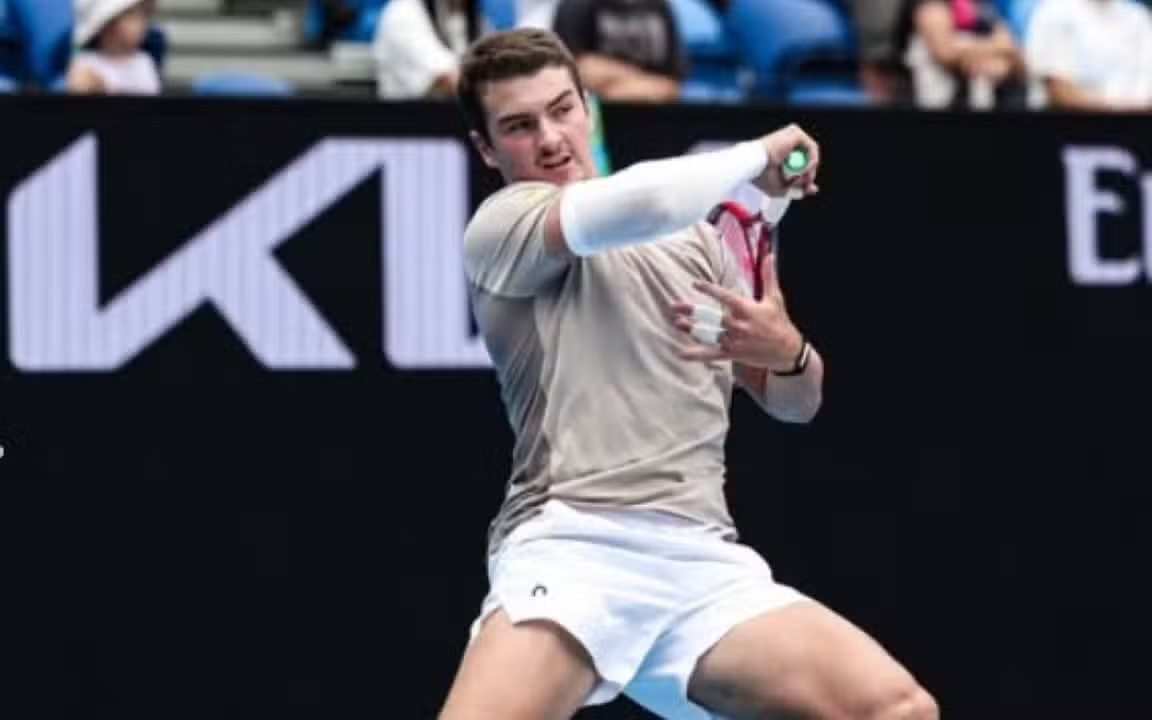
Brazilian tennis player João Fonseca begins his journey in the European clay court season during the Masters 1000 of Monte Carlo, which officially starts this Sunday, April 5th. Após a sequence of impressive results in the Estados Unidos, the eighteen-year-old athlete will make his absolute debut on the courts of the Mônaco Mônaco seeking to consolidate his rise in the world rankings. The official draw for the main draw is scheduled for this Friday, April 3, at 5pm local time, defining the Rio de Janeiro’s first opponent in the competition.
The structure of the Monegasque tournament presents significant differences in relation to the Indian Wells and Miami events held in the previous month. Enquanto the North American competitions had 96 players and lasted ten days, the Masters 1000 of Monte Carlo brings together just 56 tennis players in a week of intense games. Essa reduction in the number of subscribers changes the dynamics of initial confrontations and guarantees strategic benefits for the best positioned competitors in the list of Associação of Tenistas Profissionais.
The eight main favorites for the title received the right to rest in the first round, entering directly into the round of 32 stage between Monday and Tuesday. Entre the names that João Fonseca will not be able to face in their debut are the Spanish Carlos Alcaraz, current defender of the trophy, and the Italian Jannik Sinner, current number two in the world. Também This initial protection group includes German Alexander Zverev, Italian Lorenzo Musetti, Australian Alex De Minaur, Canadian Felix Auger-Aliassime and Kazakh Alexander Bublik.
Strategic configuration of favorites in the main key
The absence of clashes against the top 8 in the first phase allows João Fonseca to have a theoretically less bumpy path at the beginning of the competition. The Brazilian is coming off a solid performance in Indian Wells, where he reached the round of 16, and a balanced duel against Carlos Alcaraz in the Miami tournament. The transition to clay requires specific technical adjustments in ball movement and timing, factors that the tennis player has prioritized in recent training.
- Carlos Alcaraz leads the list of entries as the main candidate for the title after recent achievements.
- Jannik Sinner appears as the great clay court challenger after winning the first Grand Slam of the year.
- Alexander Zverev seeks recovery on European clay after fluctuations on American fast courts.
- Lorenzo Musetti and Alex De Minaur complete the list of athletes who only debut in the second round.
The definition of the seedings used as criteria the official ranking released by the ATP on March 9th. Due to this temporal criterion, some elite tennis players who have risen in position in recent weeks will not enjoy the benefit of skipping the first round. João Fonseca will need extra attention, as the chance of facing an experienced veteran or a former world number one in the opening game remains high due to the highly competitive nature of the team.
Presence of Daniil Medvedev as a potential danger at premiere
Russian Daniil Medvedev appears as one of the most dangerous names that could cross the Brazilian’s path in the opening round. Atualmente appears in tenth position in the world rankings, Medvedev occupied a lower position at the time of closing the list of entries for Monte Carlo. Como is not part of the first eight selected by the criteria of March 9th, the experienced thirty-year-old athlete will have to take the court on Sunday or Monday.
Medvedev’s history on clay shows fluctuations, with the best result being the semi-final reached in the 2019 season. Naquela On this occasion, the Muscovite was surpassed by Dusan Lajovic, showing that players who perform well on clay can surprise the Russian’s style of play. In 2025, the veteran demonstrated physical strength by reaching the final of Indian Wells, where he was only defeated by Jannik Sinner in a high-level technical clash.
João Fonseca and Medvedev have playing styles based on the power of their strikes from the back of the court, which promises a physical clash if the draw puts them face to face. The Brazilian has already proven that he can compete against the elite by playing tough matches against Sinner himself in March, decided only in detail in tiebreaks. Physical preparation and quick adaptation to the slowness of clay will be the pillars for the young national talent to advance in the European tournament.
Important absences and changes in the competition scenario
This year’s edition of Masters 1000 of Monte Carlo will feature notable absences that changed the final configuration of the confrontation groups. The Serbian Novak Djokovic chose not to participate in the competition, focusing on his physical preparation for the rest of the European tour that culminates in Roland Garros. Além of the title record holder of Grand Slam, the North Americans Ben Shelton and Taylor Fritz also confirmed that they would not will travel to Principado this week.
- Novak Djokovic prioritizes physical recovery and specific training for the tournaments in May and June.
- Ben Shelton decided to extend his training period on green clay courts at Estados Unidos.
- Taylor Fritz announced his withdrawal citing the need to rest after the exhausting tour in March.
- The withdrawals made room for players who were on the waiting list to enter directly into the bracket.
With these names leaving the top 10, the pressure on young talents and clay specialists increases considerably. The Monte Carlo tournament is known for being one of the most traditional and glamorous on the world circuit, demanding absolute mental focus from participants. Para João Fonseca, each match represents an opportunity to gain valuable points and guarantee a better position in the draws for the next tournaments in the Masters 1000 series.
Technical evolution of João Fonseca on slow surfaces
João Fonseca’s performance on clay has been watched with great anticipation by analysts and fans since his victories on the youth circuit. The ability to generate power even on surfaces that absorb the ball’s speed is a differentiator that puts him at an advantage against many opponents. The Brazilian’s coach highlighted that the current focus is on improving the “slide” and building longer points, essential characteristics for success in Mônaco.
The experience gained against Carlos Alcaraz in Miami served as a high-level laboratory for the young Brazilian to face intense game rhythms. Mesmo with the double 6/4 defeat, the numbers showed that Fonseca managed to balance the ball exchanges and create service break opportunities. The confidence generated by this performance is essential to face the atmosphere of Monte Carlo, where the crowd is usually vibrant and the atmosphere of pressure is constant from the first points.



Maintaining tactical aggressiveness without committing excessive unforced errors will be the big challenge for Brasil’s number one next week. Especialistas point out that Monte Carlo clay tends to get heavier at the end of the day, which may favor players with greater aerobic endurance. João Fonseca has invested in double training sessions to ensure that the stamina can withstand matches that can easily exceed two hours in duration around Mediterrâneo.
History of Brazilians and record holders on Principado of Mônaco
The Monte Carlo tournament holds important emotional memories for Brazilian tennis, especially due to the Gustavo Kuerten campaigns. Guga won the title at Principado on two occasions, establishing a standard of excellence that serves as an inspiration for new generations such as João Fonseca. Monegasque clay usually rewards players who have tactical intelligence and can vary the height of the balls to disturb the positioning of rivals.
Currently, the record for titles in the competition belongs to Spaniard Rafael Nadal, who dominated the Monte Carlo Country Club courts for more than a decade. Embora Nadal is not in this edition, the style of play implemented by him continues to be the reference for those who wish to triumph in Mônaco. João Fonseca seeks to write his own name in this history, trying to be the first Brazilian in many years to advance to the final rounds of a Masters 1000 played on clay.
The performance graphs of the latest champions show that regularity in looting is a determining factor in avoiding surprises against lower-ranked players. Fonseca has been working specifically on the variation of the first serve, looking for angles that take the opponent off the court right at the beginning of the point. If he manages to maintain a high percentage of success in service games, the Brazilian will drastically increase his chances of advancing and possibly facing a seed in the second phase.
Final preparation and expectations for Friday’s draw
The anxiety surrounding Friday’s draw is justified by the possibility of epic encounters in the first days of competition on clay. João Fonseca will enter the draw as one of the players that all the seeds want to avoid in a possible second round due to his momentum on the rise. The international press already classifies the Brazilian as one of the main “unranked threats” of the tournament, highlighting his courage in decisive moments of pressure.
Weather conditions at Mônaco for the start of next week predict mild temperatures and a low probability of rain, which should keep the court in ideal speed conditions. The Brazilian tennis player is already carrying out adaptation sessions at the competition site, testing different string tensions to adapt to the location’s altitude and maritime humidity. The technical committee is confident that the work carried out since the end of the Miami tournament will bear positive fruit in this European debut.
With the main draw defined, the game schedule will be published daily, respecting the local time of Monte Carlo for all matches. Brazilian tennis fans are eagerly awaiting to see if João Fonseca will be able to repeat the brilliance of Indian Wells’s round of 16 in a totally different scenario. The immediate objective is to add victories to guarantee direct entry into the main tables of Roland Garros and Wimbledon without the need for invitations or qualifying disputes.
Determining factors for success in the first clay court Masters
The mental capacity to deal with the typical variations of clay will be tested to the extreme for João Fonseca during your stay at Principado. Diferente of the fast courts, clay allows for almost impossible defenses, requiring the player to have the patience to hit the ball multiple times until finishing the point. The young Brazilian has demonstrated maturity in this regard, avoiding frustration when powerful shots return to his side of the net unexpectedly.
Another crucial point will be managing the energy accumulated after the exhausting tournaments in the Estados Unidos and the transatlantic trip to the Europa. Physical recovery between matches in a one-week tournament is much shorter, not allowing long periods of rest for those who advance through the rounds. Fonseca has a multidisciplinary team that monitors every aspect of your health, aiming to maintain a high level of competitiveness without the risk of overuse injuries.
The Masters 1000 of Monte Carlo serves as the first big thermometer for the favorites for the French Grand Slam title. Para João Fonseca, it’s the chance to prove that your game is versatile enough to upset the best in the world on any type of surface. Independentemente Whoever’s opponent is drawn this Friday, the promise is that the Brazilian will take to the court with the same determination that turned him into the biggest revelation in national sport in recent years.
Veja Tambem em News (EN)

Research reveals that parents are unaware of how their children use artificial intelligence

Samsung releases new system update with new features for Galaxy Watch 4 users

Digital retail reduces the value of the Galaxy S25 5G smartphone with bank bonuses and device exchange

Amazon’s wireless CarPlay adapter has a 50% discount and high approval ratings from drivers

Zach Cregger’s new Resident Evil ignores games and focuses on an unprecedented story with new characters

Rumor suggests that Nintendo is preparing a special edition of the Switch 2 with a remake of Ocarina of Time

Apple accelerates production of the iPhone 17e and develops new Air model with dual camera system

Epic Games platform releases twelve high-budget games at no permanent cost for PC users

PlayStation 5 Pro price drop accelerates digital retail sales and eliminates global stocks

New Galaxy Watch 9 firmware appears on server and confirms progress in software development

Apple’s commemorative project tests cell phone with 1.1 millimeter edge and curved screen for 2027
