
Study with Gaia data raises the chance of a merger between the Milky Way and Andromeda to 90%

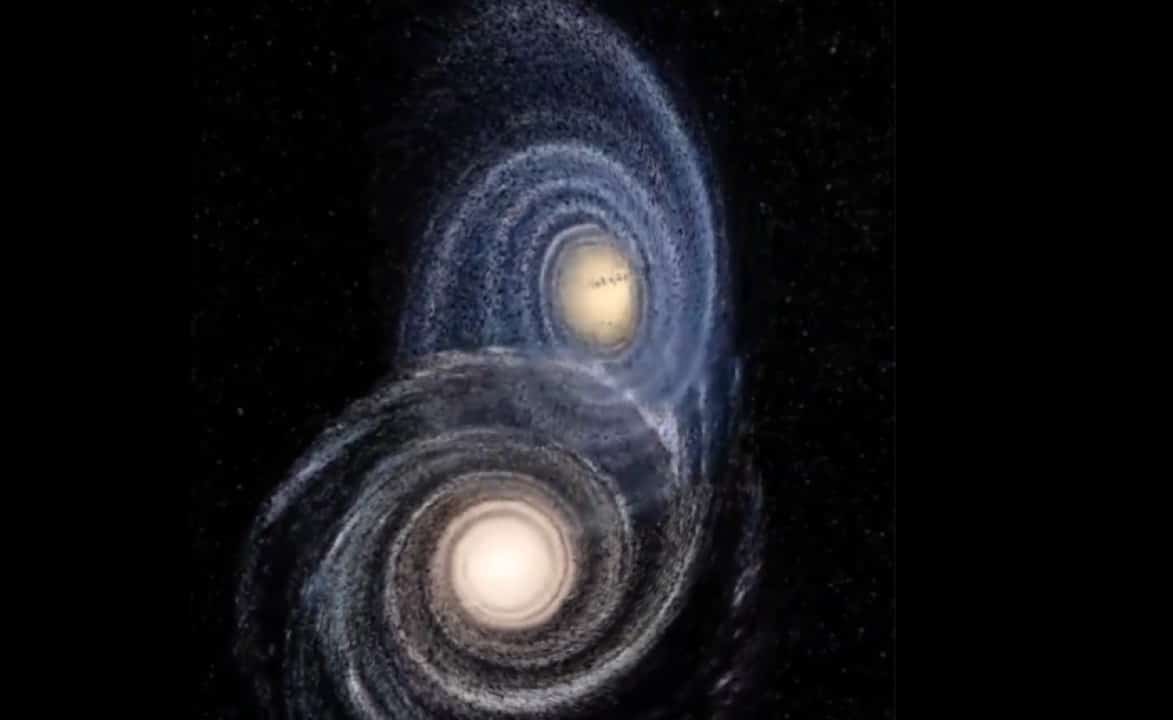
The galaxy Andrômeda, Via Láctea’s closest neighbor, is located about 2.5 million light years away. The dark matter halos of the two galaxies, each with approximately one trillion solar masses, are already in contact. Enquanto Therefore, the cores of the spiral structures follow a trajectory that suggests continuous approximation. A new numerical study updated with precise measurements from satellite Gaia reinforces classical projections about the fate of the two galaxies.
- The current relative speed between Via Láctea and Andrômeda reaches 110 kilometers per second.
- Dark matter halos of giant galaxies already interact gravitationally.
- Spiral cores maintain a gradual approach over billions of years.
- Simulations incorporate refined proper motions of stars in Andrômeda.
Researchers performed 10,000 realizations of future trajectories to map the behavior of the local group of galaxies. The calculations include not only Via Láctea and Andrômeda, but also M33 and Grande Nuvem of Magalhães. Frontal and side projections reveal patterns of orbits with varying probability density over time.
Data from Gaia updates galactic encounter predictions
The latest study uses the most accurate proper motions available for stars in the Andrômeda galaxy. Essas information comes from refined observations by the Gaia satellite. The results indicate that the probability of a merger between the two main galaxies rises to 90% in the next 10 billion years. The predicted average time for fusion reaches 6.5 billion years, with a margin of uncertainty between approximately 5 and 7.8 billion years.
Computer simulations show that the process involves the shuffling of the stellar disks of the two spirals. The end result tends to form a giant elliptical galaxy, named in previous work as Milkomeda. Individual stars, including Sol, do not directly collide with each other because of the large distances that separate them within the galaxies.
During the merger, Sol can be displaced along with a group of stars that follow Via Láctea’s core. An observer at Terra, if it still exists, would be able to see the two galaxies approaching as the stars fill the night sky with constantly changing configurations. Dentro 5 billion years old, while Sol is still in its active phase, the new combined structure will have double the stellar and dark matter reserves compared to the current Via Láctea.

Influence of smaller galaxies affects trajectories in the local group
Previous studies had considered the gravitational influence of other galaxies in the local group, such as M33 and Grande Nuvem of Magalhães. The perpendicular orbit of Grande Nuvem of Magalhães in relation to the main plane of the two giants introduces additional uncertainties in the projections. Mesmo thus, the inclusion of M33 in the simulations tends to increase the overall chance of a merger between Via Láctea and Andrômeda.
Simulated trajectories for 100 randomly selected paths demonstrate significant variations in the separation between galaxy centers over time. The most likely curve points to a progressive approach that culminates in merger. The lines representing the orbits highlight the probability density at different positions over billions of years.
The new numerical work largely restores the classical view about the inevitable encounter. Ele contrasts with analyzes from 2025 that estimated only a 50% chance of merger in 10 billion years, considering greater uncertainties in masses and positions. Refined measurements with Gaia reduce some of this margin of doubt.
Merger forms new elliptical galaxy without direct stellar collision
The merger process does not involve physical clashes between individual stars. The vast interstellar space within each galaxy allows star systems to intertwine without direct collisions. The spiral disks distort and mix, generating a more spherical and compact elliptical structure in the end.
Within 5 billion years, the resulting galaxy, Milkomeda, will have approximately twice the stellar mass and dark matter as Via Láctea alone. Sol, with a remaining life expectancy of about 7.6 billion years, will still be active during the early phases of the merger. Astrônomos Hypothetical Earthlings would observe constantly evolving stellar patterns in the night sky.
After complete merger, the acceleratingly expanding universe will leave Milkomeda in an increasingly isolated environment. Dentro One hundred billion years, the giant galaxy will be surrounded by regions of cosmic vacuum. Estrelas hypervelocities ejected during the process may serve as indirect evidence of universal expansion even on extremely long time scales.
Future measurements refine predictions about cosmic encounter
Astronomers highlight the need for measurements of proper motions with uncertainties of less than 2 microarcseconds per year. Esses More accurate data will help confirm or adjust current conclusions about the trajectories of galaxies. Continuous observations with advanced instruments will allow us to refine numerical simulations over the next few years.
The study published in March 2026 incorporates the best available information on the positions, velocities and masses of the galaxies involved. The 10 thousand trajectory realizations generate robust statistical distributions for the future behavior of the local group. The front and side projection panels illustrate possible variations in orbits over 10 billion years.
The gradual approach can now be monitored by ground and space observatories. Embora event occurs on incommensurable human time scales, the simulations offer a detailed overview of what could happen to the structure of the local group of galaxies. The merger would represent the last significant major dynamical event in local cosmic history before a period of increasing isolation.
Local group evolution includes interaction with dwarf galaxies
Grande Nuvem, Magalhães and M33 play secondary but relevant roles in the full simulations. Suas orbits influence the overall dynamics and may slightly alter the probabilities of merger between the two main galaxies. The pink and silver lines in the projections represent these complementary trajectories with probability density indicated by varying brightness.
The simulations show that, in around 90% of the analyzed trajectories, the merger between Via Láctea and Andrômeda occurs within the interval of 10 billion years. The median time of 6.5 billion years concentrates most of the probable occurrences. The margins of uncertainty reflect current limitations in accurate measurements of distant stellar motions.
The complete merger process spans billions of years, with multiple passes and gravitational interactions before final stabilization in an elliptical galaxy. Durante During this period, the night sky would undergo visible transformations on geological and astronomical time scales. The stars would redistribute themselves into new orbital patterns around the combined center.
The galaxies involved maintain their structural identities for long periods before merging completely. The dark matter halos, which are already touching each other, begin the process of large-scale gravitational interaction. The luminous cores, rich in stars, follow trajectories that lead to the progressive shuffling of the disks.



